03 — ARTWORK
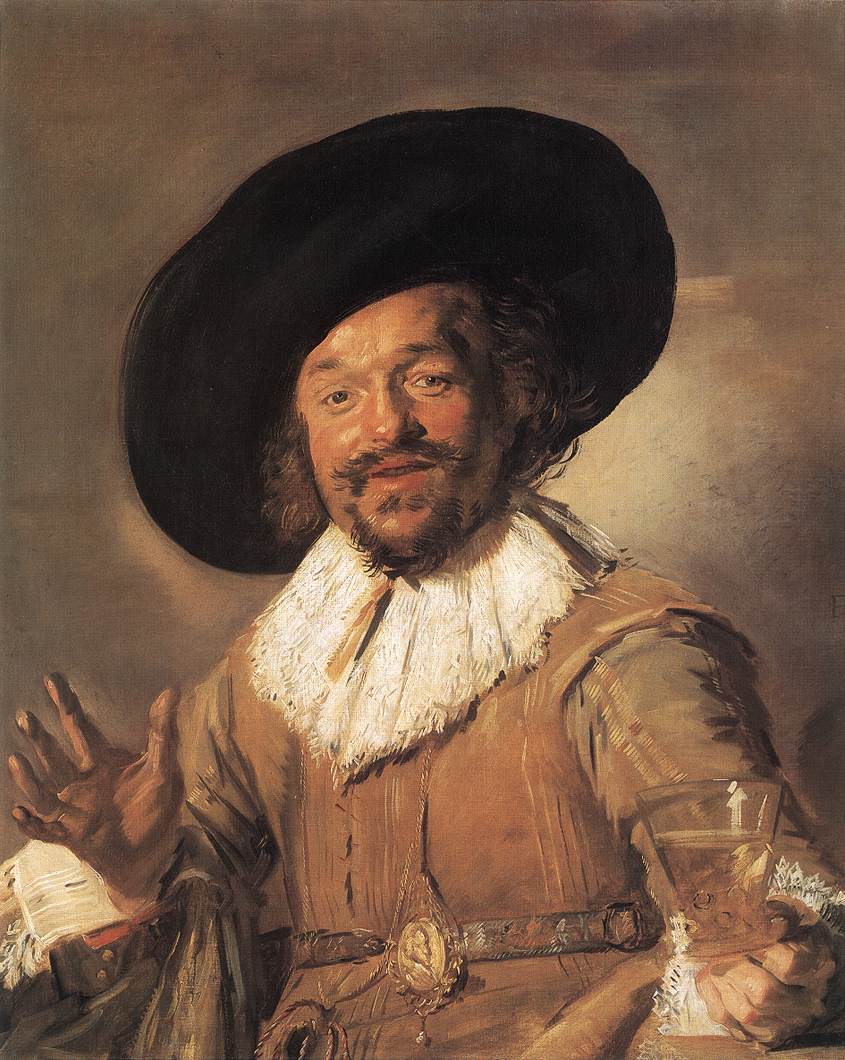
The Merry Drinker
- MEDIUM
- Oil on canvas, 81 x 66,5 cm
- TYPE
- Portrait
PALETTE
HOVER OR TAP A SWATCH FOR NAME, SHARE AND HEX. SAMPLED FROM THE IMAGE — INDICATIVE, NOT A PIGMENT ANALYSIS.
DEVELOPMENT BUILD — NOT FOR PUBLIC USE. CONTRIBUTE ON GITHUB.
03 — ARTWORK
PALETTE
HOVER OR TAP A SWATCH FOR NAME, SHARE AND HEX. SAMPLED FROM THE IMAGE — INDICATIVE, NOT A PIGMENT ANALYSIS.
COMMENTARY
UNDERLINED TERMS ARE DEFINED IN THE GLOSSARY.
The Merry Drinker is painted in a bright, blond tonality which anticipates nineteenth-century ImpressionismA style of painting that became prominent in the last quarter of the 19th century as a reaction to the ossified doctrine of the Academy and the content-oriented atelier, historical, and genre painting. The name is derived from the 1872 painting Impression, Sunrise by Claude Monet, and first was used by art critics as a mocking description for a group of artists excluded from the official Salon, but who had their own first group exhibition in 1874 at the salon of the Parisian photographer Nadar. Impressionism, as a new type of naturalism, negated classical pictorial methods; based on contemporary theories of physics, it indicated the natural object in a revolutionary fashion - entirely as a manifestation of colour. Their supreme principle was "plein-air" or open-air painting, through which the painters tried to capture a direct, spontaneous impression of what they saw. in its most brilliant manifestations. Manet must have been particularly impressed by this painting. The picture also shows Hals supreme mastery of one of the principal preoccupations of BaroqueThe period in art history from about 1600 to about 1750. In this sense the term covers a wide range of styles and artists. In painting and sculpture there were three main forms of Baroque: (1) sumptuous display, a style associated with the Catholic Counter Reformation and the absolutist courts of Europe (Bernini, Rubens); (2) dramatic realism (Caravaggio); and (3) everyday realism, a development seen in particular in Holland (Rembrandt, Vermeer). In architecture, there was an emphasis on expressiveness and grandeur, achieved through scale, the dramatic use of light and shadow, and increasingly elaborate decoration. In a more limited sense the term Baroque often refers to the first of these categories. The development of the Baroque reflects the period's religious tensions (Catholic versus Protestant); a new and more expansive world view based on science and exploration; and the growth of absolutist monarchies. artists: the rendering of instantaneous emotion and movement. No seventeenth-century artist surpassed Hals in this fields. The realismRealism (with an upper case "R"), also known as the Realist school, denotes a mid-nineteenth century art movement and style in which artists discarded the formulas of Neoclassicism and the theatrical drama of Romanticism to paint familiar scenes and events as they actually looked. Typically it involved some sort of sociopolitical or moral message, in the depiction of ugly or commonplace subjects. One of the main representatives and spokesmen was the painter Gustave Courbet. In the dispute about ways to represent reality, Realism rebelled against the idealistic and classicist tendencies in painting. and illusionismThe painting techniques that create the realistic impression of solid, three-dimensional objects (such as picture frames, architectural features, plasterwork etc.) of Caravaggio and his followers look forced compared to Hals, and Rubens and van Dyck do not convey a comparable intensity in the suggestion of a fleeting instant packed with vitality. Hals's vigorous concentration on this was more than an ordinary rendering of reality. He selected moments when human nature reveals all its vital energy. Most frequently he shows the instant when the joy of life is at its highest. <P> <TABLE ALIGN=LEFT CELLPADDING=5 BORDER=1 WIDTH=320 BGCOLOR="#99CCCC"> <TR VALIGN=MIDDLE><TD><IMG SRC="/support/gif/listen.gif" BORDER=0 VALIGN=MIDDLE> Suggested listening (streaming mp3, 5 minutes):<BR><A HREF="#" onClick="w=window.open ('/music1/19_cent/nicolai_windsor_drinking.html', 'newWin', 'scrollbars=yes,status=no,dependent=yes,screenX=0,screenY=0,width=350,height=350');w.opener=this;w.focus();return true"><B>Otto Nicolai: Die lustigen Weiber von Windsor (The Merry Wives of Windsor), drinking song</B></A> </TD></TR></TABLE>
@online{wga-r5ef850fbb1fd13,
  author       = {Krén, Emil and Marx, Daniel},
  title        = {The Merry Drinker by HALS, Frans},
  organization = {{Web Gallery of Art}},
  date         = {2026-09-13},
  url          = {https://beta.wga.hu/artists/hals-frans-r70576a8b6d10d2/the-merry-drinker-r5ef850fbb1fd13},
  urldate      = {2026-09-13},
  langid       = {english}
}
ACCESSED 2026-09-13. REPLACE THE AUTHOR FIELD WITH THE COMMENTARY AUTHOR WHERE ONE IS NAMED.


