03 — ARTWORK
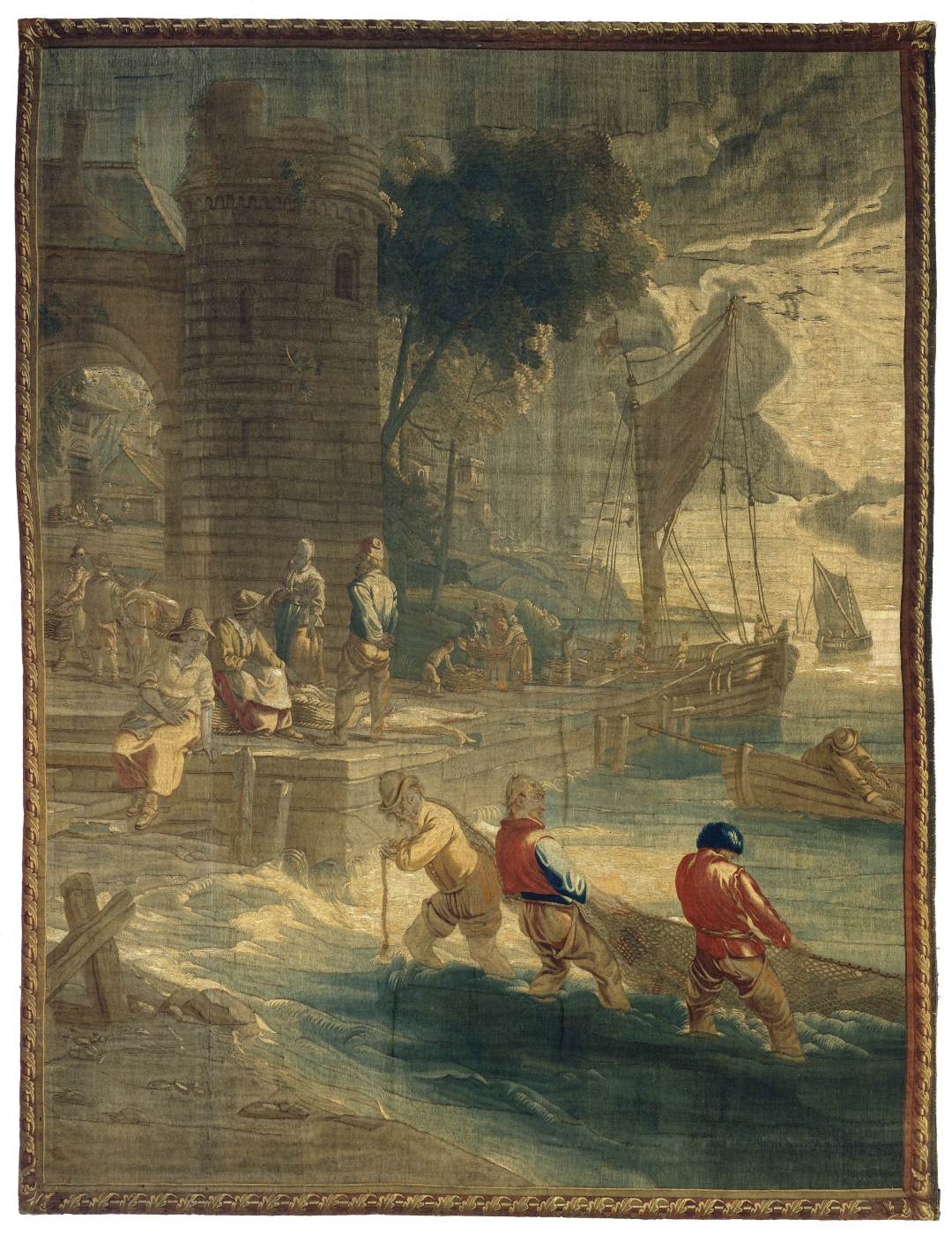
The Fish Quay
HELMONT, Zeger Jacob van · 1729 →
- MEDIUM
- Tapestry, 336 x 260 cm
- TYPE
- Genre
PALETTE
HOVER OR TAP A SWATCH FOR NAME, SHARE AND HEX. SAMPLED FROM THE IMAGE — INDICATIVE, NOT A PIGMENT ANALYSIS.
DEVELOPMENT BUILD — NOT FOR PUBLIC USE. CONTRIBUTE ON GITHUB.
CURRENT LOCATION · Rijksmuseum
03 — ARTWORK
HELMONT, Zeger Jacob van · 1729 →
PALETTE
HOVER OR TAP A SWATCH FOR NAME, SHARE AND HEX. SAMPLED FROM THE IMAGE — INDICATIVE, NOT A PIGMENT ANALYSIS.
COMMENTARY
UNDERLINED TERMS ARE DEFINED IN THE GLOSSARY.
This tapestryAs historical climatologists have not shown that Renaissance Italian winters and springs were warmer than they are now, it is puzzling that Italy did not fabricate tapestries to decorate and draught-proof the stony rooms of its palaces until 1545, when Cosimo I set up a manufactory in Florence. To hardiness or stinginess (tapestry was by far the most expensive form of wall decoration) we owe the existence of such secular frescoed decorative schemes as the labours of the months in the castle at Trent (c. 1407), the Arthurian scenes of Pisanello and the courtly ones of Mantegna in the Ducal Palace of Mantua, the delicious calendar fantasies of Cossa and others in the Palazzo Schifanoia in Ferrara - and, doubtless, many others that await liberation from whitewash or later panelling. These are all in situations where northern patrons would have used tapestries. These were imported, chiefly from Flanders, into Italy. The influence of their hunting and ceremonial scenes in particular registered on Italian 'gothic' painting or illumination and stained glass, and in literature. But the Italians did not make them. The most famous of all 'Italian' tapestries, those for the Sistine Chapel designed by Raphael, were made in Brussels from the full-scale coloured patterns, or cartoons, now in the Victoria and Albert Museum, London. Nor is it clear whether imported tapestries were used habitually or simply to add grandeur to special occasions. Even when Cosimo's manufactory was in being, and working from designs by court artists of the calibre of Bronzino, Salviati and Allori, his own headquarters, the Palace of the Signoria (now the Palazzo Vecchio), was being decorated with frescoes. The subject is underexplored. was woven in the Brussels workshop of Urbanus Leyniers. The cartoonA full-scale preparatory drawing for a painting, tapestry, or fresco. In fresco painting, the design was transferred to the wall by making small holes along the contour lines and then powdering them with charcoal in order to leave an outline on the surface to be painted. In the 19th centurry designs submitted in a competition for frescos in the Houses of Parliament in London were parodied in the magazine Punch. From this the word has acquired its most common meaning today - a humorous drawing or parody. was designed by Zeger Jacob van Helmont (figures) and Augustin Coppens (landscape).
The archive catalogues no further works by this artist.
TRY SAME COLLECTION →@online{wga-r0f2653da782667,
author = {Krén, Emil and Marx, Daniel},
title = {The Fish Quay by HELMONT, Zeger Jacob van},
organization = {{Web Gallery of Art}},
date = {2026-09-14},
url = {https://beta.wga.hu/artists/helmont-zeger-jacob-van-r4d058643912300/the-fish-quay-r0f2653da782667},
urldate = {2026-09-14},
langid = {english}
}ACCESSED 2026-09-14. REPLACE THE AUTHOR FIELD WITH THE COMMENTARY AUTHOR WHERE ONE IS NAMED.
