03 — ARTWORK
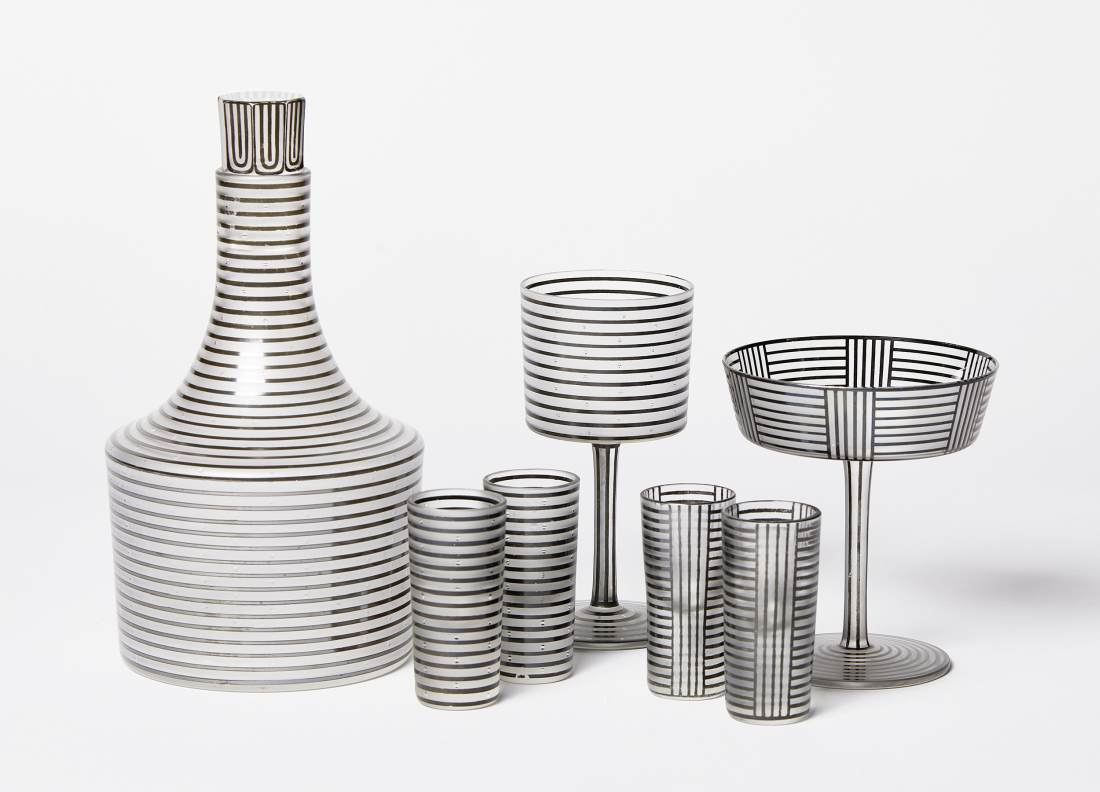
Drinking set, Series "B"
- MEDIUM
- Glass
- TYPE
- Other
PALETTE
HOVER OR TAP A SWATCH FOR NAME, SHARE AND HEX. SAMPLED FROM THE IMAGE — INDICATIVE, NOT A PIGMENT ANALYSIS.
DEVELOPMENT BUILD — NOT FOR PUBLIC USE. CONTRIBUTE ON GITHUB.
03 — ARTWORK
PALETTE
HOVER OR TAP A SWATCH FOR NAME, SHARE AND HEX. SAMPLED FROM THE IMAGE — INDICATIVE, NOT A PIGMENT ANALYSIS.
COMMENTARY
UNDERLINED TERMS ARE DEFINED IN THE GLOSSARY.
With an eye that favoured strict geometric shapes, Josef Hoffmann was in many ways anticipatory of the cubist movement. His fondness for the square was so well-known that the architect and designer earned the nickname Quadrati-Hoffmann (Square Hoffman) among his peers. Perhaps one of the finest examples of Hoffmann’s aesthetic principles is the Series "B" glasses, produced with the iconic glassmaker Lobmeyr. The elegantly styled, round glass objects are made by blowing the glass into a beechwood mould. The result is a glass with remarkably thin walls, which has been dubbed “muslin” because of its likeness to the eponymous French fabric. The glass is etched with columns and rows of black lines that lend the pieces a classicalRelating to the culture of ancient Greece and Rome (classical Antiquity). The classical world played a profoundly important role in the Renaissance, with Italian scholars, writers, and artists seeing their own period as the rebirth (the "renaissance") of classical values after the Middle Ages. The classical world was considered the golden age for the arts, literature, philosophy, and politics. Concepts of the classical, however, changed greatly from one period to the next. Roman literature provided the starting point in the 14th century, scholars patiently finding, editing and translating a wide range of texts. In the 15th century Greek literature, philosophy and art - together with the close study of the remains of Roman buildings and sculptures-expanded the concept of the classical and ensured it remained a vital source of ideas and inspiration. feel. The original collection debuted at the Werkbund Exhibition of 1914 in Cologne, Germany.
The Lobmeyr company was founded in 1823 by Josef Lobmeyr (1792-1855). When his sons acquired the company, they renamed it J. & L. Lobmeyr, named after Joseph, who became the marketing director, and Louis, who managed the art department. The family-owned company developed professional relationships with Bohemian glassworks and glass making companies; it is still active and has its main store in Vienna.
@online{wga-r4d71079ed5e777,
  author       = {Krén, Emil and Marx, Daniel},
  title        = {Drinking set, Series "B" by HOFFMANN, Josef},
  organization = {{Web Gallery of Art}},
  date         = {2026-09-13},
  url          = {https://beta.wga.hu/artists/hoffmann-josef-rb0a047b1a75582/drinking-set-series-b-r4d71079ed5e777},
  urldate      = {2026-09-13},
  langid       = {english}
}
ACCESSED 2026-09-13. REPLACE THE AUTHOR FIELD WITH THE COMMENTARY AUTHOR WHERE ONE IS NAMED.


