03 — ARTWORK
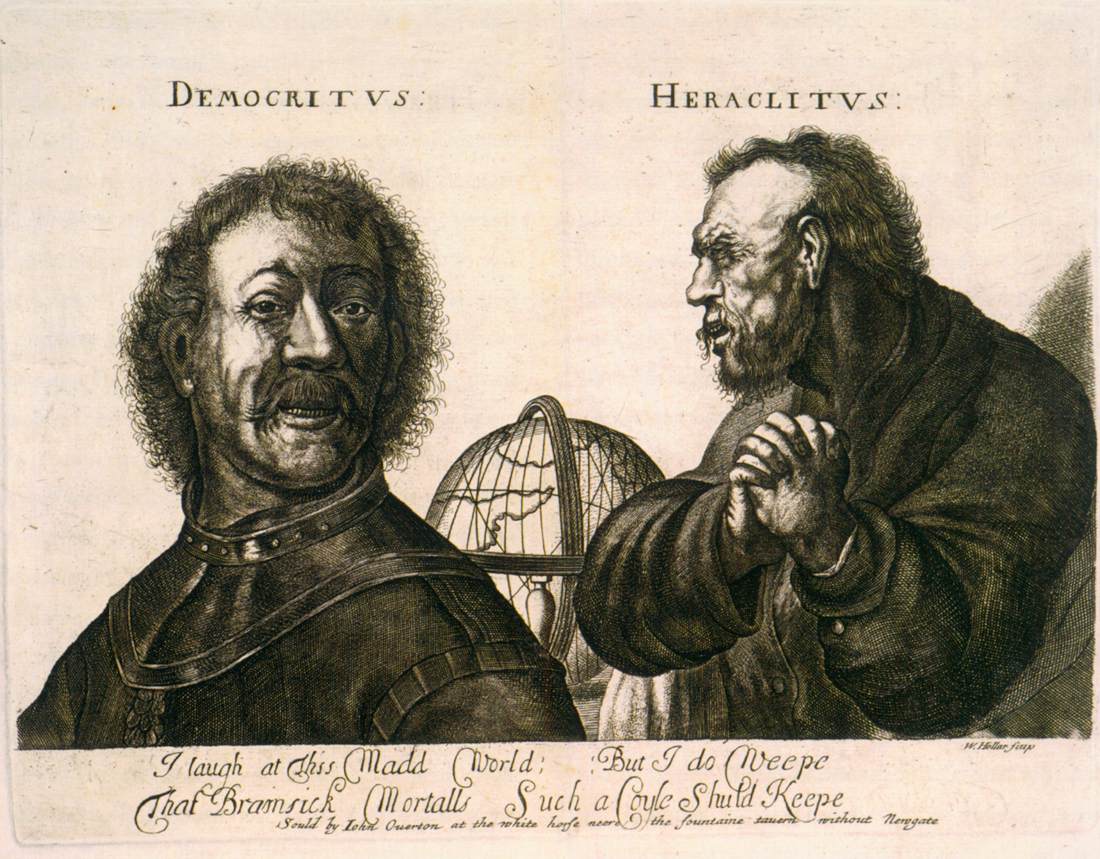
Democritus and Heraclitus
- MEDIUM
- Etching
- TYPE
- Mythological
PALETTE
HOVER OR TAP A SWATCH FOR NAME, SHARE AND HEX. SAMPLED FROM THE IMAGE — INDICATIVE, NOT A PIGMENT ANALYSIS.
DEVELOPMENT BUILD — NOT FOR PUBLIC USE. CONTRIBUTE ON GITHUB.
CURRENT LOCATION · Metropolitan Museum of Art
03 — ARTWORK
PALETTE
HOVER OR TAP A SWATCH FOR NAME, SHARE AND HEX. SAMPLED FROM THE IMAGE — INDICATIVE, NOT A PIGMENT ANALYSIS.
COMMENTARY
UNDERLINED TERMS ARE DEFINED IN THE GLOSSARY.
Democritus (c. 460 - c. 370 B.C.) and Heraclitus (c. 540 - c. 475 B.C.) are known as the 'laughing and crying philosophers.'
Democritus, a Greek philosopher, born at Abdera in Thrace, was known as the laughing philosopher because he found amusement in the folly of mankind. (The citizens of Abdera were proverbially stupid.) His philosophic system was contrasted with that of the earlier Heraclitus of Ephesus, who was known as the 'Dark' or 'Obscure' and was reputed to be melancholic. They were linked as a contrasting pair by Seneca, by Juvenal and others. Florentine humanists, to whom such classicalRelating to the culture of ancient Greece and Rome (classical Antiquity). The classical world played a profoundly important role in the Renaissance, with Italian scholars, writers, and artists seeing their own period as the rebirth (the "renaissance") of classical values after the Middle Ages. The classical world was considered the golden age for the arts, literature, philosophy, and politics. Concepts of the classical, however, changed greatly from one period to the next. Roman literature provided the starting point in the 14th century, scholars patiently finding, editing and translating a wide range of texts. In the 15th century Greek literature, philosophy and art - together with the close study of the remains of Roman buildings and sculptures-expanded the concept of the classical and ensured it remained a vital source of ideas and inspiration. texts were well-known used the pair to support the view that a cheerful demeanour was proper to a philosopher.
The two philosophers are widely represented in European art of the Renaissance and BaroqueThe period in art history from about 1600 to about 1750. In this sense the term covers a wide range of styles and artists. In painting and sculpture there were three main forms of Baroque: (1) sumptuous display, a style associated with the Catholic Counter Reformation and the absolutist courts of Europe (Bernini, Rubens); (2) dramatic realism (Caravaggio); and (3) everyday realism, a development seen in particular in Holland (Rembrandt, Vermeer). In architecture, there was an emphasis on expressiveness and grandeur, achieved through scale, the dramatic use of light and shadow, and increasingly elaborate decoration. In a more limited sense the term Baroque often refers to the first of these categories. The development of the Baroque reflects the period's religious tensions (Catholic versus Protestant); a new and more expansive world view based on science and exploration; and the growth of absolutist monarchies. period, either in one picture or as companion pieces.
@online{wga-re6864529372fa1,
  author       = {Krén, Emil and Marx, Daniel},
  title        = {Democritus and Heraclitus by HOLLAR, Wenceslaus},
  organization = {{Web Gallery of Art}},
  date         = {2026-09-13},
  url          = {https://beta.wga.hu/artists/hollar-wenceslaus-red2b3c8f3f6ce7/democritus-and-heraclitus-re6864529372fa1},
  urldate      = {2026-09-13},
  langid       = {english}
}
ACCESSED 2026-09-13. REPLACE THE AUTHOR FIELD WITH THE COMMENTARY AUTHOR WHERE ONE IS NAMED.


