03 — ARTWORK
Christ before the High Priest
HONTHORST, Gerrit van · 1617 →
- MEDIUM
- Oil on canvas, 272 x 183 cm
- TYPE
- Religious
PALETTE
HOVER OR TAP A SWATCH FOR NAME, SHARE AND HEX. SAMPLED FROM THE IMAGE — INDICATIVE, NOT A PIGMENT ANALYSIS.
DEVELOPMENT BUILD — NOT FOR PUBLIC USE. CONTRIBUTE ON GITHUB.
CURRENT LOCATION · National Gallery
03 — ARTWORK
HONTHORST, Gerrit van · 1617 →
PALETTE
HOVER OR TAP A SWATCH FOR NAME, SHARE AND HEX. SAMPLED FROM THE IMAGE — INDICATIVE, NOT A PIGMENT ANALYSIS.
COMMENTARY
UNDERLINED TERMS ARE DEFINED IN THE GLOSSARY.
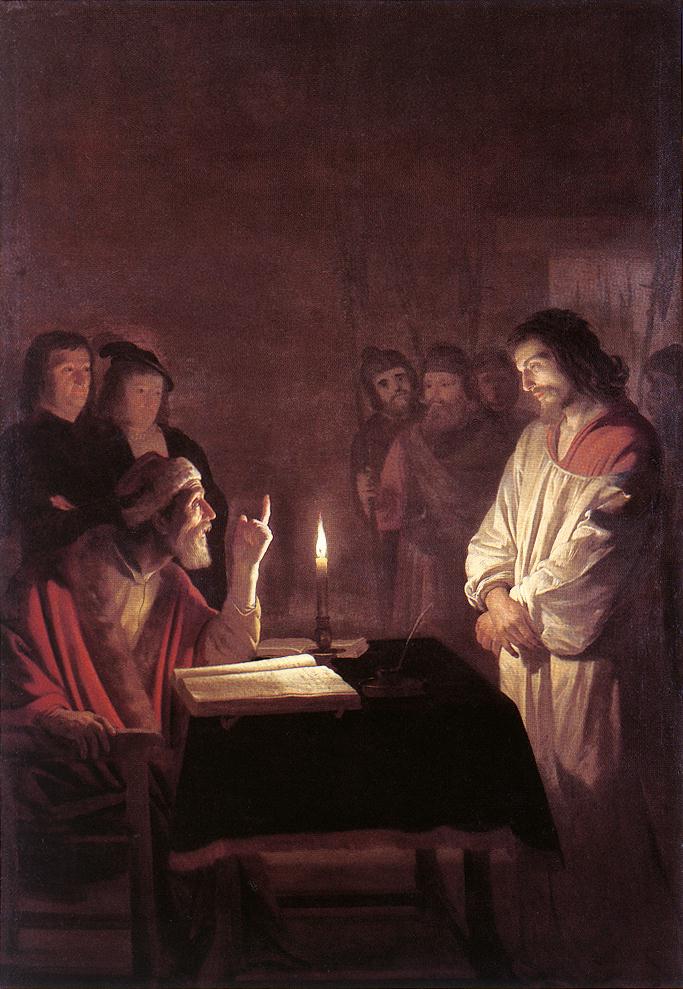
Christ before the High Priest c. 1617 Oil on canvasA woven cloth used as a support for painting. The best-quality canvas is made of linen; other materials used are cotton, hemp, and jute. It is now so familiar a material that the word 'canvas' has become almost a synonym for an oil painting, but it was not until around 1500 that it began to rival the wooden panel (which was more expensive and took longer to prepare) as the standard support for movable paintings (the transition came later in Northern Europe than in Italy). Canvas is not suitable for painting on until it has been coated with a ground, which isolates the fabric from the paint; otherwise it will absorb too much paint, only very rough effects will be obtainable, and parts of the fabric may be rotted by the pigments. It must also be made taut on a stretcher or by some other means., 272 x 183 cm National Galleryan upper story, similar to a tribune, running along the side of a building and open on one side to the interior; in a church (basilica) above the side aisles, over the ambulatory (central-plan building) and also over the west end. The gallery was used to keep certain groups of worshippers apart (women, noblemen)., London
Honthorst, like Ter Brugghen, was a pupil of the history painter Abraham Bloemaert in Utrecht and also went to Rome. Unlike Ter Brugghen, however, he there achieved an international reputation, working for nobles and princes of the Church. The Italians called him Gherardo delle Notti, - Gerard of the Nocturnes - and this painting, made for the Marchese Vincenzo Giustiniani in whose palace Honthorst stayed, explains why. On his return north of the Alps Honthorst was so famous that he was invited to England by Charles I, for whom he painted mythological subjects and many portraits. He continued to receive commissions from royalty in Holland, executing portraits and allegorical decorations for Prince Frederik Hendrik of Orange, and in 1635 he sent the first of a long series of historical and mythological narratives to Christian IV of Denmark. The exiled Queen of Bohemia, Elisabeth Stuart and her daughters were among his many pupils in The Hague.
Where Ter Brugghen in the Concert uses candlelight to create a scene of dreamlike enchantment, Honthorst employ it to lend veracity and dramatic tension to a biblical story (Matthew 26:57-64). After his capture on the night of the Agony in the Garden, Jesus is taken for interrogation and trial before the High Priest Caiaphas, where two false witnesses - the shifty-looking men behind Caiaphas - speak against him. Within the vast composition - in scale and format like an altarpieceA picture or sculpture that stands on or is set up behind an altar. The term reredos is used for an ornamental screen or partition, not directly attached to the altar table but affixed to the wall behind it. A diptych is an altarpiece consisting of two panels, a triptych one of three panels, and a polyptych one of four or more panels. From the 14th to 16th century, the altarpiece was one of the most important commissions in European art; it was through the altarpiece that some of the most decisive developments in painting and sculpture came about. but never intended for one - the visibility of the life-size figures depends entirely on that single candle flame. Its gleam unifies the whole, by giving the impression of illuminating the entire room with evenly decreasing intensity until its force is spent in the dark, and by justifying the reddish cast of all the colours. It allows the two principal characters to stand out more solidly in reliefA sculptural work in which all or part projects from the flat surface. There are three basic forms: low relief (bas-relief, basso rilievo), in which figures project less than half their depth from the background; medium relief (mezzo-rilievo), in which figures are seen half round; and high relief (alto rilievo), in which figures are almost detached from their background. and in greater detail than the others. It focuses attention on their poses, gestures and expressions. It picks out the few significant accessories, notably the books of the Law and the rope by which Christ is tied, and it creates the solemn and threatening atmosphere of a night-time interrogation.
Through his mastery of the physical effects of illuminationThe decoration of manuscripts, one of the most common forms of medieval art; because of its monastic origins, usually of religious texts. The practice extends from heavy decorations of initial letters and inter-woven margin patterns (as in Celtic examples) to miniatures and and full-page illuminations, often of a formal and grandiose kind (as in Byzantine manuscripts). Rich colors are a common feature, in particular a luxirious use of gold and silver. Illuminations survived the advent of printing for some time and only died out with the rise of printed illustration in the 16 century. from a single source, Honthorst is also able to make symbolic points. Christ's white robe, torn from his shoulder when he was made prisoner, reflects more light than the priest's furred cloak - so that light seems to radiate from him. Though submissive, Christ is without question the main subject of the painting, the Light of the World and the Son of God.
@online{wga-ra391af9912ad17,
  author       = {Krén, Emil and Marx, Daniel},
  title        = {Christ before the High Priest by HONTHORST, Gerrit van},
  organization = {{Web Gallery of Art}},
  date         = {2026-09-14},
  url          = {https://beta.wga.hu/artists/honthorst-gerrit-van-r1678e980c789f2/christ-before-the-high-priest-ra391af9912ad17},
  urldate      = {2026-09-14},
  langid       = {english}
}
ACCESSED 2026-09-14. REPLACE THE AUTHOR FIELD WITH THE COMMENTARY AUTHOR WHERE ONE IS NAMED.


