03 — ARTWORK
Jefferson's House
- MEDIUM
- Photo
- TYPE
- Other
PALETTE
HOVER OR TAP A SWATCH FOR NAME, SHARE AND HEX. SAMPLED FROM THE IMAGE — INDICATIVE, NOT A PIGMENT ANALYSIS.
DEVELOPMENT BUILD — NOT FOR PUBLIC USE. CONTRIBUTE ON GITHUB.
03 — ARTWORK
PALETTE
HOVER OR TAP A SWATCH FOR NAME, SHARE AND HEX. SAMPLED FROM THE IMAGE — INDICATIVE, NOT A PIGMENT ANALYSIS.
COMMENTARY
UNDERLINED TERMS ARE DEFINED IN THE GLOSSARY.
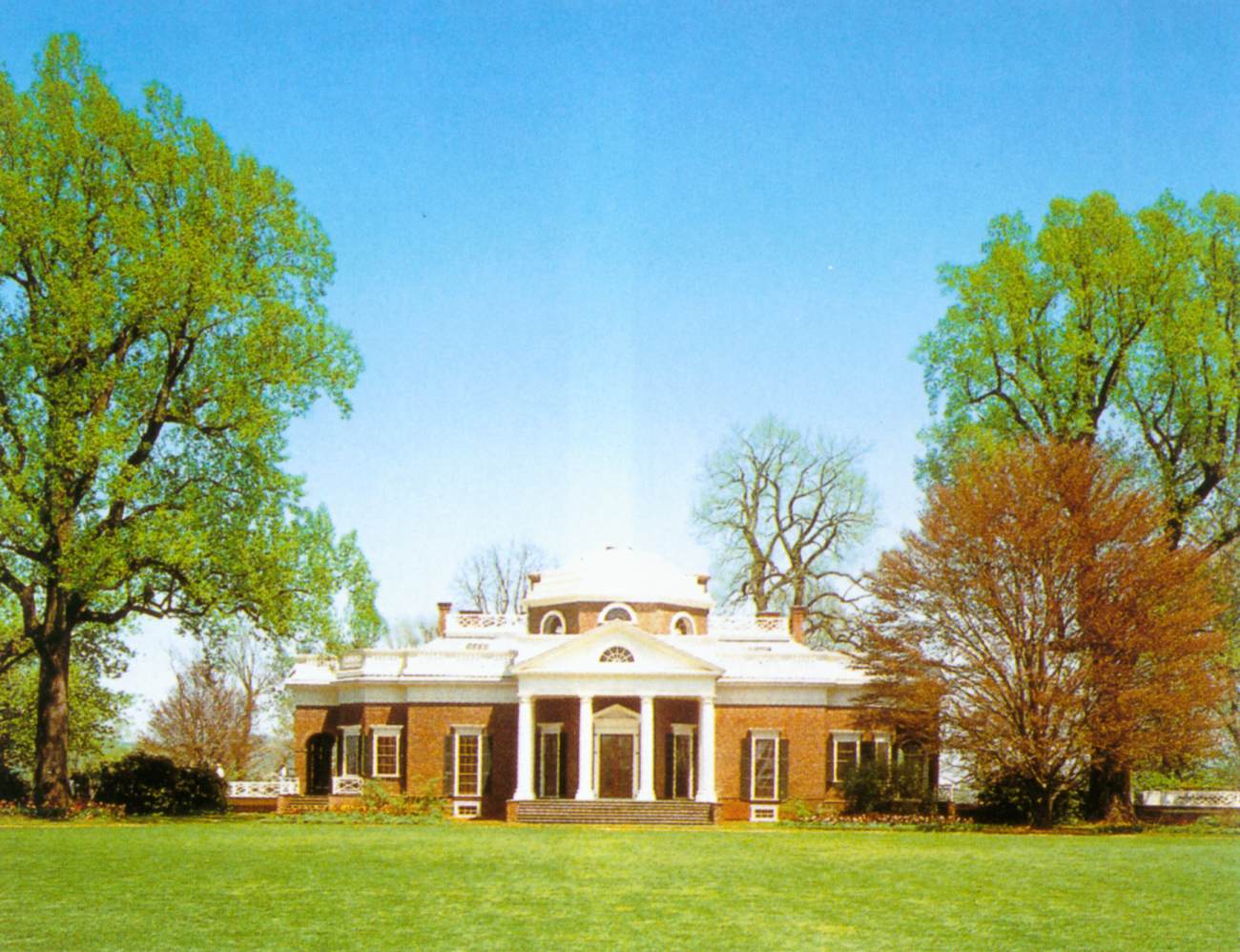
Thomas Jefferson, the third president of the United States, became a key figure in the turn to NeoclassicismA style in European art and architecture from the mid 18th century until the end of the 19th century. Based as it was on the use of ancient Greek and Roman models and motifs, its development was greatly influenced by the excavations at Pompeii and Herculaneum, and by the theories of the German art historian Johann Joachim Winckelmann (1717-1768). Intellectually and politically it was closely linked to the Enlightenment's rejection of the aristocratic frivolity of Rococo, the style of the Ancien Régime. Among Neoclassicism's leading figures were the French painter Jacques-Louis David (1744-1825), the German painter Anton Raffael Mengs (1728-1729), and the Italian sculptor Antonio Canova (1757-1822). from the Roman-BaroqueThe period in art history from about 1600 to about 1750. In this sense the term covers a wide range of styles and artists. In painting and sculpture there were three main forms of Baroque: (1) sumptuous display, a style associated with the Catholic Counter Reformation and the absolutist courts of Europe (Bernini, Rubens); (2) dramatic realism (Caravaggio); and (3) everyday realism, a development seen in particular in Holland (Rembrandt, Vermeer). In architecture, there was an emphasis on expressiveness and grandeur, achieved through scale, the dramatic use of light and shadow, and increasingly elaborate decoration. In a more limited sense the term Baroque often refers to the first of these categories. The development of the Baroque reflects the period's religious tensions (Catholic versus Protestant); a new and more expansive world view based on science and exploration; and the growth of absolutist monarchies. pathos of the Late Georgian Style that had begun to be thought of as conservative. He pioneered also an independent North American architecture. As a connoisseur he had studied the works of the English Neo-Palladians early in his career, and from 1768 had begun to draw his own designs. In 1769 he designed and built a villaa residence in the country (in Italy); villas acquired palace-like characteristics from the Renaissance onwards. modeled on Palladio's centrally planned structures for his country estate in Monticello. Influenced by his years as ambassador to Paris - which had brought him into contact with contemporary French architecture - he later redesigned crucial features of this building, lending it more monumentality and grace. The building was not completed until 1809.
The white porticoUsually open porch supported by columns or pillars on the main entrance side of a buildings. Frequently supports a pediment. on four Corinthian columns rises to the height of a single floor and is clearly differentiated from the broad brick expanse of the body of the house. A domein architecture, hemispherical structure evolved from the arch, usually forming a ceiling or roof. on an octagonal drumthe cylindrical or polygonal base of a dome. signals this as being the most important part of the house. In a language of classicalRelating to the culture of ancient Greece and Rome (classical Antiquity). The classical world played a profoundly important role in the Renaissance, with Italian scholars, writers, and artists seeing their own period as the rebirth (the "renaissance") of classical values after the Middle Ages. The classical world was considered the golden age for the arts, literature, philosophy, and politics. Concepts of the classical, however, changed greatly from one period to the next. Roman literature provided the starting point in the 14th century, scholars patiently finding, editing and translating a wide range of texts. In the 15th century Greek literature, philosophy and art - together with the close study of the remains of Roman buildings and sculptures-expanded the concept of the classical and ensured it remained a vital source of ideas and inspiration. forms Jefferson created a building whose elegance - and, in particular, its integration into the surrounding landscape - directly address the viewers's senses.
The villa in Monticello became the cradle of the Federal Style, as the architecture of the newly independent 13 North American states was called. This Neoclassical style was combined with Enlightenment thought, while at the same time its monumentality and dominance of landscape could be translated into ever greater dimensions.
@online{wga-rf3384eb2780de7,
  author       = {Krén, Emil and Marx, Daniel},
  title        = {Jefferson's House by JEFFERSON, Thomas},
  organization = {{Web Gallery of Art}},
  date         = {2026-09-13},
  url          = {https://beta.wga.hu/artists/jefferson-thomas-r5f6187e518aeba/jeffersons-house-rf3384eb2780de7},
  urldate      = {2026-09-13},
  langid       = {english}
}
ACCESSED 2026-09-13. REPLACE THE AUTHOR FIELD WITH THE COMMENTARY AUTHOR WHERE ONE IS NAMED.


