03 — ARTWORK
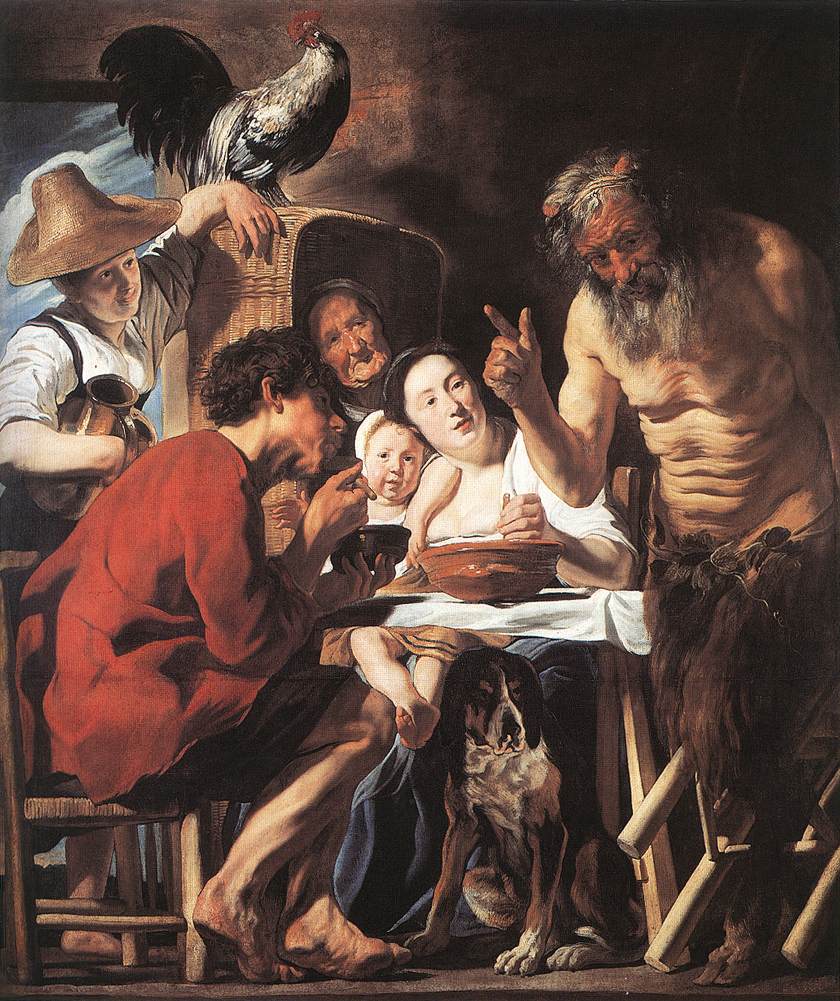
Satyr and Peasant
- MEDIUM
- Oil on canvas, 188,5 x 168 cm
- TYPE
- Mythological
PALETTE
HOVER OR TAP A SWATCH FOR NAME, SHARE AND HEX. SAMPLED FROM THE IMAGE — INDICATIVE, NOT A PIGMENT ANALYSIS.
DEVELOPMENT BUILD — NOT FOR PUBLIC USE. CONTRIBUTE ON GITHUB.
03 — ARTWORK
PALETTE
HOVER OR TAP A SWATCH FOR NAME, SHARE AND HEX. SAMPLED FROM THE IMAGE — INDICATIVE, NOT A PIGMENT ANALYSIS.
COMMENTARY
UNDERLINED TERMS ARE DEFINED IN THE GLOSSARY.
The theme is taken from a fable by the ancient Greek author Aesop. In the right foreground a satyrIn Greek mythology, human-like woodland deities with the ears, legs and horns of a goat. Often depicted as the attendant of the Bacchus, the god of wine. gets up brusquely from a table to which he has been invited by a peasant family, and admonishes his host, sitting to the left, for cooling his hot porridge by blowing on it, whereas earlier he had warmed his cold hands with the same breath when travelling home with the satyr. The peasant "blows both hot and cold". This still popular expression means that someone does not take a clear position and is therefore unreliable.
The earnestness of this moralising message appears, however, to be lost on this country group. The satyr's approach is greeted rather with astonishment. The plump young farmer's wife stops eating, but looks like she still does not understand clearly what is going on. Her child is uninterested by the satyr and looks at the viewer rascally. From inside the shadowed canopy of her wicker chair the grandmother bends her wrinkled head, in pointed contrast to the flushed head of the young peasant woman in the same pose beneath her. To the left the composition is rounded off by a fresh, softly smiling milkmaid. The lumbering dog under the table and the cock proudly enthroned on top of grandmother's chair seem equally unperturbed. The very low horizon, just visible under the peasant's chair, makes the country people tower above the viewer, lending them an imposing monumentality which one would normally expect with high-born people. As simple people they take, with a certain dignity, their appointed place in the social order.
Jordaens' lifelike characterisation of the peasants, full of insight into human nature, and their closeness to nature expressed in their unpolished manners must have strongly seduced the city-dwellers commissioning these tableaux, who considered themselves as more civilised. In a later version, also in the Brussels museum, the fable appears to turn into a good-humoured joke. There the warm palette and the rich texture have made way for the more even reproduction of colours and materials that are typical of the artist's later work. Jordaens' oeuvreThe complete body of works created by an artist. contains various other paintings on this theme, including one in the Göteborg museum that literally repeats the Brussels canvasA woven cloth used as a support for painting. The best-quality canvas is made of linen; other materials used are cotton, hemp, and jute. It is now so familiar a material that the word 'canvas' has become almost a synonym for an oil painting, but it was not until around 1500 that it began to rival the wooden panel (which was more expensive and took longer to prepare) as the standard support for movable paintings (the transition came later in Northern Europe than in Italy). Canvas is not suitable for painting on until it has been coated with a ground, which isolates the fabric from the paint; otherwise it will absorb too much paint, only very rough effects will be obtainable, and parts of the fabric may be rotted by the pigments. It must also be made taut on a stretcher or by some other means..
@online{wga-r997b2f7b7df1a8,
  author       = {Krén, Emil and Marx, Daniel},
  title        = {Satyr and Peasant by JORDAENS, Jacob},
  organization = {{Web Gallery of Art}},
  date         = {2026-09-09},
  url          = {https://beta.wga.hu/artists/jordaens-jacob-ra0a7a7c3268177/satyr-and-peasant-r997b2f7b7df1a8},
  urldate      = {2026-09-09},
  langid       = {english}
}
ACCESSED 2026-09-09. REPLACE THE AUTHOR FIELD WITH THE COMMENTARY AUTHOR WHERE ONE IS NAMED.


