03 — ARTWORK
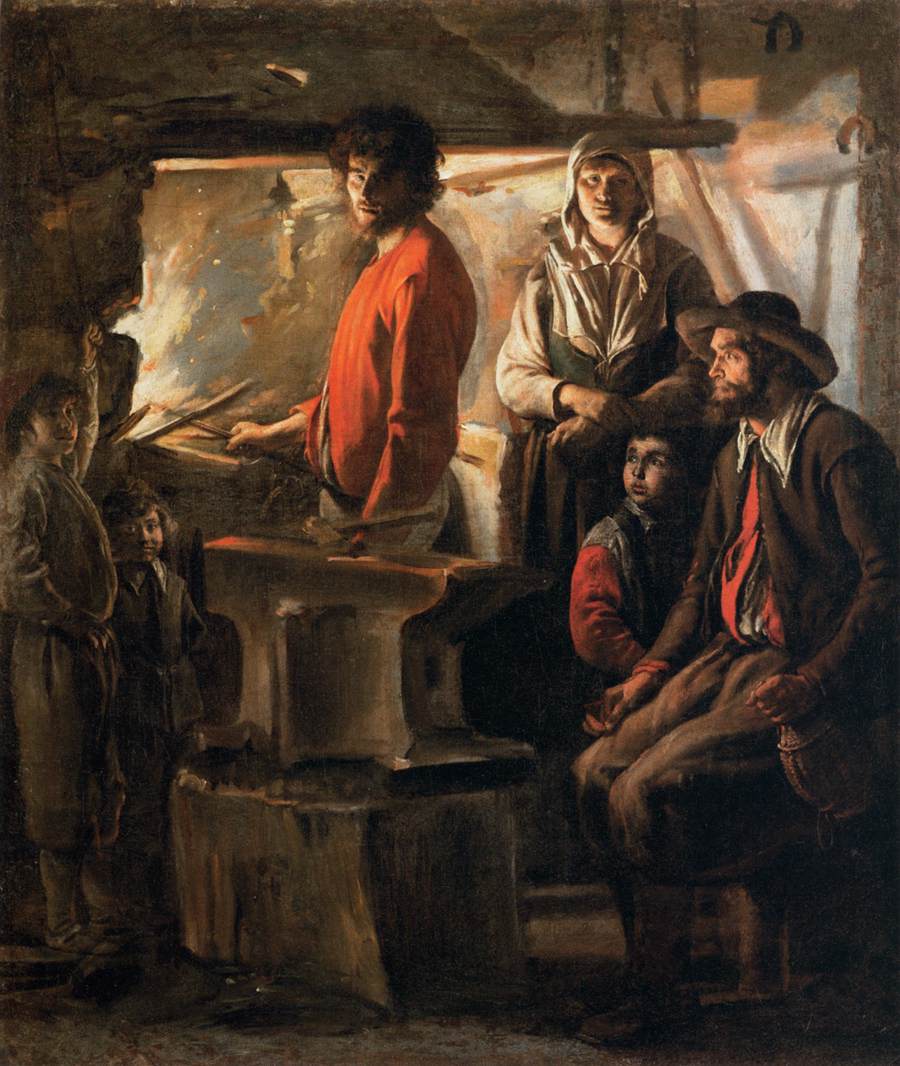
Blacksmith at His Forge
- MEDIUM
- Oil on canvas, 69 x 57 cm
- TYPE
- Genre
PALETTE
HOVER OR TAP A SWATCH FOR NAME, SHARE AND HEX. SAMPLED FROM THE IMAGE — INDICATIVE, NOT A PIGMENT ANALYSIS.
DEVELOPMENT BUILD — NOT FOR PUBLIC USE. CONTRIBUTE ON GITHUB.
03 — ARTWORK
PALETTE
HOVER OR TAP A SWATCH FOR NAME, SHARE AND HEX. SAMPLED FROM THE IMAGE — INDICATIVE, NOT A PIGMENT ANALYSIS.
COMMENTARY
UNDERLINED TERMS ARE DEFINED IN THE GLOSSARY.
LE NAIN brothers (b. 1598/1610, Laon, d. Louis and Antoine: 1648, Mathieu: 1677, Paris)
Blacksmith at His Forge c. 1640 Oil on canvasA woven cloth used as a support for painting. The best-quality canvas is made of linen; other materials used are cotton, hemp, and jute. It is now so familiar a material that the word 'canvas' has become almost a synonym for an oil painting, but it was not until around 1500 that it began to rival the wooden panel (which was more expensive and took longer to prepare) as the standard support for movable paintings (the transition came later in Northern Europe than in Italy). Canvas is not suitable for painting on until it has been coated with a ground, which isolates the fabric from the paint; otherwise it will absorb too much paint, only very rough effects will be obtainable, and parts of the fabric may be rotted by the pigments. It must also be made taut on a stretcher or by some other means., 69 x 57 cm Musée du Louvre, Paris
The Reims Venus and the Forge are close in style, in the latter the artist simply removed Venus and painted a straightforward genreIn a broad sense, the term is used to mean a particular branch or category of art; landscape and portraiture, for example, are genres of painting, and the essay and the short story are genres of literature. picture in which he could concentrate on the most sympathetic rendering of men working in a forge.
The smith himself looks towards the spectator as if he has been disturbed by the artist and asked to hold the pose while a photograph is taken. The other figures look in different directions, exactly as a group of people will do today when caught unawares by the camera. Especially perceptive is the depiction of the seated old man on the right - he is staring into space exactly as many old people tend to do, particularly when they are preoccupied with something which is not part of the event in front of them. The gazes of the three children are alert but lacking the concentration of the adults. Thus the painters of this picture have observed, for the first time in French painting, a 'slice of life'.
The depiction of the better-off peasantry is interesting from a sociological point of view because there are so few renderings of that class, but, even more important, it showed that masterpieces could be produced from humble material. This realistic treatment of 'low' subjects was not to be found again in French art until Courbet in the nineteenth century.
@online{wga-rbb3eb0265b2e2d,
  author       = {Krén, Emil and Marx, Daniel},
  title        = {Blacksmith at His Forge by LE NAIN brothers},
  organization = {{Web Gallery of Art}},
  date         = {2026-09-13},
  url          = {https://beta.wga.hu/artists/le-nain-brothers-rcc3e6d758d6679/blacksmith-at-his-forge-rbb3eb0265b2e2d},
  urldate      = {2026-09-13},
  langid       = {english}
}
ACCESSED 2026-09-13. REPLACE THE AUTHOR FIELD WITH THE COMMENTARY AUTHOR WHERE ONE IS NAMED.


