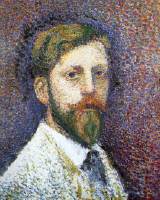
Belgian neo-impressionist painter. As the son of an architect, he was encouraged to study art. He started studying at the school of drawing at Sint Joost-ten-Noode, but soon dropped out. At about age 20, Georges Lemmen started painting. He exhibited at several different galleries in Brussels and in Ghent. In 1888 Lemmen joined the art group Les XXGLOSSARYA group that began with 20 Belgian painters and sculptors as well as critics, founded to organize juryless exhibitions following their dissatisfaction with the selection process of the Brussels Academy and the Paris Salon. The group did not represent any one style, but exhibited works of Realism, Impressionism, Symbolism, and Art Nouveau, all together. The artist group played a significant role in the modernization of art in Belgium by inviting foreign artists as well to the exhibitions, including Whistler, Monet, and Renoir. The frequent participation of Signac and Seurat led to the development of an independent Belgian Neo-Impressionism with international flair.Important members of Les Vingts included, among others, James Ensor, Fernand Khnopff, Theo van Rysselberghe, and Henri van der Velde. The group dissolved itself in 1893 after holding a total of 126 exhibitions. (Les Vingt). He met Théo van Rysselberghe, which led him to move towards Neo-ImpressionismGLOSSARYAn artistic trend that developed toward the end of the nineteenth century and became a revival movement for Impressionist painting. The Impressionist technique of juxtaposing small amounts of colour to create the impression of a total area that first becomes whole in the perception of the viewer was elevated to the supreme principle of painting and refined by Georges Seurat. Seurat wanted to give the spontaneous, impressionistic painting process a scientific foundation. His theories are underpinned by studies in physics, optics, and colour theory by Chevreul, Blanc, and Rood. Unbroken points of colour set directly next to each other (Pointillism, Divisionism, or Chromo-Luminarism) reflect not only the colour value of the depicted object, but also convey the colour of light as a reflection of the object, Other representatives of Neo-Impressionism include Paul Signac, Camille Pissarro and Henri-Edmond Cross..
Inspired by his friendship with Georges Seurat, Lemmen began experimenting with DivisionismGLOSSARYSee Pointillism and adopted a Pointillist style. He continued painting in a pointillist way till 1895, four years after the death of Seurat. After 1895, Lemmen abandoned PointillismGLOSSARYPainting style that appeared in France toward the end of the nineteenth century. The technique of the Neo-Impressionists of applying pure colours next to each other in order to create the actual colour only from a distance through optical mixing in the eye of the beholder was declared to be the supreme principle in painting by Georges Seurat, who rigorously developed it further by applying unbroken colours next to each other in a strict pattern of points or commas. This new technique, called Divisionism by Seurat, was exhibited to the public for the first time in 1884 in Paris at an exhibition of the Indépendents. to Art Nouveau. He created numerous book illustrations, ceramics, carpets, posters, drawings, pastels and gouaches in this particular style.