03 — ARTWORK
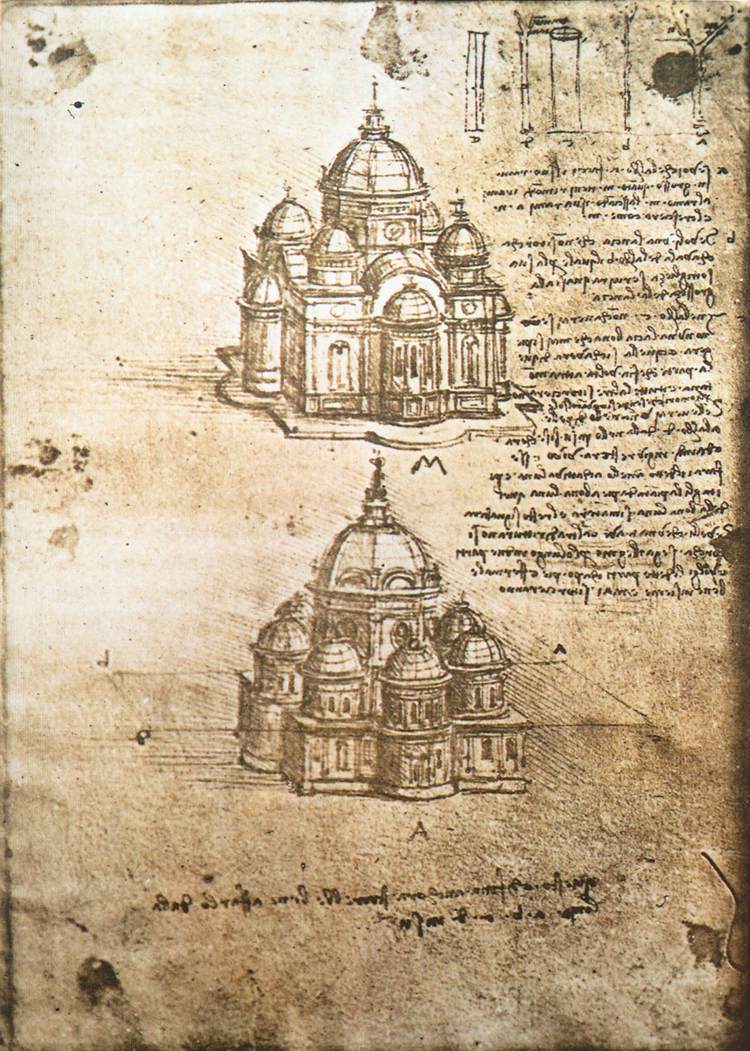
Studies of central plan buildings
- MEDIUM
- Pen and ink on paper, 23 x 16 cm
- TYPE
- Study
PALETTE
HOVER OR TAP A SWATCH FOR NAME, SHARE AND HEX. SAMPLED FROM THE IMAGE — INDICATIVE, NOT A PIGMENT ANALYSIS.
DEVELOPMENT BUILD — NOT FOR PUBLIC USE. CONTRIBUTE ON GITHUB.
03 — ARTWORK
PALETTE
HOVER OR TAP A SWATCH FOR NAME, SHARE AND HEX. SAMPLED FROM THE IMAGE — INDICATIVE, NOT A PIGMENT ANALYSIS.
COMMENTARY
UNDERLINED TERMS ARE DEFINED IN THE GLOSSARY.
Studies of central plan buildings c. 1498 Pen and inkColoured fluid used for writing, drawing, or printing. Inks usually have staining power without body, but printers' inks are pigments mixed with oil and varnish, and are opaque. The use of inks goes back in China and Egypt to at least 2500 BC. They were usually made from lampblack (a pigment made from soot) or a red ochre ground into a solution of glue or gums. These materials were moulded into dry sticks or blocks, which were then mixed with water for use. Ink brought from China or Japan in such dry form came to be known in the West as 'Chinese ink' or 'Indian ink'. The names are also given to a similar preparation made in Europe. on paper, 23 x 16 cm Bibliothèque de l'Institut de France, Paris
The picture shows fol. 17v of Manuscriptcollective term for books or other documents written by hand; in a specific sense, the hand-written medieval book, the Codex manuscriptus, often ornamented with decorative borders, illuminated initials and miniatures, and containing works of ancient philosophy or scholarly, ecclesiastical, and literary texts. Manuscripts were usually produced on commission. At first the scriptoria (writing rooms) of monasteries transcribed the contents of famous manuscripts and made copies. Monastic communities in the Netherlands and northern Germany began producing manuscripts around 1383/84. Flanders, Burgundy, and in particular Paris became major centres for the mass production of breviaries (prayer books) and Books of Hours. B.
It has been proposed that the central plan designs in Manuscript B were originally to be used in a collection of architectural plans. In addition to ground plans and elevations common until then, there are mainly aerial perspectival views, which were a novelty in the field of architectural drawing. However, Vitruvius had already introduced them as a third form of architectural depiction in "De Architectura", his ten books on architecture.
@online{wga-r4b5c75d5ff4ba8,
  author       = {Krén, Emil and Marx, Daniel},
  title        = {Studies of central plan buildings by LEONARDO da Vinci},
  organization = {{Web Gallery of Art}},
  date         = {2026-09-13},
  url          = {https://beta.wga.hu/artists/leonardo-da-vinci-r0350d435570f6c/studies-of-central-plan-buildings-r4b5c75d5ff4ba8},
  urldate      = {2026-09-13},
  langid       = {english}
}
ACCESSED 2026-09-13. REPLACE THE AUTHOR FIELD WITH THE COMMENTARY AUTHOR WHERE ONE IS NAMED.


