03 — ARTWORK
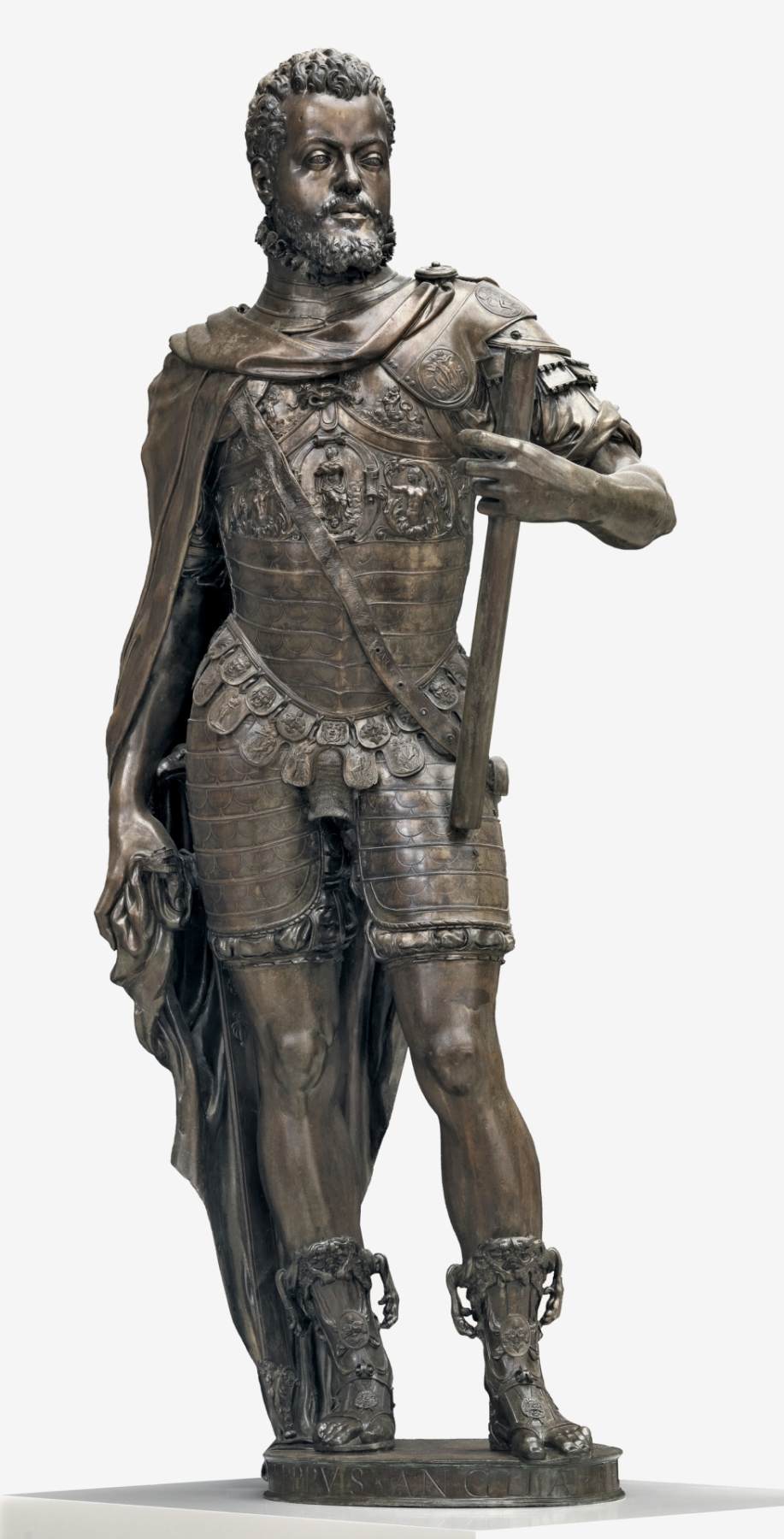
Philip II
- MEDIUM
- Bronze, height 171 cm
- TYPE
- Portrait
PALETTE
HOVER OR TAP A SWATCH FOR NAME, SHARE AND HEX. SAMPLED FROM THE IMAGE — INDICATIVE, NOT A PIGMENT ANALYSIS.
DEVELOPMENT BUILD — NOT FOR PUBLIC USE. CONTRIBUTE ON GITHUB.
03 — ARTWORK
PALETTE
HOVER OR TAP A SWATCH FOR NAME, SHARE AND HEX. SAMPLED FROM THE IMAGE — INDICATIVE, NOT A PIGMENT ANALYSIS.
COMMENTARY
UNDERLINED TERMS ARE DEFINED IN THE GLOSSARY.
The son of Emperor Charles V and Empress Isabella of Portugal, Philip II was born in Valladolid in 1527. In October, 1555 he was named ruler of the Low Countries and in January, 1556 he became King of Spain. The following year he married his third wife, Isabel of Valois and in 1570 he married Anne of Austria, mother of the future Philip III. He died in El Escorial in 1598.
Dressed in armor, he is represented at the age of 24. He carries a baton in his left hand while his right hand rests on his sword, the handle of which is topped by an eagle's head. An outstanding element in the sumptuous decoration of his armor is the low reliefA sculptural work in which all or part projects from the flat surface. There are three basic forms: low relief (bas-relief, basso rilievo), in which figures project less than half their depth from the background; medium relief (mezzo-rilievo), in which figures are seen half round; and high relief (alto rilievo), in which figures are almost detached from their background. on the breastplate, where a medallionIn architecture, a large ornamental plaquc or disc. depicts the Virgin Mary surrounded by snakes, over the head of an angel and under more snakes, alluding to the triumphWith growing interest from the early 14th century in the history of ancient Rome came a fascination with the city's conquests, the wars by which they were won - and the ceremony which marked their success: the victor's triumph. The knowledge that the privilege of being commemorated by one of these enormous and costly processions of warriors, loot and prisoners was given sparingly, only to the sole commander of a major victory over a foreign army of whom at least 5000 were slain, added to the glamour of the triumph. Its centrepiece was the chariot of the victor himself. Dante gave one to Beatrice in Purgatorio XXIX: 'Rome upon Africanus ne'er conferred / Nor on Augustus's self, a car so brave'. But it was tentatively with the relief carvings on the Triumphal Arch (1452-66) at Castelnuovo in Naples commemorating Alfonso the Magnanimous, and finally with Mantegna's superb Triumph of Caesar cartoons (Hampton Court), that the visual reconstruction of a Roman triumph became complete. Meanwhile, in an age which did not like the idea of large numbers of victory-flushed soldiers parading through its streets, the military triumph became sublimated, as it were, into a number of less controversial forms. This was largely under the influence of Petrarch's 'Trionfi' - poems describing the processions commemorating the triumphs of love, chastity, death; fame, time and eternity. Disseminated soon after his death, they soon appeared in illuminated manuscripts, and the triumph scene became a popular one for woodcuts, decorated marriage chests and other paintings, most beautifully of all on the backs of Piero della Francesca's portraits of Federigo da Montefeltro and his wife, Battista Sforza. Other 'triumphs' were invented: of the seasons, of virtues and of the arts. Nor was the theme allowed to be simply a profane one. Just before his death Savonarola published his 'Triumph of the Cross', in which the reader was invited to imagine 'a four-wheeled chariot on which is seated Christ as Conqueror.' Before it go the apostles, patriarchs and prophets, beside it the army of martyrs, behind it, after 'a countless number of virgins, of both sexes', come the prisoners: 'the serried ranks of the enemies of the Church of Christ.' This aspect of the theme was magnificently realized in Titian's great woodcut 'The Triumph of the Faith'. over Sin. The armor's epaulettes and belt alternate mythological themes with other decorative ones. The artist crafts this piece very meticulously, and his work has been compared to that of a goldsmith.
This work is signed and dated on the basemolded foot of a pillar or column providing the transition from the plinth to the shaft.. It is paired with a Leoni's portraitThe Roman portrait bust survived in the form of life-sized reliquaries of saints, but it was in 15th century Florence that the individual features and character of a contemporary sitter were accurately recorded by sculptors such as Donatello, Desiderio da Settignano, Mino da Fiesole and the Rossellino. A similar degree of realism occurs in 15th century tomb sculpture. The equestrian portrait, based on antique statues such as the Marcus Aurelius monument (Rome, Campidoglio), was revived in the 14th century. Two examples in fresco are Simone Martini's Guidoriccio (c. 1328; Siena, Palazzo Pubblico) and the posthumous portrait of Sir John Hawkwood (1436; Florence, Cathedral) by Uccello, which gives the illusion of a 3-dimensional statue seen from below. The Venetian Republic ordered imposing monuments from Donatello (1447; Gattarnelata, Padua) and Verrocchio (14799; Colleoni, Venice), whilst other statesmen ordered their own images to be erected in public places, directly relating themselves to the military heroes of ancient Rome. Another form of political portraiture derived from antiquity was the commemorative portrait medal designed by artists such as Pisanello. The carved or painted profile portrait became popular in the 1450s. The realism of the clear, flattened image, painted under the influence of Flemish examples by the Pollaiuolo brothers, Piero della Francesca and Botticelli, was superseded by the three-quarter and frontal portrait, psychologically more complex, such as Leonardo's enigmatic Mona Lisa (Paris, Louvre) with her momentary smile or Andrea del Sarto's arresting Portrait of a Man (London, National Gallery). The 16th century portrait became generalized, Lotto's Andrea Odoni (1527; Royal Collection) being an idealized concept of a collector rather than an individual. Group portraits, decorating whole rooms, include the narrative scenes of the Gonzaga court painted by Mantegna (completed 1474; Mantua, Palazzo Ducale) and the elaborate schemes commissioned by the Farnese family in Rome from Vasari (1546; Palazzo della Cancelleria) and Salviati (after 1553; Palazzo Farnese). Portraits were also incorporated into religious narratives, as in Ghirlandaio's fresco cycle painted for Giovanni Tornabuoni in S. Maria Novella, Florence (1486-90). of Mary of Hungary, also at the Prado Museum. Both were commissioned from the artist by Mary of Hungary herself, and it was Leoni who personally took them to Brussels along with some of his other works for the same patron.
@online{wga-rf83ea156567d0c,
  author       = {Krén, Emil and Marx, Daniel},
  title        = {Philip II by LEONI, Leone},
  organization = {{Web Gallery of Art}},
  date         = {2026-09-13},
  url          = {https://beta.wga.hu/artists/leoni-leone-r7e912931a78c70/philip-ii-rf83ea156567d0c},
  urldate      = {2026-09-13},
  langid       = {english}
}
ACCESSED 2026-09-13. REPLACE THE AUTHOR FIELD WITH THE COMMENTARY AUTHOR WHERE ONE IS NAMED.


