03 — ARTWORK
High Altar
- MEDIUM
- Marble
- TYPE
- Religious
PALETTE
HOVER OR TAP A SWATCH FOR NAME, SHARE AND HEX. SAMPLED FROM THE IMAGE — INDICATIVE, NOT A PIGMENT ANALYSIS.
DEVELOPMENT BUILD — NOT FOR PUBLIC USE. CONTRIBUTE ON GITHUB.
CURRENT LOCATION · Santa Maria della Salute
03 — ARTWORK
PALETTE
HOVER OR TAP A SWATCH FOR NAME, SHARE AND HEX. SAMPLED FROM THE IMAGE — INDICATIVE, NOT A PIGMENT ANALYSIS.
COMMENTARY
UNDERLINED TERMS ARE DEFINED IN THE GLOSSARY.
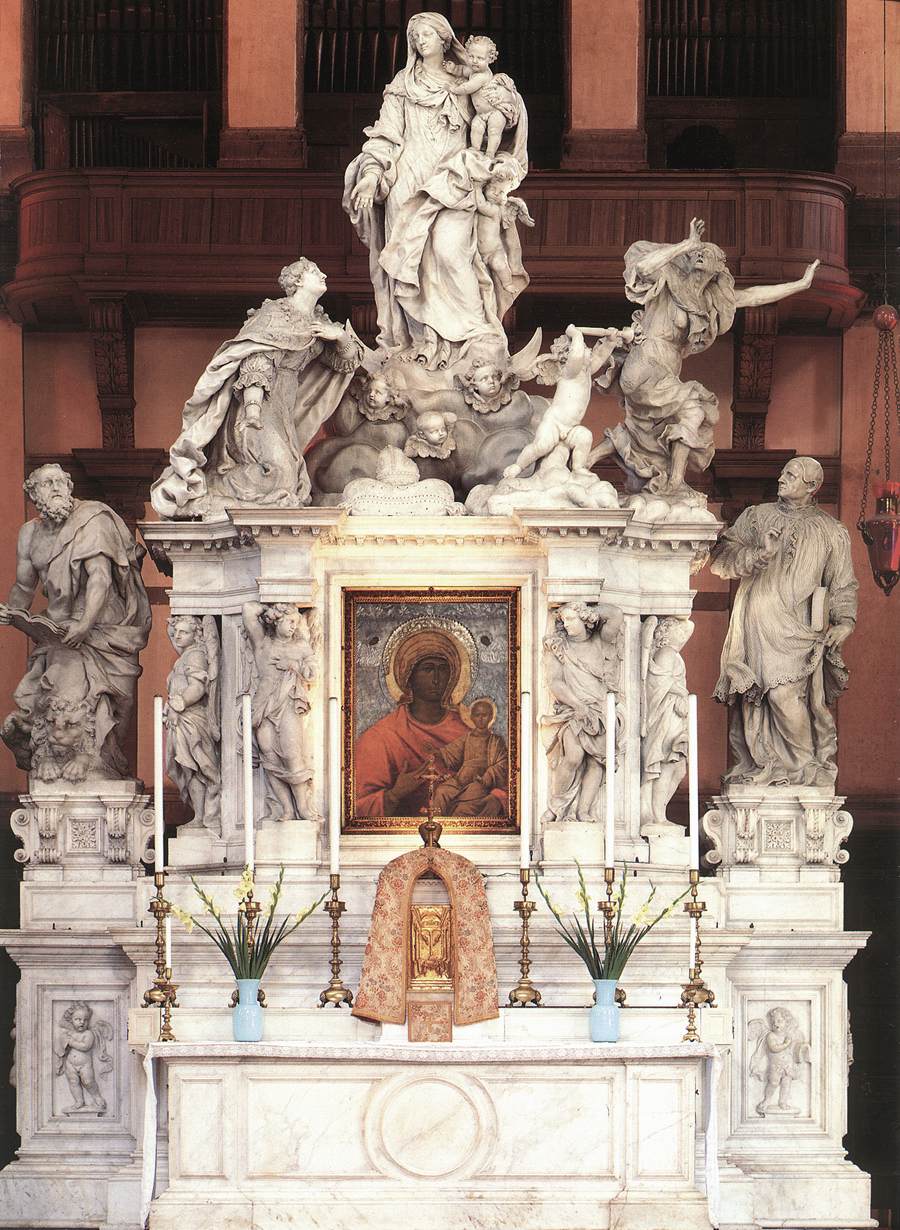
The high altar in the Santa Maria della Salute, with its octagonal plan, was designed by Longhena and portrays angels acting as caryatids and cherubs singing and playing instruments on the lower bases executed by Josse de Corte and assistants.
Sculptural altarpieces enjoyed a particular revival in Venice in the second half of the seventeenth century. A tradition of free-standing altarpieces had been introduced by Palladio's churches at the end of the sixteenth century, so it was not surprising that Baldassare Longhena made provision for a similar structure in his great Venetian votive church, Santa Maria della Salute. Raised as an offering against the plaguePlague, which had been extinct in Italy from the 8th century, returned along eastern trade routes to strike the peninsula, and thereafter all Europe, in October 1347. During 1348 the Black Death, comprising the bubonic and still more deadly septicaemic and pneumonic forms of the disease, swept town and countryside in a series of attacks whose horror was strikingly portrayed by Boccaccio in his preface to the Decameron. Thenceforward, though in less widespread, more sporadic outbreaks, plague recurred periodically until the 18th century. Thirty per cent of the population of Venice died in the outbreak of 1575-7, for instance, which was commemorated by Palladio's church of the Redentore. Preventive measures included the boarding up of infected families, the isolation of sufferers in plague hospitals, the burning of 'infected' clothing, but none worked or mitigated the feeling of hopelessness. The plague's social effects are an object of controversy. It seems probable, however, that during the second half of the 14th century plague reduced the population of Italy by a half and at certain centres, such as Florence and Genoa, sharply accentuated an economic depression which had already set in during the 1340s. In the 15th century, despite regional variations, it is unlikely that population began to rise significantly before the 1470s. Large claims have been made in the field of the arts and of human sensibility for the influence of plague. In Florence and Siena from 1348 to 1380, religious feeling and the art which mirrors it seem to assume more sombre forms and to reflect less the human and more the divine, transcendent and threatening aspects of faith. Yet the black rat and its plague-bearing flea could find a more hospitable environment in the hovels of the poor than in the stone-built houses of wealthy patrons of the arts (who, moreover, were often able to remove themselves from areas where plague had broken out). For this reason, perhaps, it is difficult to find, outside Tuscany, evidence of cultural change which could be attributed to plague, and in the Italy of the 15th and 16th centuries the main effect of the disease in art is to be found only in the frequent portrayal of the plague saints, Rocco and Sebastian. It is none the less interesting to recall that it was against a stark background of continual menace from plague that the human achievements of the Renaissance came into being., the Salute housed a miraculous icona small, portable painting in the Orthodox Church. The form and colours are strictly idealized and unnatural. The cultic worship of icons was a result of traditionally prescribed patterns of representation in terms of theme and form, for it was believed that icons depicted the original appearances of Christ, Mary and the saints. of the Virgin which was incorporated into the high altar by Josse de Corte. As the altar stands between the monks' choirthe part of a church interior, usually raised and set apart from the rest of the church, reserved for the clergy to pray together, or for choral singing. Since Carolingian times, "choir" has been the word for the part of the central nave of the church extending over the crossing (the place where nave and transept intersect), and including the apse (a niche in the wall, roofed with a half dome) that often stands at the end of this area. and the presbyteryThe raised space at the end of a church's nave which contains the high altar and is reserved for members of the clergy., De Corte followed the formula of sculptural complexes for San Giorgio Maggiore and the Redentore by Girolamo Campagna, fashioning a sacred drama of Venice's deliverance from the plague.
The Virgin is shown with the Christ Child interceding on behalf of a kneeling figure of Venice, while on her other side the plague is represented by a witchlike apparition toppling into the void; the city's patron saints Mark and Lorenzo Giustinian look up from below.
As a whole the altar does not quite succeed, the statuary being too small in scale and too meticulously worked to register in the vastness of its setting.
@online{wga-rc572c15b575519,
  author       = {Krén, Emil and Marx, Daniel},
  title        = {High Altar by LONGHENA, Baldassare},
  organization = {{Web Gallery of Art}},
  date         = {2026-09-13},
  url          = {https://beta.wga.hu/artists/longhena-baldassare-rb2f5247c581f50/high-altar-rc572c15b575519},
  urldate      = {2026-09-13},
  langid       = {english}
}
ACCESSED 2026-09-13. REPLACE THE AUTHOR FIELD WITH THE COMMENTARY AUTHOR WHERE ONE IS NAMED.


