03 — ARTWORK
Antiphonary (Cod. Cor. 1, folio 63)
- MEDIUM
- Tempera and gold on parchment, 223 x 204 mm
- TYPE
- Religious
PALETTE
HOVER OR TAP A SWATCH FOR NAME, SHARE AND HEX. SAMPLED FROM THE IMAGE — INDICATIVE, NOT A PIGMENT ANALYSIS.
DEVELOPMENT BUILD — NOT FOR PUBLIC USE. CONTRIBUTE ON GITHUB.
CURRENT LOCATION · Staatliche Museen (Berlin)
03 — ARTWORK
PALETTE
HOVER OR TAP A SWATCH FOR NAME, SHARE AND HEX. SAMPLED FROM THE IMAGE — INDICATIVE, NOT A PIGMENT ANALYSIS.
COMMENTARY
UNDERLINED TERMS ARE DEFINED IN THE GLOSSARY.
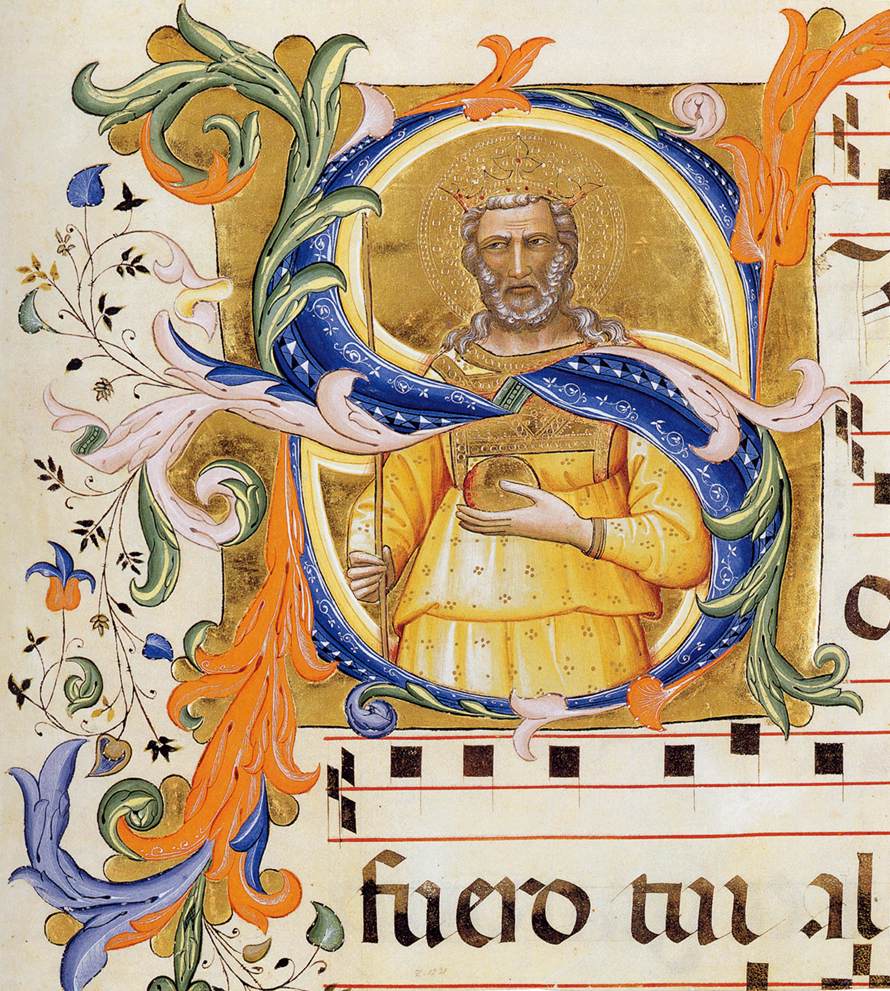
Antiphonary (Cod. Cor. 1, folio 63) 1396 TemperaA method of painting in which the pigments are mixed with an emulsion of water and egg yolks or whole eggs (sometimes glue or milk). Tempera was widely used in Italian art in the 14th and 15th centuries, both for panel painting and fresco, then being replaced by oil paint. Tempera colors are bright and translucent, though because the paint dried very quickly there is little time to blend them, graduated tones being created by adding lighter or darker dots or lines of color to an area of dried paint. and gold on parchmentWriting material made from the skins of sheep or calf, less frequently pig, goat,, and other animals; it has also been used for painting, and occasionally for printing and bookbinding. Pliny says that it ewas invented in the 2nd century BC in Pergamum; hence the name parchment from the Latin pergamena (of Pergamum). Skin had been used as a writng material before this, but the refined methods of cleaning and stretching involved in making parchment enabled booth sides of a leaf to be used, leading eventually to the supplanting of the manuscript roll by the bound book. Vellum is a fine kind of parchment made from delicate skins of young (sometimes stillborn) animals. Paper began to replace parchment from about the 14th century, but parchment is still used for certain kinds of documents, and the name is often applied to high-quality writng paper., 223 x 204 mm Staatliche Museen, Berlin
The choirthe part of a church interior, usually raised and set apart from the rest of the church, reserved for the clergy to pray together, or for choral singing. Since Carolingian times, "choir" has been the word for the part of the central nave of the church extending over the crossing (the place where nave and transept intersect), and including the apse (a niche in the wall, roofed with a half dome) that often stands at the end of this area. books of Santa Maria degli Angeli are the crowning monuments of the art of illuminationThe decoration of manuscripts, one of the most common forms of medieval art; because of its monastic origins, usually of religious texts. The practice extends from heavy decorations of initial letters and inter-woven margin patterns (as in Celtic examples) to miniatures and and full-page illuminations, often of a formal and grandiose kind (as in Byzantine manuscripts). Rich colors are a common feature, in particular a luxirious use of gold and silver. Illuminations survived the advent of printing for some time and only died out with the rise of printed illustration in the 16 century. in early Renaissance Florence. They were highly praised by Vasari, who claims to have seen them many times. Twenty codices, most of them missing pages where illuminated initials were presumably cut out and sold to collectors, were transferred to the Biblioteca Laurenziana from Santa Maria degli Angeli upon the suppression of the monasterythe complex of buildings used by a community of monks. Among the main elements of the complex are the church, cloister, chapter house (used by the governing body), refectory (dining room) and dormitory (sleeping quarters). at the beginning of the nineteenth century.
The earliest of the series of choir books (Cod. Cor. 2, dated February 1370, and illuminated by Don Silvestro dei Gherarducci) is the only volume written before the sacking and burning of Santa Maria degli Angeli in 1378. In 1382 the monastery received a large bequest, provided for the completion of a full set of choir books for both Santa Maria degli Angeli and its neighbour Santa Maria Nuova. A complete set of antiphonaries, in twelve volumes, was apparently finished (that is, written, but not necessarily illuminated) for Santa Maria degli Angeli by 1397. Eleven of the volumes of the antiphonary (Cod. Cor. 9, 16, 14, 17, 13, 12, 1, 8, 19, 5, 6) contain both movable and fixed feast for a portion of the liturgical year. Two volumes Cod. Cor. 11 and 7), containing commons of the saints, were added in the 1390s and in 1406. The series of graduals was completed in 1406 and 1410 with the addition of four further volumes (including Cod. Cor. 18, 3 and 4).
In studying the rich variety of illuminations present in these volumes, as well as those cuttings in collections around the world that can confidently be traced to these codices, it is apparent that they were not completed strictly in the order in which the books were written, and in some cases there was a considerable delay between writing and painting a given volume. It is probable that the first three volumes to be completed with illuminations were Cod. Cor. 9, 19 and 6, all painted by Don Silvestro dei Gherarducci. The illuminations from Cod. Cor. 16 and 11 were commissioned to artists outside the monastery, while the remaining volumes of the antiphonary, Cod. Cor. 1, 5, 7, 8 and 13, may all be associated with the art of Lorenzo Monaco.
Most scholars see Lorenzo Monaco as directly responsible for only a limited number of the initials in the books associated with Lorenzo Monaco, assigning the others to a variety of assistants and followers.
This cutting contains a depiction of King David in an initialthe first letter of the text in medieval manuscripts and early printed books, made to stand out emphatically by its colour, size, and ornamentation. S. It is a fragment of the missing folio 63 from Cod. Cor. 1 at the Biblioteca Laurenziana. The half-length figure wearing a crown and holding a sceptre and orb appears against a gold ground within the initial, which is shaded to appear three-dimensional and bordered with a friezea horizontal band of architectural decoration; in a classical entablature, the horizontal member band between the architrave and the cornice. of diamond-shaped lozenges and foliate decoration. The figure's robes are embellished with a repeat pattern of spots and covered at the breast with a gilt and elaborately tooled apparel.
@online{wga-rf350f36770e845,
  author       = {Krén, Emil and Marx, Daniel},
  title        = {Antiphonary (Cod. Cor. 1, folio 63) by LORENZO Monaco},
  organization = {{Web Gallery of Art}},
  date         = {2026-09-13},
  url          = {https://beta.wga.hu/artists/lorenzo-monaco-r2c20e060ae72ec/antiphonary-cod-cor-1-folio-63-rf350f36770e845},
  urldate      = {2026-09-13},
  langid       = {english}
}
ACCESSED 2026-09-13. REPLACE THE AUTHOR FIELD WITH THE COMMENTARY AUTHOR WHERE ONE IS NAMED.


