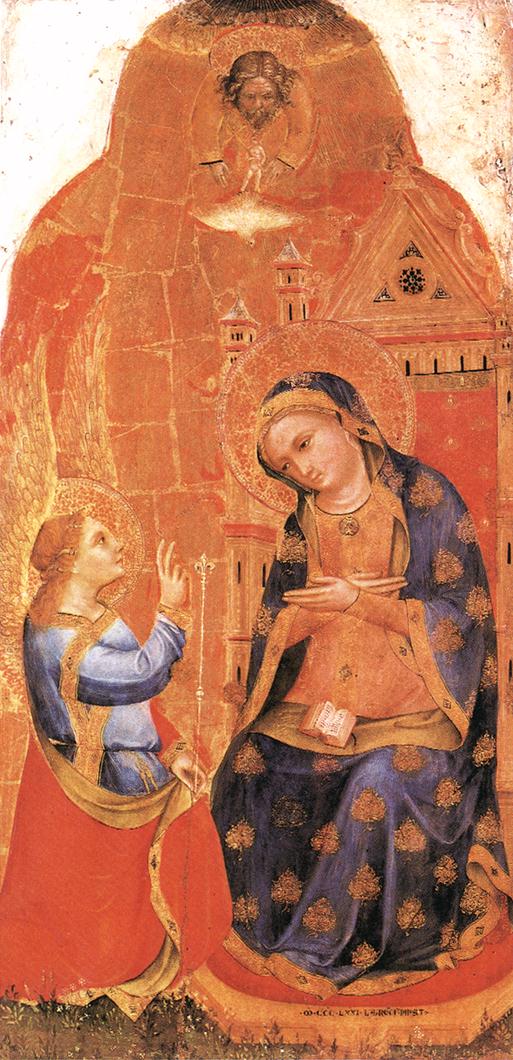
03 — ARTWORK
Annunciation
- MEDIUM
- Tempera on panel, 111 x 54 cm
- TYPE
- Religious
PALETTE
HOVER OR TAP A SWATCH FOR NAME, SHARE AND HEX. SAMPLED FROM THE IMAGE — INDICATIVE, NOT A PIGMENT ANALYSIS.
DEVELOPMENT BUILD — NOT FOR PUBLIC USE. CONTRIBUTE ON GITHUB.
CURRENT LOCATION · Gallerie dell'Accademia
03 — ARTWORK
PALETTE
HOVER OR TAP A SWATCH FOR NAME, SHARE AND HEX. SAMPLED FROM THE IMAGE — INDICATIVE, NOT A PIGMENT ANALYSIS.
COMMENTARY
UNDERLINED TERMS ARE DEFINED IN THE GLOSSARY.
This painting, signed and dated 1371, is the central panelTerm in painting for a support of wood, metal, or other rigid substance, as distinct from canvas. Until the adoption of canvas in the 15th century nearly all the movable paintings of Europe were executed on wood, and even up to the beginning of the 17th century it is probable that as much painting was done on the one support as on the other. Painters who worked on a small scale often used copper panels (Elsheimer is a leading example), and in the colonial art of South America copper and tin and even lead and zinc were used. On a larger scale, slate has occasionally been used as a support, notably by Rubens for his altarpiece for Sta Maria in Vallicella (the Chiesa Nuova) in Rome; the picture he originally painted was said to reflect the light unpleasantly and slate was used for the replacement to produce a more matt finish. For wood panels the Italian masters of the Renaissance preferred white poplar, while oak was the most common wood used in northern Europe. Many other types were used, however; analysis of the contents of art galleries has yielded a long list, including beech, cedar, chestnut, fir, larch, linden, mahogany, olive, and walnut. In the 20th century cedar, teak, and dark walnut are favourites, and modern painters have also used plywood, fibre-board, and other synthetic materials as supports. of a polyptychA painting (usually an altarpiece) made up of a number of panels fastened together. Some polyptychs were very elaborate, the panels being housed in richly carved and decorated wooden frameworks. Duccio's "Maestà" (1308-1311) is a well-known example.. Here we can see clearly how Lorenzo Veneziano, in his mature work moved increasingly towards the musical expressiveness of colour shot through with GothicGothic, which may well have originated with Alberti as a derogatory term and which certainly corresponds to Vasari's 'maniera tedesca' ('German style'), is properly the descriptive term for an artistic style which achieved its first full flowering in the Ile de France and the surrounding areas in the period between c. 1200 and c. 1270, and which then spread throughout northern Europe. It is characterized by the hitherto unprecedented integration of the arts of sculpture, painting, stained glass and architecture which is epitomized in the great cathedrals of Chartres, Amiens, and Reims or in the Sainte Chapelle in Paris. In all the arts the predominantly planar forms of the Romanesque are replaced by an emphasis on line. There is a transcendental quality, whether in the soaring forms of the pointed arches or in the new stress on the humanity of Christ, which similarly distinguishes it from the preceding Romanesque style. In thinking of Nicola (d. c. 1284) or Giovanni Pisano (d. after 1314) there is same danger of forgetting what had happened in French sculpture half a century or more earlier, and likewise it is hard to remember that the spectacular achievements of early Renaissance art are a singularly localized eddy in the continuing stream of late gothic European art. By northern European standards few Italian works of art can be called gothic without qualification, and the story of 13th and 14th century Italian architecture is as much one of resistance to the new style as of its reception, whether directly from France or through German or central European intermediaries. In sculpture and in painting, the Italian reluctance to distort the human figure, conditioned by a never wholly submerged awareness of the omnipresent antique heritage, gives a special quality to the work of even those artists such as Giovanni Pisano or Simone Martini who most closely approached a pure gothic style. Nevertheless, the vitalizing role of Northern gothic art throughout the early Renaissance and the period leading up to it should never be underestimated. The artistic, like the cultural and commercial, interaction was continuous and much of the Italian achievement is incomprehensible if seen in isolation. It is not merely at the level of direct exchanges between one artist and another, or the influence of one building; painting, manuscript or piece of sculpture upon another, that the effects are to be felt. The streaming quality of line which is so characteristic of Brunelleschi's early Renaissance architecture surely reflects a sensitivity to the gothic contribution which is entirely independent of, and lies much deeper than, the superficial particularities of form. The counterflow of influence and inspiration from South to North must likewise not be underrated. In particular, the contribution of Italian painters from Duccio and Simone Martini onwards is central to the evolution of the so-called International Gothic style developing in Burgundy, Bohemia and north Italy in the late 14th and early 15th centuries. accents. The iconographical scheme of this Annunciationthe term for the event described in the Gospel according to St. Luke, when the Angel Gabriel brings the Virgin Mary the news that she is to bear her son, Jesus Christ. The Annunciation was among the most widespread pictorial subjects of European art during the Middle Ages and the Renaissance. is radically different from that of the Lion polyptych. The figures of the Virgin and the herald angel inhabit the space of the picture in a much more substantial sense, are in much solider bodily contact with the grass and flowers. Indeed this is the first example in Venice of a naturalistic motif which was dear to the hearts of the refined artists working in the International GothicEuropean art was characteristic of a rare uniformity for 60-70 years around 1400. Art historians have still not been able to come to an agreement on an appropriate name for it. The term "art around 1400" suits the style best which, because of its prevalence is referred to as international Gothic. The terms court style, soft style, beautiful style, trecento rococo and lyrical style, etc. are also used in art literature. Elements of style which were generally wide-spread, did not belong to any particular country and were characteristic of art in courts. In the second half of the 14th century, models appeared in court art in the circle of French-Flemish artists serving at French courts and Bohemian regions of the Emperor's Court which determined works of art all over Europe at the end of the century. Human figures, landscapes and spaces in a realistic approach were accompanied by a peculiar quality of dreams, decorative dynamism and deep emotional charge. It is called as a soft style on the basis of lyrical expressions and drapes: it is more than a simple system of formal motifs, it denominates a kind of behaviour. Artists of the period were engaged in learning the human soul until their attention was attracted to the world (e.g. Donatallo, Masaccio and Jan van Eyck). style. This style too is exemplified in the elaborate linear cadences and the way the figures are presented in curving compositional rhythms.
@online{wga-r822df9d728fd40,
  author       = {Krén, Emil and Marx, Daniel},
  title        = {Annunciation by LORENZO VENEZIANO},
  organization = {{Web Gallery of Art}},
  date         = {2026-09-13},
  url          = {https://beta.wga.hu/artists/lorenzo-veneziano-r803e0eb21177b1/annunciation-r822df9d728fd40},
  urldate      = {2026-09-13},
  langid       = {english}
}
ACCESSED 2026-09-13. REPLACE THE AUTHOR FIELD WITH THE COMMENTARY AUTHOR WHERE ONE IS NAMED.


