03 — ARTWORK
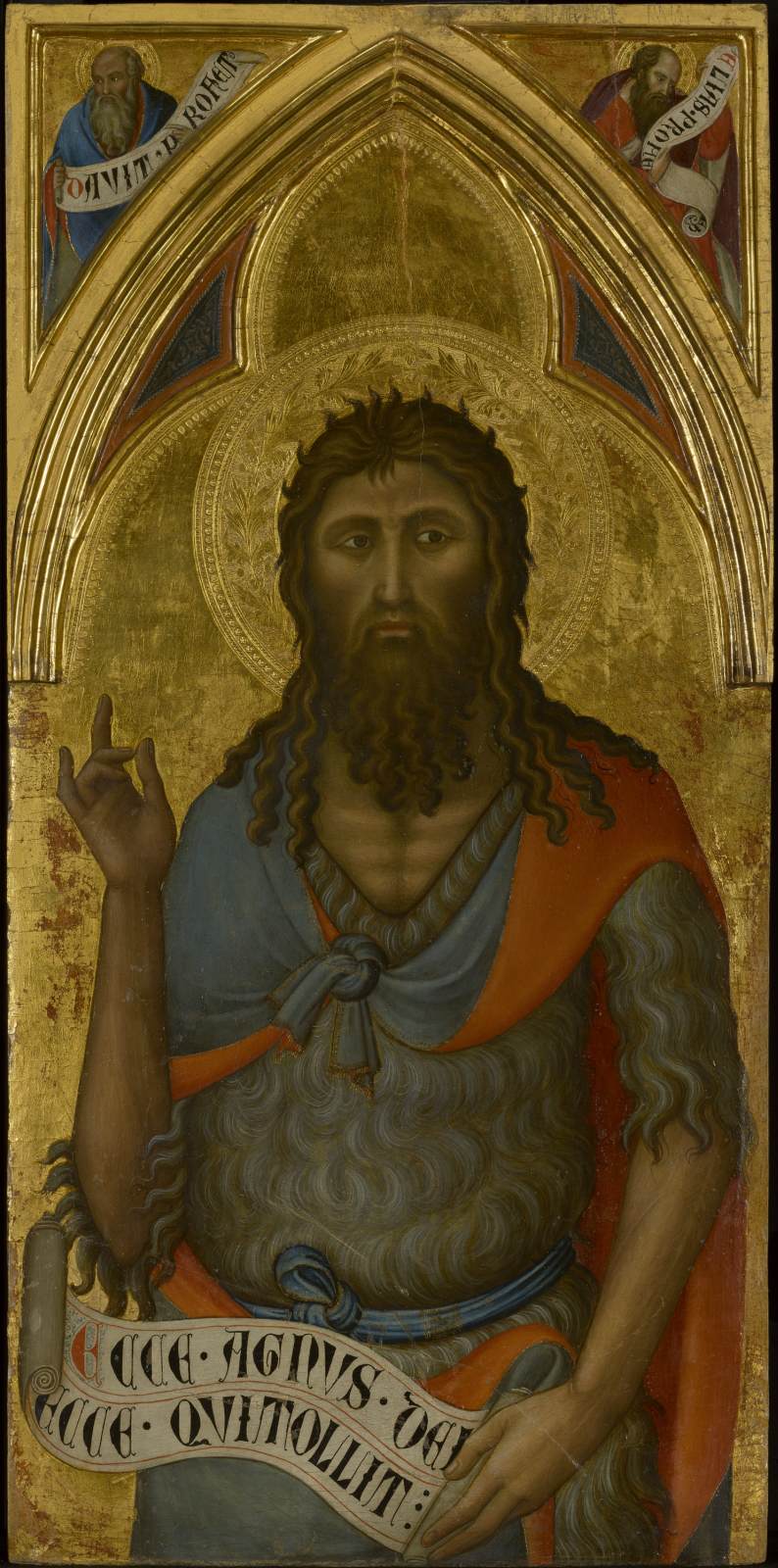
St John the Baptist
- MEDIUM
- Tempera and gold leaf on panel, 100 x 49 cm
- TYPE
- Religious
PALETTE
HOVER OR TAP A SWATCH FOR NAME, SHARE AND HEX. SAMPLED FROM THE IMAGE — INDICATIVE, NOT A PIGMENT ANALYSIS.
DEVELOPMENT BUILD — NOT FOR PUBLIC USE. CONTRIBUTE ON GITHUB.
03 — ARTWORK
PALETTE
HOVER OR TAP A SWATCH FOR NAME, SHARE AND HEX. SAMPLED FROM THE IMAGE — INDICATIVE, NOT A PIGMENT ANALYSIS.
COMMENTARY
UNDERLINED TERMS ARE DEFINED IN THE GLOSSARY.
St John the Baptist 1380s TemperaA method of painting in which the pigments are mixed with an emulsion of water and egg yolks or whole eggs (sometimes glue or milk). Tempera was widely used in Italian art in the 14th and 15th centuries, both for panel painting and fresco, then being replaced by oil paint. Tempera colors are bright and translucent, though because the paint dried very quickly there is little time to blend them, graduated tones being created by adding lighter or darker dots or lines of color to an area of dried paint. and gold leaf on panelTerm in painting for a support of wood, metal, or other rigid substance, as distinct from canvas. Until the adoption of canvas in the 15th century nearly all the movable paintings of Europe were executed on wood, and even up to the beginning of the 17th century it is probable that as much painting was done on the one support as on the other. Painters who worked on a small scale often used copper panels (Elsheimer is a leading example), and in the colonial art of South America copper and tin and even lead and zinc were used. On a larger scale, slate has occasionally been used as a support, notably by Rubens for his altarpiece for Sta Maria in Vallicella (the Chiesa Nuova) in Rome; the picture he originally painted was said to reflect the light unpleasantly and slate was used for the replacement to produce a more matt finish. For wood panels the Italian masters of the Renaissance preferred white poplar, while oak was the most common wood used in northern Europe. Many other types were used, however; analysis of the contents of art galleries has yielded a long list, including beech, cedar, chestnut, fir, larch, linden, mahogany, olive, and walnut. In the 20th century cedar, teak, and dark walnut are favourites, and modern painters have also used plywood, fibre-board, and other synthetic materials as supports., 100 x 49 cm J. Paul Getty Museum, Los Angeles
"Behold the Lamb of God, which taketh [away the sin of the world]". These words, inscribed in Latin on the scroll held by St John the Baptist, announce the coming of Christ. Standing against a gold background and enclosed in a GothicGothic, which may well have originated with Alberti as a derogatory term and which certainly corresponds to Vasari's 'maniera tedesca' ('German style'), is properly the descriptive term for an artistic style which achieved its first full flowering in the Ile de France and the surrounding areas in the period between c. 1200 and c. 1270, and which then spread throughout northern Europe. It is characterized by the hitherto unprecedented integration of the arts of sculpture, painting, stained glass and architecture which is epitomized in the great cathedrals of Chartres, Amiens, and Reims or in the Sainte Chapelle in Paris. In all the arts the predominantly planar forms of the Romanesque are replaced by an emphasis on line. There is a transcendental quality, whether in the soaring forms of the pointed arches or in the new stress on the humanity of Christ, which similarly distinguishes it from the preceding Romanesque style. In thinking of Nicola (d. c. 1284) or Giovanni Pisano (d. after 1314) there is same danger of forgetting what had happened in French sculpture half a century or more earlier, and likewise it is hard to remember that the spectacular achievements of early Renaissance art are a singularly localized eddy in the continuing stream of late gothic European art. By northern European standards few Italian works of art can be called gothic without qualification, and the story of 13th and 14th century Italian architecture is as much one of resistance to the new style as of its reception, whether directly from France or through German or central European intermediaries. In sculpture and in painting, the Italian reluctance to distort the human figure, conditioned by a never wholly submerged awareness of the omnipresent antique heritage, gives a special quality to the work of even those artists such as Giovanni Pisano or Simone Martini who most closely approached a pure gothic style. Nevertheless, the vitalizing role of Northern gothic art throughout the early Renaissance and the period leading up to it should never be underestimated. The artistic, like the cultural and commercial, interaction was continuous and much of the Italian achievement is incomprehensible if seen in isolation. It is not merely at the level of direct exchanges between one artist and another, or the influence of one building; painting, manuscript or piece of sculpture upon another, that the effects are to be felt. The streaming quality of line which is so characteristic of Brunelleschi's early Renaissance architecture surely reflects a sensitivity to the gothic contribution which is entirely independent of, and lies much deeper than, the superficial particularities of form. The counterflow of influence and inspiration from South to North must likewise not be underrated. In particular, the contribution of Italian painters from Duccio and Simone Martini onwards is central to the evolution of the so-called International Gothic style developing in Burgundy, Bohemia and north Italy in the late 14th and early 15th centuries. trefoil frame, St John wears a hair shirt that represents his ascetic life of prayer and penance. Using carefully curved brushstrokes, Luca di Tommè described the woolly texture of St John's shirt and the unruly curliness of his hair and beard. Patterned punch marks form the decorative halo around the saint's head. The Old Testament prophets Elijah and David, who predicted the coming of the Messiah, occupy the upper corners of the frame.
This panel was once part of an altarpieceA picture or sculpture that stands on or is set up behind an altar. The term reredos is used for an ornamental screen or partition, not directly attached to the altar table but affixed to the wall behind it. A diptych is an altarpiece consisting of two panels, a triptych one of three panels, and a polyptych one of four or more panels. From the 14th to 16th century, the altarpiece was one of the most important commissions in European art; it was through the altarpiece that some of the most decisive developments in painting and sculpture came about., possibly for a church in Siena.
@online{wga-rd573391fb1e016,
  author       = {Krén, Emil and Marx, Daniel},
  title        = {St John the Baptist by LUCA DI TOMMÈ},
  organization = {{Web Gallery of Art}},
  date         = {2026-09-09},
  url          = {https://beta.wga.hu/artists/luca-di-tomm-r00abbf9b68d623/st-john-the-baptist-rd573391fb1e016},
  urldate      = {2026-09-09},
  langid       = {english}
}
ACCESSED 2026-09-09. REPLACE THE AUTHOR FIELD WITH THE COMMENTARY AUTHOR WHERE ONE IS NAMED.


