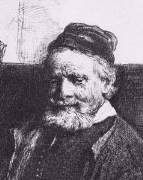
Dutch silver- and goldsmith. He was born in the German town of Emden, around 1615 he was living in Paris. In 1621 he settled permanently in Amsterdam, where he married two years later. He was a friend of Rembrandt, who etched his portraitGLOSSARYThe Roman portrait bust survived in the form of life-sized reliquaries of saints, but it was in 15th century Florence that the individual features and character of a contemporary sitter were accurately recorded by sculptors such as Donatello, Desiderio da Settignano, Mino da Fiesole and the Rossellino. A similar degree of realism occurs in 15th century tomb sculpture. The equestrian portrait, based on antique statues such as the Marcus Aurelius monument (Rome, Campidoglio), was revived in the 14th century. Two examples in fresco are Simone Martini's Guidoriccio (c. 1328; Siena, Palazzo Pubblico) and the posthumous portrait of Sir John Hawkwood (1436; Florence, Cathedral) by Uccello, which gives the illusion of a 3-dimensional statue seen from below. The Venetian Republic ordered imposing monuments from Donatello (1447; Gattarnelata, Padua) and Verrocchio (14799; Colleoni, Venice), whilst other statesmen ordered their own images to be erected in public places, directly relating themselves to the military heroes of ancient Rome. Another form of political portraiture derived from antiquity was the commemorative portrait medal designed by artists such as Pisanello. The carved or painted profile portrait became popular in the 1450s. The realism of the clear, flattened image, painted under the influence of Flemish examples by the Pollaiuolo brothers, Piero della Francesca and Botticelli, was superseded by the three-quarter and frontal portrait, psychologically more complex, such as Leonardo's enigmatic Mona Lisa (Paris, Louvre) with her momentary smile or Andrea del Sarto's arresting Portrait of a Man (London, National Gallery). The 16th century portrait became generalized, Lotto's Andrea Odoni (1527; Royal Collection) being an idealized concept of a collector rather than an individual. Group portraits, decorating whole rooms, include the narrative scenes of the Gonzaga court painted by Mantegna (completed 1474; Mantua, Palazzo Ducale) and the elaborate schemes commissioned by the Farnese family in Rome from Vasari (1546; Palazzo della Cancelleria) and Salviati (after 1553; Palazzo Farnese). Portraits were also incorporated into religious narratives, as in Ghirlandaio's fresco cycle painted for Giovanni Tornabuoni in S. Maria Novella, Florence (1486-90).. He has wrongly been thought to have been a pupil of the goldsmith Paulus van Vianen. He is best known for the choirGLOSSARYthe part of a church interior, usually raised and set apart from the rest of the church, reserved for the clergy to pray together, or for choral singing. Since Carolingian times, "choir" has been the word for the part of the central nave of the church extending over the crossing (the place where nave and transept intersect), and including the apse (a niche in the wall, roofed with a half dome) that often stands at the end of this area.-screen in the Nieuwe Kerk, Amsterdam (etched by Johannes the Younger), and his designs for zoomorphic ornaments. This 'auricular' style was briefly influential among a small group of artists in the Netherlands, Germany, and possibly Denmark.
His son Johannes Lutma the Younger also worked in precious metals and published a series of prints of ornamental designs by his father.