03 — ARTWORK
Interior view
- MEDIUM
- Photo
- TYPE
- Other
PALETTE
HOVER OR TAP A SWATCH FOR NAME, SHARE AND HEX. SAMPLED FROM THE IMAGE — INDICATIVE, NOT A PIGMENT ANALYSIS.
DEVELOPMENT BUILD — NOT FOR PUBLIC USE. CONTRIBUTE ON GITHUB.
03 — ARTWORK
PALETTE
HOVER OR TAP A SWATCH FOR NAME, SHARE AND HEX. SAMPLED FROM THE IMAGE — INDICATIVE, NOT A PIGMENT ANALYSIS.
COMMENTARY
UNDERLINED TERMS ARE DEFINED IN THE GLOSSARY.
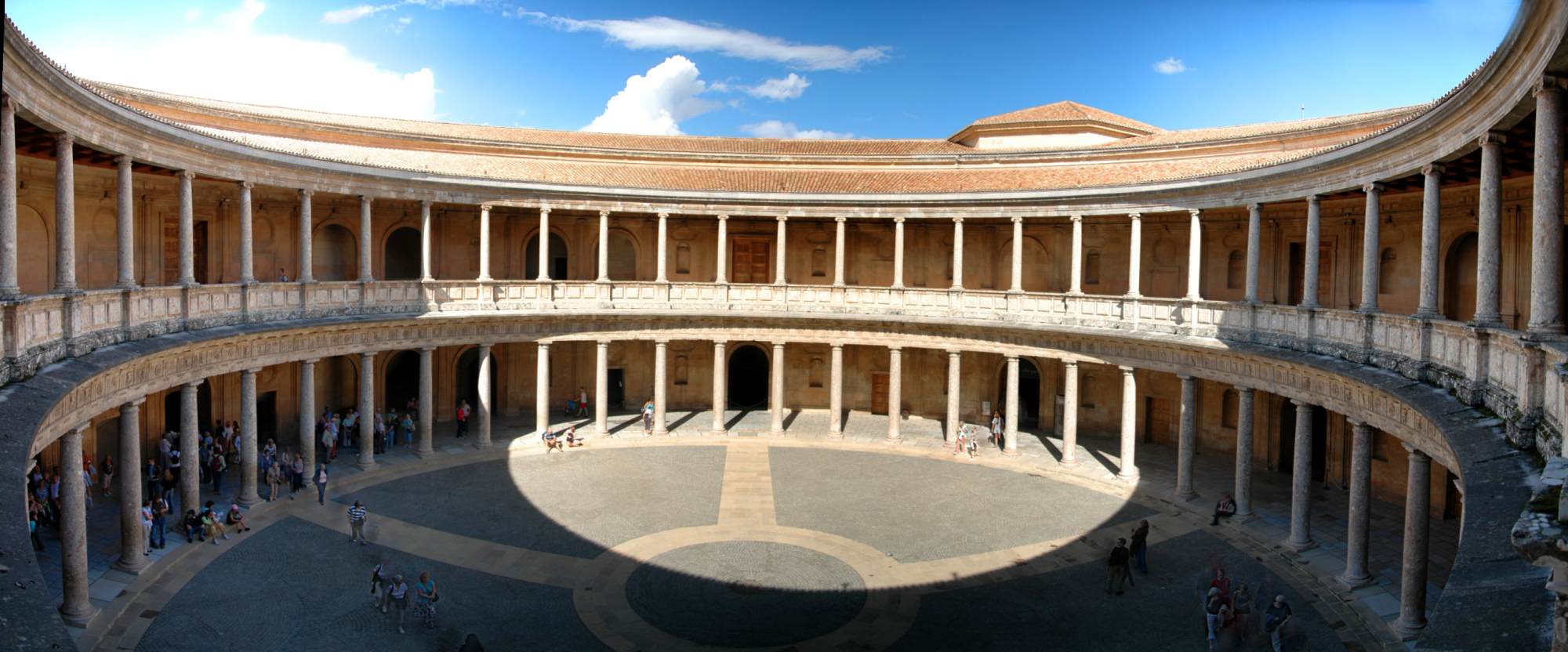
The circular patio has also two levels. The lower consists of a Doric colonnadeRow of columns with a straight entablature and no arches. of conglomerate stone, with an orthodox classicalRelating to the culture of ancient Greece and Rome (classical Antiquity). The classical world played a profoundly important role in the Renaissance, with Italian scholars, writers, and artists seeing their own period as the rebirth (the "renaissance") of classical values after the Middle Ages. The classical world was considered the golden age for the arts, literature, philosophy, and politics. Concepts of the classical, however, changed greatly from one period to the next. Roman literature provided the starting point in the 14th century, scholars patiently finding, editing and translating a wide range of texts. In the 15th century Greek literature, philosophy and art - together with the close study of the remains of Roman buildings and sculptures-expanded the concept of the classical and ensured it remained a vital source of ideas and inspiration. entablatureIn classical architecture, the part of a building between the capitals of the columns and the roof. It consists of the architrave, the frieze, and the cornice. formed of triglyphs and metopes. The upper floor is formed by a stylised Ionic colonnade whose entablature has no decoration. This organisation of the patio shows a deep knowledge of Roman architecture, and would be framed in pure Renaissance style but for its curved shape, which surprises the visitor entering from the main façades. The interior spaces and the staircases are also governed by the combination of square and circle. Similar aesthetic devices would be developed in the following decades under the classification of MannerismA movement in Italian art from about 1520 to 1600. Developing out of the Renaissance, Mannerism rejected Renaissance balance and harmony in favor of emotional intensity and ambiguity. In Mannerist painting, this was expressed mainly through severe distortions of perspective and scale; complex and crowded compositions; strong, sometimes harsh or discordant colors; and elongated figures in exaggerated poses. In architecture, there was a playful exaggeration of Renaissance forms (largely in scale and proportion) and the greater use of bizarre decoration. Mannerism gave way to the Baroque. Leading Mannerists include Pontormo, Bronzino, Parmigianino, El Greco and Tintoretto..
The photo shows the patio of the Palace of Charles V.
View the <a href="#" onClick="w=window.open ('/support/plans/m/machuca/2archite/palace1.html', 'newWin', 'scrollbars=yes,status=no,dependent=yes,screenX=0,screenY=0,width=400,height=600');w.opener=this;w.focus();return false">ground plan</a> of the Palace of Charles V, Granada.
@online{wga-re2c1b80873deb7,
  author       = {Krén, Emil and Marx, Daniel},
  title        = {Interior view by MACHUCA, Pedro},
  organization = {{Web Gallery of Art}},
  date         = {2026-09-12},
  url          = {https://beta.wga.hu/artists/machuca-pedro-r74223379bfb064/interior-view-re2c1b80873deb7},
  urldate      = {2026-09-12},
  langid       = {english}
}
ACCESSED 2026-09-12. REPLACE THE AUTHOR FIELD WITH THE COMMENTARY AUTHOR WHERE ONE IS NAMED.


