03 — ARTWORK
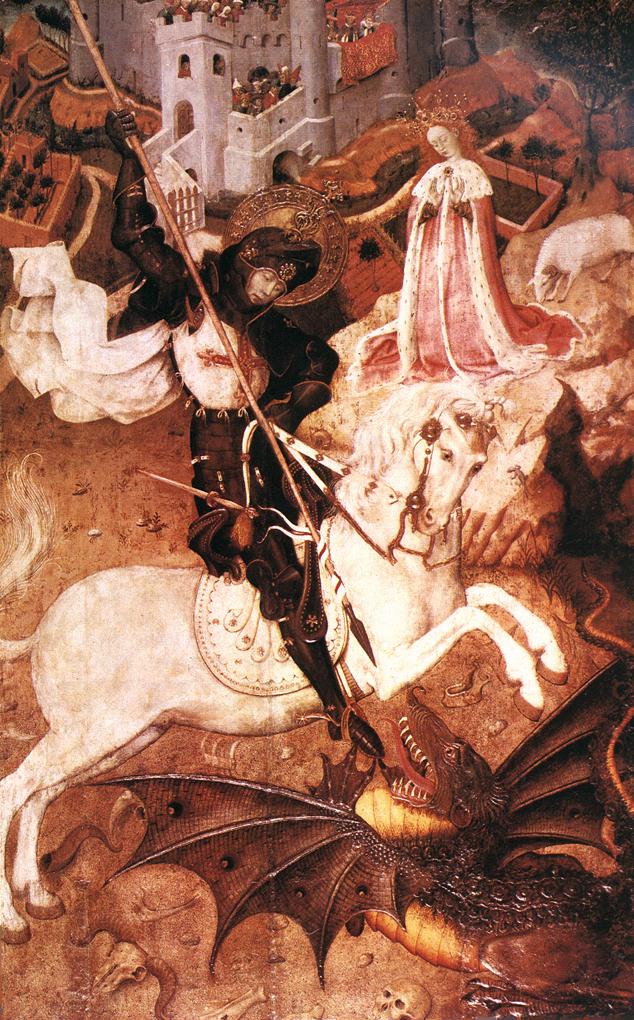
Saint George Killing the Dragon
- MEDIUM
- Tempera on wood, 141 x 96 cm
- TYPE
- Religious
PALETTE
HOVER OR TAP A SWATCH FOR NAME, SHARE AND HEX. SAMPLED FROM THE IMAGE — INDICATIVE, NOT A PIGMENT ANALYSIS.
DEVELOPMENT BUILD — NOT FOR PUBLIC USE. CONTRIBUTE ON GITHUB.
03 — ARTWORK
PALETTE
HOVER OR TAP A SWATCH FOR NAME, SHARE AND HEX. SAMPLED FROM THE IMAGE — INDICATIVE, NOT A PIGMENT ANALYSIS.
COMMENTARY
UNDERLINED TERMS ARE DEFINED IN THE GLOSSARY.
Martorell worked as a panelTerm in painting for a support of wood, metal, or other rigid substance, as distinct from canvas. Until the adoption of canvas in the 15th century nearly all the movable paintings of Europe were executed on wood, and even up to the beginning of the 17th century it is probable that as much painting was done on the one support as on the other. Painters who worked on a small scale often used copper panels (Elsheimer is a leading example), and in the colonial art of South America copper and tin and even lead and zinc were used. On a larger scale, slate has occasionally been used as a support, notably by Rubens for his altarpiece for Sta Maria in Vallicella (the Chiesa Nuova) in Rome; the picture he originally painted was said to reflect the light unpleasantly and slate was used for the replacement to produce a more matt finish. For wood panels the Italian masters of the Renaissance preferred white poplar, while oak was the most common wood used in northern Europe. Many other types were used, however; analysis of the contents of art galleries has yielded a long list, including beech, cedar, chestnut, fir, larch, linden, mahogany, olive, and walnut. In the 20th century cedar, teak, and dark walnut are favourites, and modern painters have also used plywood, fibre-board, and other synthetic materials as supports. painter and illuminator in the service of the city of Barcelona, but he was often given the task of preparing designs for stained glass windows and for sculptures as well. This composition was originally the centre panel of an altarpieceA picture or sculpture that stands on or is set up behind an altar. The term reredos is used for an ornamental screen or partition, not directly attached to the altar table but affixed to the wall behind it. A diptych is an altarpiece consisting of two panels, a triptych one of three panels, and a polyptych one of four or more panels. From the 14th to 16th century, the altarpiece was one of the most important commissions in European art; it was through the altarpiece that some of the most decisive developments in painting and sculpture came about.; the two volets, with panels representing the saint's martyrdomthe sufferings, torture and death inflicted on a person on account of his faith or convictions., are preserved in the Louvre in Paris.
In the arid, rocky surroundings of the foreground St George is on the point of killing the formidable dragon with a stab of his lance. Only the frightened eyes of the dragon and of the horse convey the dramatic qualities of the scene. Fright would be unworthy of the saint, his face is etherealized and serene. Bones of humans and animals are scattered on the ground. The princess is to be seen praying on the top of a rock. The wavy line of the dragon's tail is practically continued by the crevice in the rock. In the background, in the middle of civilized, idyllic scenery is the royal castle, surrounded by a moat, on whose emerald waters swans are swimming. The crowd gathered on the balconies and bastions of the building watch with excitement to see how the fight will end.
If we turn the pages of the present volume to compare the illustrations we cannot see any other landscape which is so extensive - except, perhaps, in Gentile da Fabriano's picture. True, in this painting too the ground is rising steeply, as it usually is in works created in the International Style. However, it no longer stretches behind the scene like a decorative tapestryAs historical climatologists have not shown that Renaissance Italian winters and springs were warmer than they are now, it is puzzling that Italy did not fabricate tapestries to decorate and draught-proof the stony rooms of its palaces until 1545, when Cosimo I set up a manufactory in Florence. To hardiness or stinginess (tapestry was by far the most expensive form of wall decoration) we owe the existence of such secular frescoed decorative schemes as the labours of the months in the castle at Trent (c. 1407), the Arthurian scenes of Pisanello and the courtly ones of Mantegna in the Ducal Palace of Mantua, the delicious calendar fantasies of Cossa and others in the Palazzo Schifanoia in Ferrara - and, doubtless, many others that await liberation from whitewash or later panelling. These are all in situations where northern patrons would have used tapestries. These were imported, chiefly from Flanders, into Italy. The influence of their hunting and ceremonial scenes in particular registered on Italian 'gothic' painting or illumination and stained glass, and in literature. But the Italians did not make them. The most famous of all 'Italian' tapestries, those for the Sistine Chapel designed by Raphael, were made in Brussels from the full-scale coloured patterns, or cartoons, now in the Victoria and Albert Museum, London. Nor is it clear whether imported tapestries were used habitually or simply to add grandeur to special occasions. Even when Cosimo's manufactory was in being, and working from designs by court artists of the calibre of Bronzino, Salviati and Allori, his own headquarters, the Palace of the Signoria (now the Palazzo Vecchio), was being decorated with frescoes. The subject is underexplored.: its continuity is broken. A valley separates the background from the foreground; the castle appears to be placed lower than the place where the fight occurs. (All the same, the king and his household look downwards - to preserve his dignity and to render his superiority indisputable.) And whereas of the two spaces depicted in the painting the one further back has preserved the homogeneous and decorative features of landscapes in the International Style, the scene in the foreground is represented in a highly expressive manner, with many gradations of values. The light is reflected in different ways by the grains of sand, by the smooth rock, by the dragon's skin and its belly, by the metal armour and by the precious stones.
The principal axis of the composition is determined by St George's long spear. In addition to this, a single imaginary vertical line connects the eyes of the dragon, of the horse and of the princess. In the form of a letter V the two straight lines flank the bastion of the royal castle.
@online{wga-r4338eef961d922,
  author       = {Krén, Emil and Marx, Daniel},
  title        = {Saint George Killing the Dragon by MARTORELL, Bernat},
  organization = {{Web Gallery of Art}},
  date         = {2026-09-09},
  url          = {https://beta.wga.hu/artists/martorell-bernat-rc9ebcdc2a047bf/saint-george-killing-the-dragon-r4338eef961d922},
  urldate      = {2026-09-09},
  langid       = {english}
}
ACCESSED 2026-09-09. REPLACE THE AUTHOR FIELD WITH THE COMMENTARY AUTHOR WHERE ONE IS NAMED.


The archive catalogues no further works by this artist.
TRY SAME COLLECTION →