03 — ARTWORK
Capital
MEDIEVAL SCULPTOR, French · 1200 →
- MEDIUM
- Stone
- TYPE
- Religious
PALETTE
HOVER OR TAP A SWATCH FOR NAME, SHARE AND HEX. SAMPLED FROM THE IMAGE — INDICATIVE, NOT A PIGMENT ANALYSIS.
DEVELOPMENT BUILD — NOT FOR PUBLIC USE. CONTRIBUTE ON GITHUB.
03 — ARTWORK
MEDIEVAL SCULPTOR, French · 1200 →
PALETTE
HOVER OR TAP A SWATCH FOR NAME, SHARE AND HEX. SAMPLED FROM THE IMAGE — INDICATIVE, NOT A PIGMENT ANALYSIS.
COMMENTARY
UNDERLINED TERMS ARE DEFINED IN THE GLOSSARY.
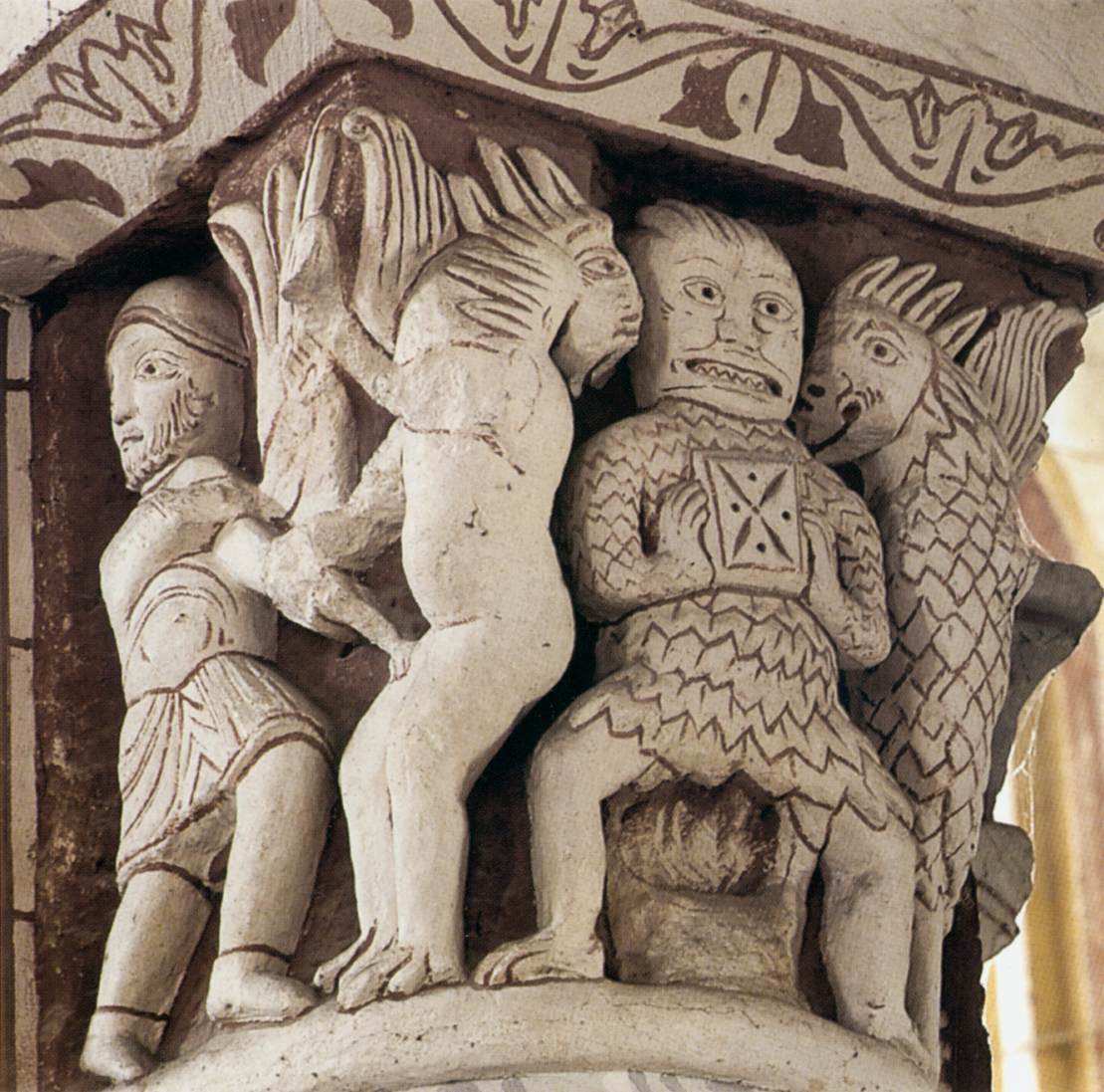
The sculptured capitals of the former collegiate church of Saint-Pierre in Chauvigny (Vienne) are some of the most expressive works of the French RomanesqueStyle of art and architecture prevailing throughout most of Europe in the 11th and 12th centuries, the first style to achieve such international currency. The dominant art of the Middle Ages was architecture, and 'Romanesque', like 'Gothic', is primarily an architectural term that has been extended to the other arts of the period. As the name suggests, it indicates a derivation from Roman art, and sometimes Romanesque is used to cover all the developments from Roman architecture in the period from the collapse of the Roman Empire until the flowering of the Gothic roughly AD 500-1200. More usually, however, it is applied to a distinctive style that emerged, almost simultaneously, in several countries - France, Germany, Italy, Spain - in the 11th century. It is characterized most obviously by a new massiveness of scale, reflecting the greater political and economic stability that followed a period when Christian civilization seemed in danger of extinction. Romanesque painting and sculpture are generally strongly stylized, with little of the naturalism and humanistic warmth of classical or later Gothic art. The forms of nature are freely translated into linear and sculptural designs which are sometimes majestically calm and severe and at others are agitated by a visionary excitement that can become almost delirious. Because of its expressionistic distortion of natural form, Romanesque art, as with other great non-naturalistic styles of the past, has had to wait for the revolution in sensibility brought about by the development of modern art in order to be widely appreciated. period. They rest on the columns between the choirthe part of a church interior, usually raised and set apart from the rest of the church, reserved for the clergy to pray together, or for choral singing. Since Carolingian times, "choir" has been the word for the part of the central nave of the church extending over the crossing (the place where nave and transept intersect), and including the apse (a niche in the wall, roofed with a half dome) that often stands at the end of this area. and ambulatorySemicircular or polygonal circulation space enclosing an apse or a straight-ended sanctuary., and present a bewildering universe of biblical and demonic figures and scenes in over thirty sculptures.
This capitalThe head or crowning feature of a column or pillar. Structurally, capitals broaden the area of a column so that it can more easily bear the weight of the arch or entablature it supports. depicts Devil displaying his altar with the symbol of death.
@online{wga-r1f836e3a3f78b4,
  author       = {Krén, Emil and Marx, Daniel},
  title        = {Capital by MEDIEVAL SCULPTOR, French},
  organization = {{Web Gallery of Art}},
  date         = {2026-09-09},
  url          = {https://beta.wga.hu/artists/medieval-sculptor-french-r563ac02828b921/capital-r1f836e3a3f78b4},
  urldate      = {2026-09-09},
  langid       = {english}
}
ACCESSED 2026-09-09. REPLACE THE AUTHOR FIELD WITH THE COMMENTARY AUTHOR WHERE ONE IS NAMED.


