03 — ARTWORK
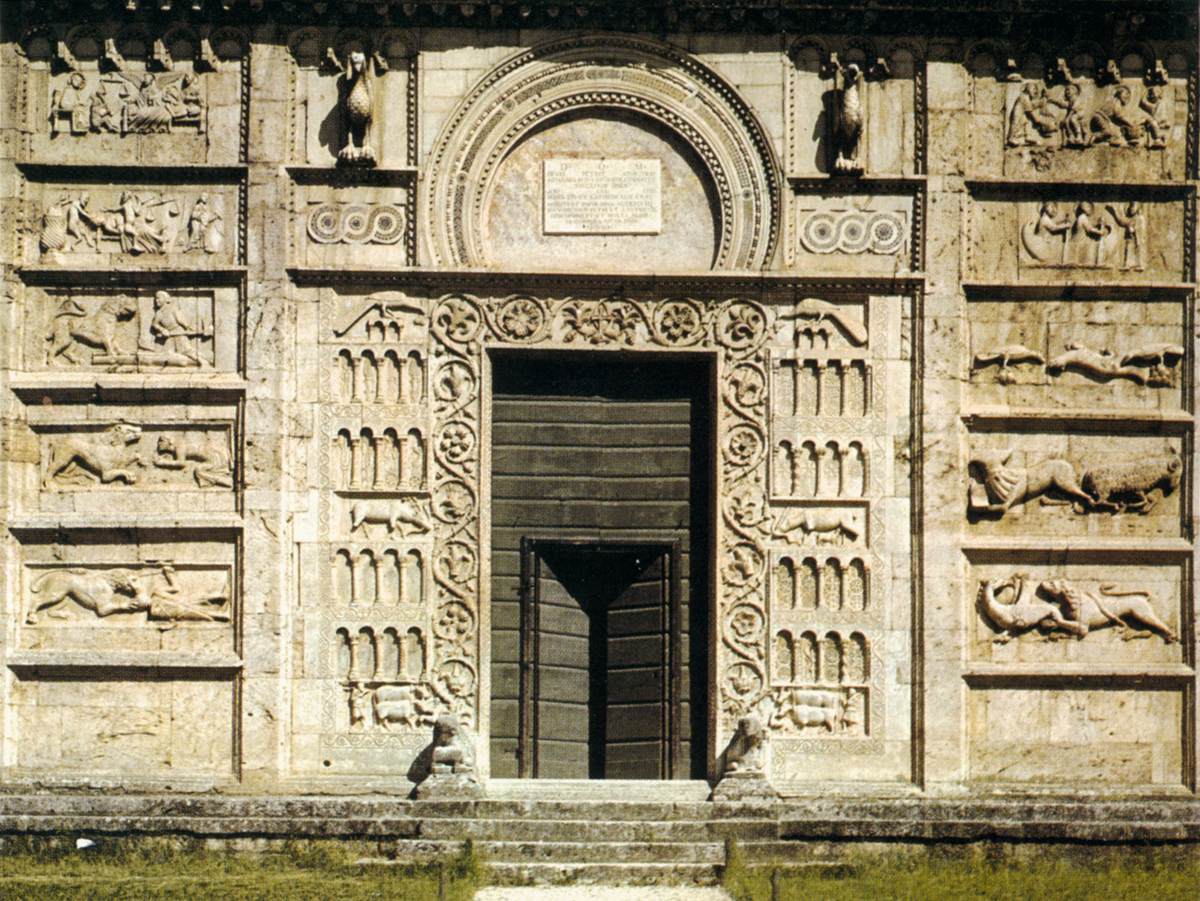
Façade (lower central part)
MEDIEVAL SCULPTOR, Italian · 1109 →
- MEDIUM
- Stone
- TYPE
- Religious
PALETTE
HOVER OR TAP A SWATCH FOR NAME, SHARE AND HEX. SAMPLED FROM THE IMAGE — INDICATIVE, NOT A PIGMENT ANALYSIS.
DEVELOPMENT BUILD — NOT FOR PUBLIC USE. CONTRIBUTE ON GITHUB.
03 — ARTWORK
MEDIEVAL SCULPTOR, Italian · 1109 →
PALETTE
HOVER OR TAP A SWATCH FOR NAME, SHARE AND HEX. SAMPLED FROM THE IMAGE — INDICATIVE, NOT A PIGMENT ANALYSIS.
COMMENTARY
UNDERLINED TERMS ARE DEFINED IN THE GLOSSARY.
The convent church of San Pietro di Spoleto was completed in the 13th century and altered in the BaroqueThe period in art history from about 1600 to about 1750. In this sense the term covers a wide range of styles and artists. In painting and sculpture there were three main forms of Baroque: (1) sumptuous display, a style associated with the Catholic Counter Reformation and the absolutist courts of Europe (Bernini, Rubens); (2) dramatic realism (Caravaggio); and (3) everyday realism, a development seen in particular in Holland (Rembrandt, Vermeer). In architecture, there was an emphasis on expressiveness and grandeur, achieved through scale, the dramatic use of light and shadow, and increasingly elaborate decoration. In a more limited sense the term Baroque often refers to the first of these categories. The development of the Baroque reflects the period's religious tensions (Catholic versus Protestant); a new and more expansive world view based on science and exploration; and the growth of absolutist monarchies. era. The central part of the decoration must date from the beginning of the 12th century, except for the upper reliefs, which are from the 13th century. It reveals Armenian and Syrian influences in its architectural structure. The six large horizontal reliefs, scenes of fierce combat in which beasts are paired with men, birds, or other animals, are Roman in handling and Oriental in inspiration. The others are directly inspired by the antiquethe classical age of Greece and Rome began with the Greek migrations of the 2nd millennium BC, and ended in the West in 476 AD with the deposition of the Roman emperor Romulus Augustulus (c. 475 AD); in the East it ended in 529 AD when the Platonic Academy was closed by Justinian (482 - 565 AD).. Religious iconographyThe systematic study and identification of the subject-matter and symbolism of art works, as opposed to their style; the set of symbolic forms on which a given work is based. Originally, the study and identification of classical portraits. Renaissance art drew heavily on two iconographical traditions: Christianity, and ancient Greek and Roman art, thought and literature. is absent from this sober and hieratic ensembleA combining of several media grouped together to form a composite art work. Chapels were among the most notable Renaissance ensembles, sometimes combining panel painting, fresco, sculpture, and architecture. - one of the most remarkable creations of Italian RomanesqueStyle of art and architecture prevailing throughout most of Europe in the 11th and 12th centuries, the first style to achieve such international currency. The dominant art of the Middle Ages was architecture, and 'Romanesque', like 'Gothic', is primarily an architectural term that has been extended to the other arts of the period. As the name suggests, it indicates a derivation from Roman art, and sometimes Romanesque is used to cover all the developments from Roman architecture in the period from the collapse of the Roman Empire until the flowering of the Gothic roughly AD 500-1200. More usually, however, it is applied to a distinctive style that emerged, almost simultaneously, in several countries - France, Germany, Italy, Spain - in the 11th century. It is characterized most obviously by a new massiveness of scale, reflecting the greater political and economic stability that followed a period when Christian civilization seemed in danger of extinction. Romanesque painting and sculpture are generally strongly stylized, with little of the naturalism and humanistic warmth of classical or later Gothic art. The forms of nature are freely translated into linear and sculptural designs which are sometimes majestically calm and severe and at others are agitated by a visionary excitement that can become almost delirious. Because of its expressionistic distortion of natural form, Romanesque art, as with other great non-naturalistic styles of the past, has had to wait for the revolution in sensibility brought about by the development of modern art in order to be widely appreciated. art.
@online{wga-r1e770ede919818,
  author       = {Krén, Emil and Marx, Daniel},
  title        = {Façade (lower central part) by MEDIEVAL SCULPTOR, Italian},
  organization = {{Web Gallery of Art}},
  date         = {2026-09-13},
  url          = {https://beta.wga.hu/artists/medieval-sculptor-italian-r836f824d496fb9/faade-lower-central-part-r1e770ede919818},
  urldate      = {2026-09-13},
  langid       = {english}
}
ACCESSED 2026-09-13. REPLACE THE AUTHOR FIELD WITH THE COMMENTARY AUTHOR WHERE ONE IS NAMED.


