03 — ARTWORK
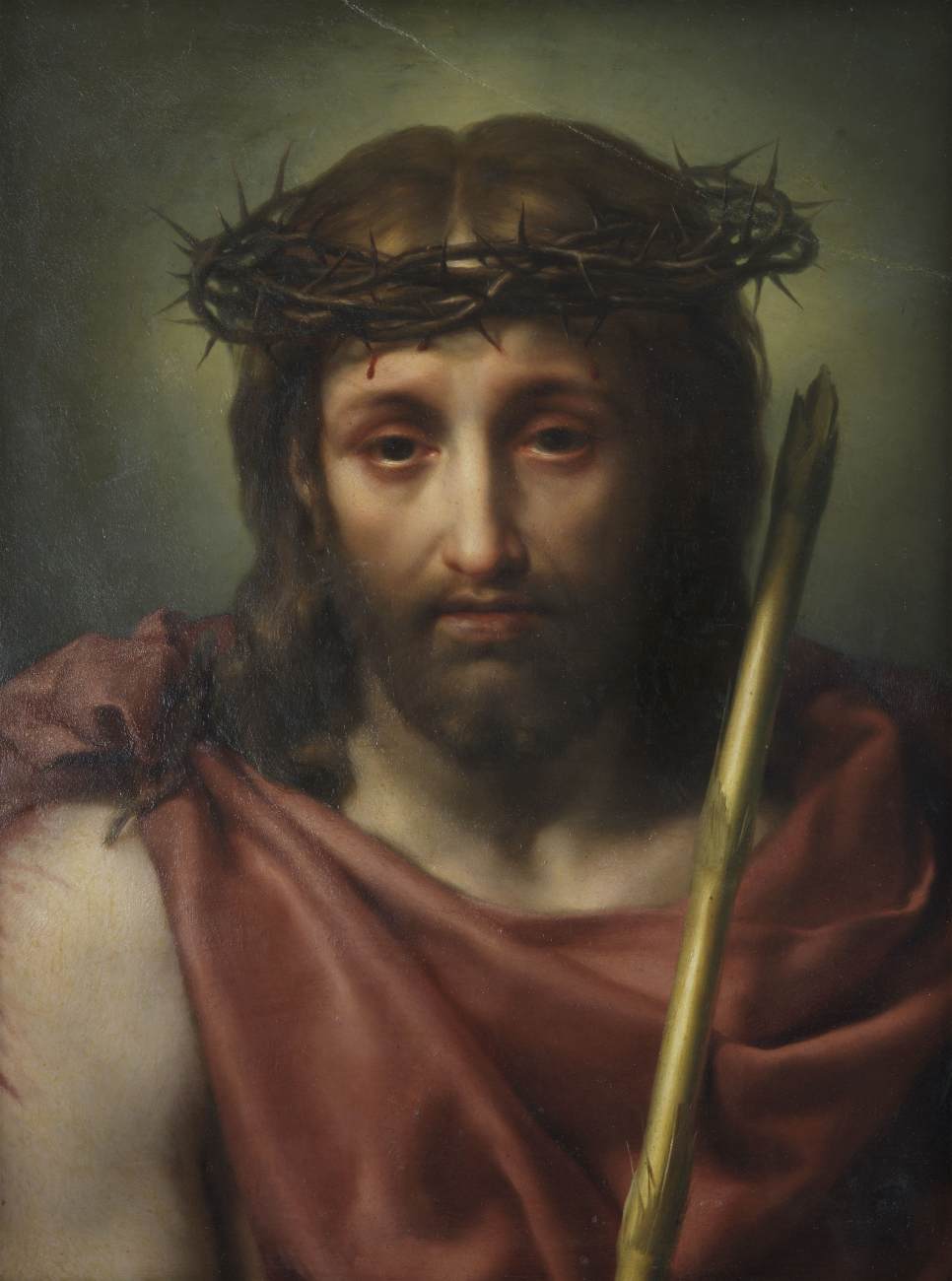
Ecce Homo
- MEDIUM
- Oil on walnut panel, 57 x 44 cm
- TYPE
- Religious
PALETTE
HOVER OR TAP A SWATCH FOR NAME, SHARE AND HEX. SAMPLED FROM THE IMAGE — INDICATIVE, NOT A PIGMENT ANALYSIS.
DEVELOPMENT BUILD — NOT FOR PUBLIC USE. CONTRIBUTE ON GITHUB.
03 — ARTWORK
PALETTE
HOVER OR TAP A SWATCH FOR NAME, SHARE AND HEX. SAMPLED FROM THE IMAGE — INDICATIVE, NOT A PIGMENT ANALYSIS.
COMMENTARY
UNDERLINED TERMS ARE DEFINED IN THE GLOSSARY.
"Ecce HomoThe words of Pontius Pilate in the Gospel of St. John (19, 5) when he presents Jesus to the crowds. Hence, in art, a depiction of Jesus, bound and flogged, wearing a crown of thorns and a scarlet robe." ("Behold the man") were the words Pilate addressed to the Jews after Christ had been whipped by the soldiers. In this work Mengs depicts Jesus shortly after having been proclaimed the King of the Jews, wearing the crown of thorns and carrying a rod as a sceptre. The blood that is beginning to dry on his right shoulder reveals the marks of the whiplashes, although the artist has preferred to focus on the psychological condition of Christ rather than on the dramatic quality of the scene. Tired and humiliated, the figure shows signs of deep suffering. Conceived as a pious image, this picture invites pity by presenting Jesus Christ as a human being, despite the characteristic idealised distance of NeoclassicismA style in European art and architecture from the mid 18th century until the end of the 19th century. Based as it was on the use of ancient Greek and Roman models and motifs, its development was greatly influenced by the excavations at Pompeii and Herculaneum, and by the theories of the German art historian Johann Joachim Winckelmann (1717-1768). Intellectually and politically it was closely linked to the Enlightenment's rejection of the aristocratic frivolity of Rococo, the style of the Ancien Régime. Among Neoclassicism's leading figures were the French painter Jacques-Louis David (1744-1825), the German painter Anton Raffael Mengs (1728-1729), and the Italian sculptor Antonio Canova (1757-1822)..
Mengs probably depicted this Ecce Homo towards the end of his life, after returning to Rome in 1777.
@online{wga-rf0ea4bbe918203,
  author       = {Krén, Emil and Marx, Daniel},
  title        = {Ecce Homo by MENGS, Anton Raphael},
  organization = {{Web Gallery of Art}},
  date         = {2026-09-13},
  url          = {https://beta.wga.hu/artists/mengs-anton-raphael-r957e6afc10d29d/ecce-homo-rf0ea4bbe918203},
  urldate      = {2026-09-13},
  langid       = {english}
}
ACCESSED 2026-09-13. REPLACE THE AUTHOR FIELD WITH THE COMMENTARY AUTHOR WHERE ONE IS NAMED.


