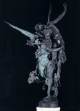
Marius-Jean-Antonin (Antoine) Mercié was a French sculptor. He entered the École des Beaux Arts, Paris, and studied under Alexandre Falguière and François Jouffroy, and in 1868 gained the Grand Prix de RomeGLOSSARYA scholarship, founded concurrently with the French Academy in Rome (1666), that enabled prize-winning students at the Academie Royale de Peinture et de Sculpture in Paris to spend a period (usually 4 years) in Rome at the state's expense. Prizes for architecture began to be awarded regularly in 1723, and prizes for engravers and musicians were added in the 19th century. The prizes were meant to perpetuate the academic tradition and during the 18th and 19th centuries winning the award was the traditional stepping stone to the highest honours for painters and sculptors. Many distinguished artists (as well as many nonentities) were Prix de Rome winners, notably David, Fragonard, and Ingres among painters and Clodion, Girardon, and Houdon among sculptors. The prizes are still awarded and the system has been adopted by other countries. at the age of 23. His first great popular successes were the bronzeGLOSSARYAn alloy of copper (usually about 90 per cent) and tin, often also containing small amounts of other metals such as lead or zinc. Since antiquity it has been the metal most commonly used in cast sculpture because of its strength, durability, and the fact that it is easily workable - both hot and cold - by a variety of processes. It is easier to cast than copper because it has a lower melting-point, and its great tensile strength makes possible the protrusion of unsupported parts - an advantage over marble sculpture. The colour of bronze is affected by the proportion of tin or other metals present, varying from silverish to a rich, coppery red, and its surface beauty can be enhanced when it acquires a patina. David and Gloria Victis, which was shown and received the Medal of Honour of the Paris SalonGLOSSARYIn the French language of the 18th and 19th centuries it designated an actual exhibition space, as well as the academic art exhibitions staged in the Salon d'Apollon of the Louvre since 1667. From 1737, the exhibitions took place biennially and, after the French Revolution, annually in the Salon Carré of the Louvre in Paris. Towards the end of the 19th century the official Salon jury was dissolved in order to make way for a committee of state-approved artists, i.e. former Salon members, who created the highly influential Société des Artistes Français.. The bronze was subsequently placed in the Square Montholon.
Mercié was appointed Professor of Drawing and Sculpture at the École des Beaux Arts, and was elected a member of the Académie Française in 1891, after being awarded the biennial prize of the Institute of 800 in 1887. He was subsequently elected to grand officier of the Légion d'Honneur, and in 1913 became the president of the Société des Artistes Français.
Tombstones, busts, architectural models, and statues of horses and riders for clients all over the world completed the oeuvreGLOSSARYThe complete body of works created by an artist. of this artist.