03 — ARTWORK
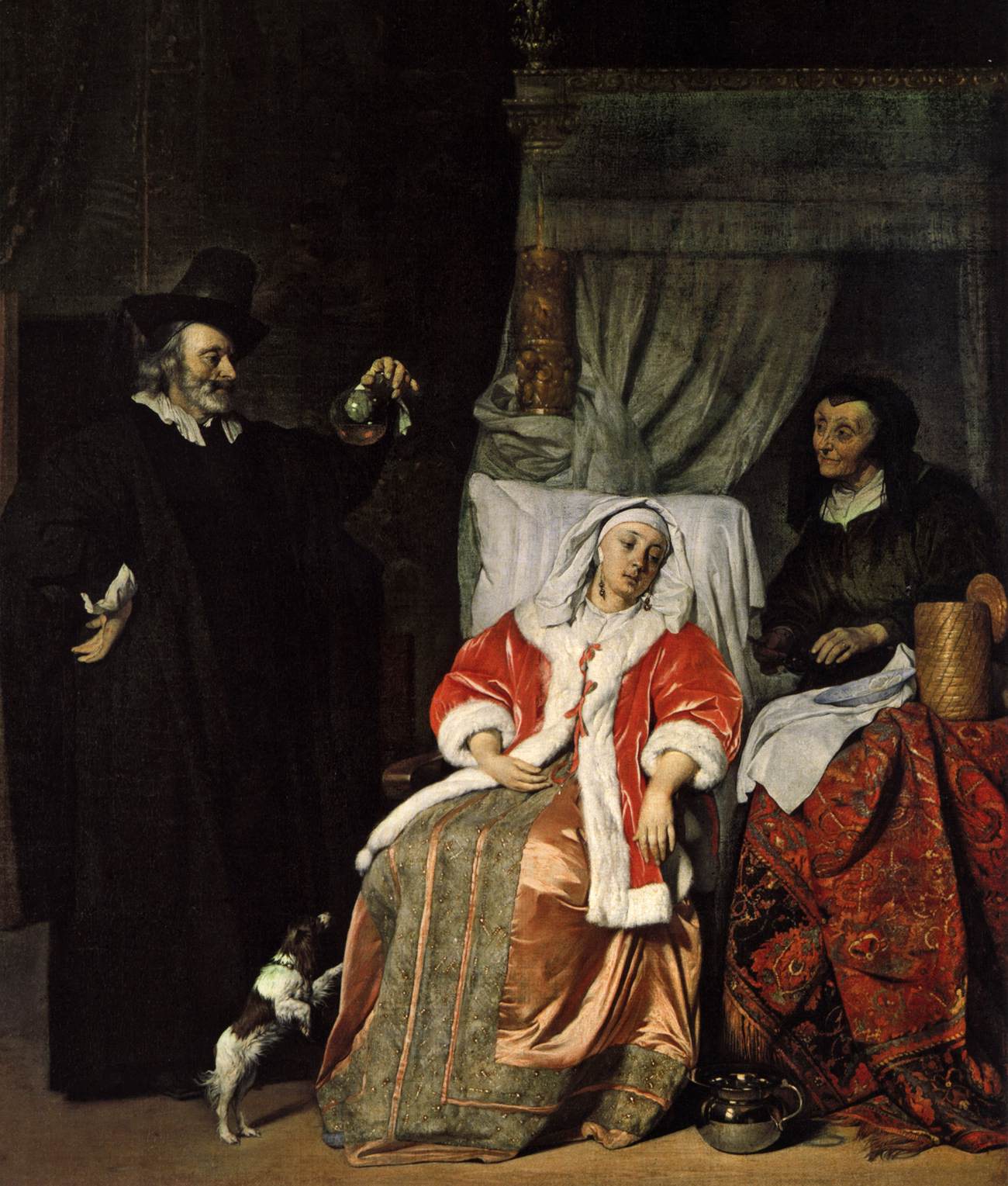
Visit of the Physician
- MEDIUM
- Oil on canvas, 61 x 48 cm
- TYPE
- Genre
PALETTE
HOVER OR TAP A SWATCH FOR NAME, SHARE AND HEX. SAMPLED FROM THE IMAGE — INDICATIVE, NOT A PIGMENT ANALYSIS.
DEVELOPMENT BUILD — NOT FOR PUBLIC USE. CONTRIBUTE ON GITHUB.
03 — ARTWORK
PALETTE
HOVER OR TAP A SWATCH FOR NAME, SHARE AND HEX. SAMPLED FROM THE IMAGE — INDICATIVE, NOT A PIGMENT ANALYSIS.
COMMENTARY
UNDERLINED TERMS ARE DEFINED IN THE GLOSSARY.
Visit of the Physician 1660-67 Oil on canvasA woven cloth used as a support for painting. The best-quality canvas is made of linen; other materials used are cotton, hemp, and jute. It is now so familiar a material that the word 'canvas' has become almost a synonym for an oil painting, but it was not until around 1500 that it began to rival the wooden panel (which was more expensive and took longer to prepare) as the standard support for movable paintings (the transition came later in Northern Europe than in Italy). Canvas is not suitable for painting on until it has been coated with a ground, which isolates the fabric from the paint; otherwise it will absorb too much paint, only very rough effects will be obtainable, and parts of the fabric may be rotted by the pigments. It must also be made taut on a stretcher or by some other means., 61 x 48 cm The Hermitage, St. Petersburg
A doctor visiting a sick young woman was a widely used subject bin Dutch genre paintingThe depiction of scenes from everyday life. Elements of everyday life had long had a role in religious works; pictures in which such elements were the subject of a painting developed in the 16th century with such artists as Pieter Bruegel. Then Carracci and Caravaggio developed genre painting in Italy, but it was in Holland in the 17th century that it became an independent form with its own major achievements, Vermeer being one of its finest exponents.. The tendency to allegoryA work of art which represents some abstract quality or idea, either by means of a single figure (personification) or by grouping objects and figures together. Renaissance allegories make frequent allusions both to both Greek and Roman legends and literature, and also to the wealth of Christian allegorical stories and symbols developed during the Middle Ages. is displayed here, too: the illness is often lovesickness and its undesirable consequences, for which medicine is powerless. The doctor here is more of a disciplinarian than a healer.
@online{wga-rdcbae35f150ead,
  author       = {Krén, Emil and Marx, Daniel},
  title        = {Visit of the Physician by METSU, Gabriel},
  organization = {{Web Gallery of Art}},
  date         = {2026-09-09},
  url          = {https://beta.wga.hu/artists/metsu-gabriel-r653508d5e3d9bf/visit-of-the-physician-rdcbae35f150ead},
  urldate      = {2026-09-09},
  langid       = {english}
}
ACCESSED 2026-09-09. REPLACE THE AUTHOR FIELD WITH THE COMMENTARY AUTHOR WHERE ONE IS NAMED.


