03 — ARTWORK
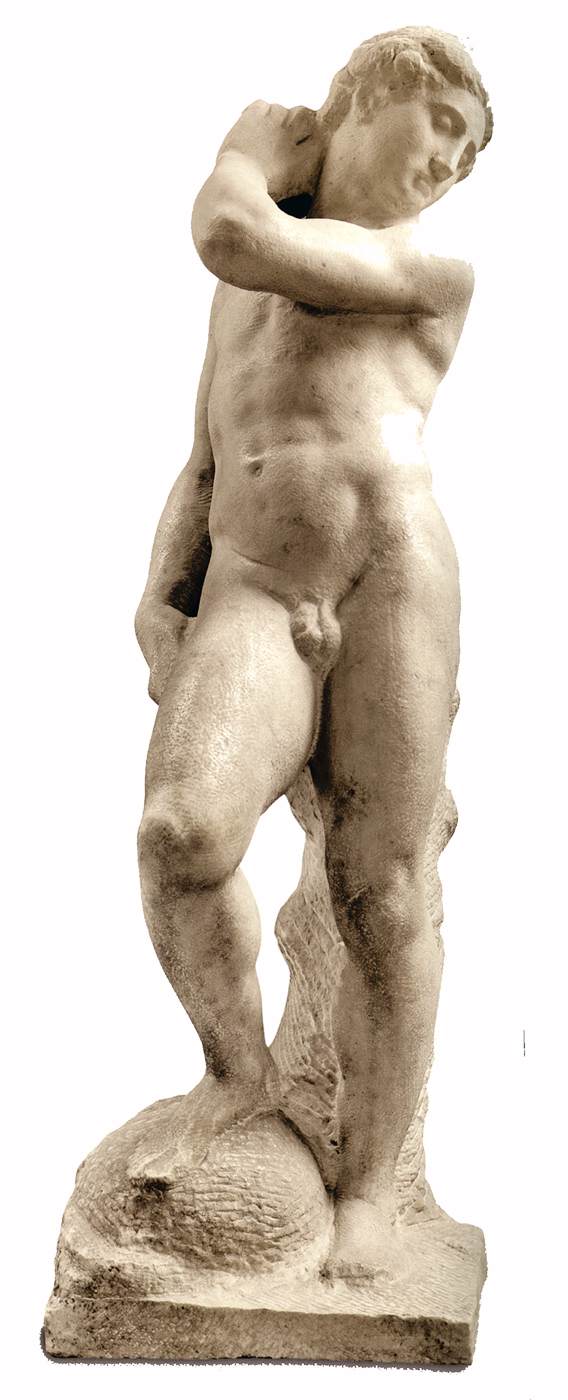
David/Apollo
MICHELANGELO Buonarroti · 1530 →
- MEDIUM
- Marble, height 146 cm
- TYPE
- Mythological
PALETTE
HOVER OR TAP A SWATCH FOR NAME, SHARE AND HEX. SAMPLED FROM THE IMAGE — INDICATIVE, NOT A PIGMENT ANALYSIS.
DEVELOPMENT BUILD — NOT FOR PUBLIC USE. CONTRIBUTE ON GITHUB.
03 — ARTWORK
MICHELANGELO Buonarroti · 1530 →
PALETTE
HOVER OR TAP A SWATCH FOR NAME, SHARE AND HEX. SAMPLED FROM THE IMAGE — INDICATIVE, NOT A PIGMENT ANALYSIS.
COMMENTARY
UNDERLINED TERMS ARE DEFINED IN THE GLOSSARY.
The statue was commissioned by the hated Papal Governor of Florence, Baccio Valori. Michelangelo used a pragmatic and political approach. This figure has had its double name for a long time, since it was not certain whether it was a representation of the Old Testament hero David or the Greek God of Art, Apollo. But in the round rock under the youth's foot one can probably recognize the head of Goliath: so once again Michelangelo has created a David.
There is a blatant difference between this figure and the one which in 1504 rose to the position of the most powerful symbol of the Republic. In the place of Strength and Wrath, we have Melancholy, almost Regret. The victorious hero no longer celebrates his triumphWith growing interest from the early 14th century in the history of ancient Rome came a fascination with the city's conquests, the wars by which they were won - and the ceremony which marked their success: the victor's triumph. The knowledge that the privilege of being commemorated by one of these enormous and costly processions of warriors, loot and prisoners was given sparingly, only to the sole commander of a major victory over a foreign army of whom at least 5000 were slain, added to the glamour of the triumph. Its centrepiece was the chariot of the victor himself. Dante gave one to Beatrice in Purgatorio XXIX: 'Rome upon Africanus ne'er conferred / Nor on Augustus's self, a car so brave'. But it was tentatively with the relief carvings on the Triumphal Arch (1452-66) at Castelnuovo in Naples commemorating Alfonso the Magnanimous, and finally with Mantegna's superb Triumph of Caesar cartoons (Hampton Court), that the visual reconstruction of a Roman triumph became complete. Meanwhile, in an age which did not like the idea of large numbers of victory-flushed soldiers parading through its streets, the military triumph became sublimated, as it were, into a number of less controversial forms. This was largely under the influence of Petrarch's 'Trionfi' - poems describing the processions commemorating the triumphs of love, chastity, death; fame, time and eternity. Disseminated soon after his death, they soon appeared in illuminated manuscripts, and the triumph scene became a popular one for woodcuts, decorated marriage chests and other paintings, most beautifully of all on the backs of Piero della Francesca's portraits of Federigo da Montefeltro and his wife, Battista Sforza. Other 'triumphs' were invented: of the seasons, of virtues and of the arts. Nor was the theme allowed to be simply a profane one. Just before his death Savonarola published his 'Triumph of the Cross', in which the reader was invited to imagine 'a four-wheeled chariot on which is seated Christ as Conqueror.' Before it go the apostles, patriarchs and prophets, beside it the army of martyrs, behind it, after 'a countless number of virgins, of both sexes', come the prisoners: 'the serried ranks of the enemies of the Church of Christ.' This aspect of the theme was magnificently realized in Titian's great woodcut 'The Triumph of the Faith'.; the blood that has been shed seems to have shown him the meaning of his actions and of its consequences. Michelangelo could not have admonished Baccio Valori in a deeper, more meaningful and yet more respectful way. <P> <TABLE ALIGN=LEFT CELLPADDING=5 BORDER=1 WIDTH=320 BGCOLOR="#99CCCC"> <TR VALIGN=MIDDLE><TD><IMG SRC="/support/gif/listen.gif" BORDER=0 VALIGN=MIDDLE> Suggested listening (streaming mp3, 11 minutes):<BR><A HREF="#" onClick="w=window.open ('/music1/17_cent/kuhnau_goliath.html', 'newWin', 'scrollbars=yes,status=no,dependent=yes,screenX=0,screenY=0,width=350,height=350');w.opener=this;w.focus();return true"><B>Johann Kuhnau: The Fight between David and Goliath (No. 1 of the 6 Stories from the Bible illustrated in music)</B></A> </TD></TR></TABLE>
@online{wga-r1a0228cd5ee681,
  author       = {Krén, Emil and Marx, Daniel},
  title        = {David/Apollo by MICHELANGELO Buonarroti},
  organization = {{Web Gallery of Art}},
  date         = {2026-09-13},
  url          = {https://beta.wga.hu/artists/michelangelo-buonarroti-r3de9890382970b/davidapollo-r1a0228cd5ee681},
  urldate      = {2026-09-13},
  langid       = {english}
}
ACCESSED 2026-09-13. REPLACE THE AUTHOR FIELD WITH THE COMMENTARY AUTHOR WHERE ONE IS NAMED.


