03 — ARTWORK
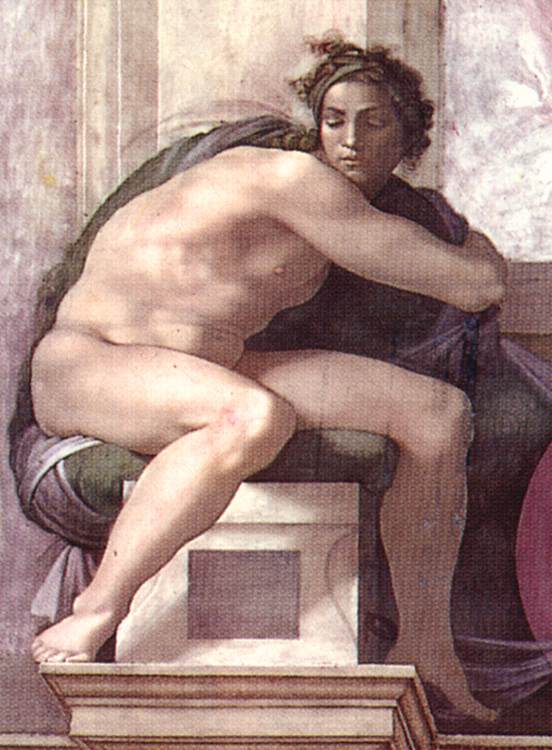
Ignudo
MICHELANGELO Buonarroti · 1511 →
- MEDIUM
- Fresco
- TYPE
- Religious
PALETTE
HOVER OR TAP A SWATCH FOR NAME, SHARE AND HEX. SAMPLED FROM THE IMAGE — INDICATIVE, NOT A PIGMENT ANALYSIS.
DEVELOPMENT BUILD — NOT FOR PUBLIC USE. CONTRIBUTE ON GITHUB.
03 — ARTWORK
MICHELANGELO Buonarroti · 1511 →
PALETTE
HOVER OR TAP A SWATCH FOR NAME, SHARE AND HEX. SAMPLED FROM THE IMAGE — INDICATIVE, NOT A PIGMENT ANALYSIS.
COMMENTARY
UNDERLINED TERMS ARE DEFINED IN THE GLOSSARY.
The picture shows the Ignudo at the lower right corner of the Separation of Light from Darkness (above the Libyan Sibyl).
The poses of the four ignudiMale nudes. The best-known are the male nudes on Michelangelo's Sistine ceiling. are very different from each other, without any attempt being made to obtain an effect of symmetry. Thus, the one above Jeremiah at the left, with a classicalRelating to the culture of ancient Greece and Rome (classical Antiquity). The classical world played a profoundly important role in the Renaissance, with Italian scholars, writers, and artists seeing their own period as the rebirth (the "renaissance") of classical values after the Middle Ages. The classical world was considered the golden age for the arts, literature, philosophy, and politics. Concepts of the classical, however, changed greatly from one period to the next. Roman literature provided the starting point in the 14th century, scholars patiently finding, editing and translating a wide range of texts. In the 15th century Greek literature, philosophy and art - together with the close study of the remains of Roman buildings and sculptures-expanded the concept of the classical and ensured it remained a vital source of ideas and inspiration. profile and a meditative attitude, contrasts sharply with the ungainly movement of the one the right, who laden with foliage and acorns, is throwing himself forward, his face in the shadow. On the opposite side, the two figures bend toward the centre, but with their torsos heads rotating in opposite directions with clearly distinct movements, splendidly rendered thanks to the artist's skilled use of perspectiveThe method of representing three-dimensional objects on a flat surface. Perspective gives a picture a sense of depth. The most important form of perspective in the Renaissance was linear perspective (first formulated by the architect Brunelleschi in the early 15th century), in which the real or suggested lines of objects converge on a vanishing point on the horizon, often in the middle of the composition (centralized perspective). The first artist to make a systematic use of linear perspective was Masaccio, and its principles were set out by the architect Alberti in a book published in 1436. The use of linear perspective had a profound effect on the development of Western art and remained unchallenged until the 20th century..
@online{wga-re5fb37ec8c8f10,
  author       = {Krén, Emil and Marx, Daniel},
  title        = {Ignudo by MICHELANGELO Buonarroti},
  organization = {{Web Gallery of Art}},
  date         = {2026-09-09},
  url          = {https://beta.wga.hu/artists/michelangelo-buonarroti-r3de9890382970b/ignudo-re5fb37ec8c8f10},
  urldate      = {2026-09-09},
  langid       = {english}
}
ACCESSED 2026-09-09. REPLACE THE AUTHOR FIELD WITH THE COMMENTARY AUTHOR WHERE ONE IS NAMED.


