03 — ARTWORK
Isaiah
MICHELANGELO Buonarroti · 1509 →
- MEDIUM
- Fresco, 365 x 380 cm
- TYPE
- Religious
PALETTE
HOVER OR TAP A SWATCH FOR NAME, SHARE AND HEX. SAMPLED FROM THE IMAGE — INDICATIVE, NOT A PIGMENT ANALYSIS.
DEVELOPMENT BUILD — NOT FOR PUBLIC USE. CONTRIBUTE ON GITHUB.
CURRENT LOCATION · Cappella Sistina (Vatican City)
03 — ARTWORK
MICHELANGELO Buonarroti · 1509 →
PALETTE
HOVER OR TAP A SWATCH FOR NAME, SHARE AND HEX. SAMPLED FROM THE IMAGE — INDICATIVE, NOT A PIGMENT ANALYSIS.
COMMENTARY
UNDERLINED TERMS ARE DEFINED IN THE GLOSSARY.
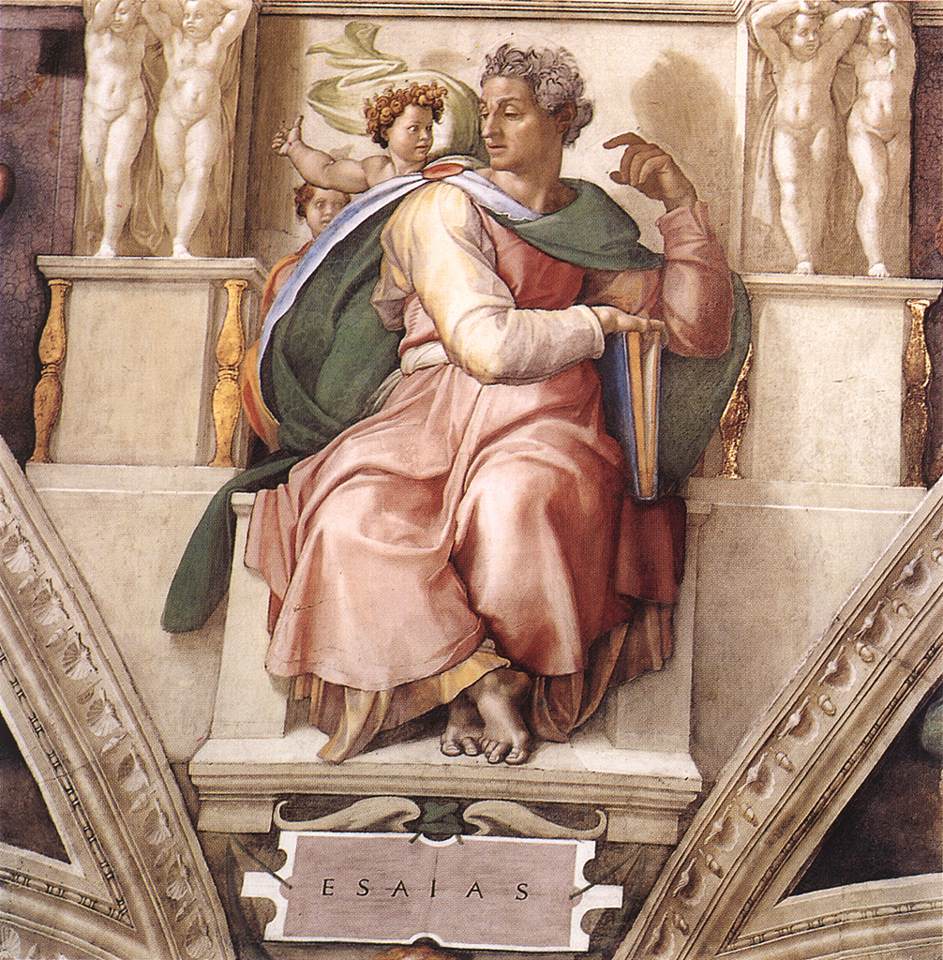
Isaiah is altogether different in character. He seems to listen intently. His forehead may express bewilderment yet he is clad in the green cloak of hope. As he listens, his genii point excitedly into the distance whence the great voice addresses him. The powerful left arm is raised as though commanding stillness or silence. He has an intimation of the mystery of the Son. The naked feet are crossed, and the entire figure expresses veneration, expectation and readiness. What is the significance of the half closed book which he marks with his inserted finger? Surely, that the book is nothing; books may fail, the voice alone is infallible. Note how the contours of the figure form a circle from which only the head and one hand emerge. The left arm, the left hand, and the head together with the genii, describe an oval superimposed on the circle. The face, with lips parted in expectation, bears an expression of rapt attention; the hair of indeterminate colour, and the vigorously drawn neck emerging from light-toned draperies in blue, green and red, symbolizing faith, hope and charity, indicate that this exalted figure is poised on the threshold of two worlds; it is intent of hearing, it is rapt in attention, and its geniusin classical Rome, a person's invisible tutelary god. In art from the classical period onwards, the low-ranking god was depicted as a winged, usually childish figure. points at Noah's offering.
Above the Prophet to the left we see an ignudo with a jubilant expression. He and the blithe youth to the right above Daniel prove that Michelangelo - was he not the contemporary of the happy saint Filippo Neri? - was not altogether a stranger to joy.
@online{wga-r170cf3787ba4fd,
  author       = {Krén, Emil and Marx, Daniel},
  title        = {Isaiah by MICHELANGELO Buonarroti},
  organization = {{Web Gallery of Art}},
  date         = {2026-09-13},
  url          = {https://beta.wga.hu/artists/michelangelo-buonarroti-r3de9890382970b/isaiah-r170cf3787ba4fd},
  urldate      = {2026-09-13},
  langid       = {english}
}
ACCESSED 2026-09-13. REPLACE THE AUTHOR FIELD WITH THE COMMENTARY AUTHOR WHERE ONE IS NAMED.


