03 — ARTWORK
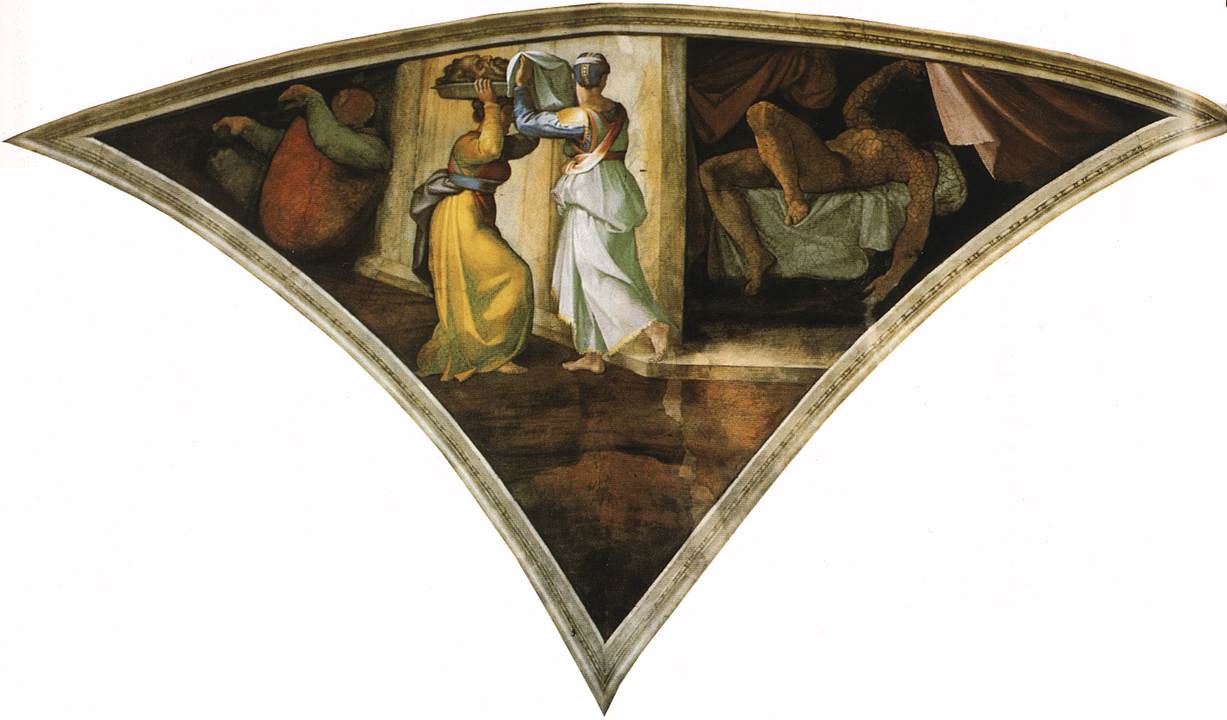
Judith and Holofernes
MICHELANGELO Buonarroti · 1509 →
- MEDIUM
- Fresco, 570 x 970 cm
- TYPE
- Religious
PALETTE
HOVER OR TAP A SWATCH FOR NAME, SHARE AND HEX. SAMPLED FROM THE IMAGE — INDICATIVE, NOT A PIGMENT ANALYSIS.
DEVELOPMENT BUILD — NOT FOR PUBLIC USE. CONTRIBUTE ON GITHUB.
CURRENT LOCATION · Cappella Sistina (Vatican City)
03 — ARTWORK
MICHELANGELO Buonarroti · 1509 →
PALETTE
HOVER OR TAP A SWATCH FOR NAME, SHARE AND HEX. SAMPLED FROM THE IMAGE — INDICATIVE, NOT A PIGMENT ANALYSIS.
COMMENTARY
UNDERLINED TERMS ARE DEFINED IN THE GLOSSARY.
Judith was a patriotic heroine and a symbol of the Jews' struggle against their ancient oppressors in the near east. She is usually shown holding the head of Holofernes, the Assyrian general, whom she has decapitated with a sword.
The Assyrian army had laid siege to the Jewish city of Bethulia. When the inhabitants were on the point of capitulating, Judith, a rich and beautiful widow, devised a scheme to save them. She adorned herself 'so as to catch the eye of any man who might see her' (O.T. ApocryphaJewish or Christian additions to the Old and New Testaments excluded from the Canon. 10:5), and set off with her maid into the Assyrian lines. By the pretence of having deserted her people she gained access to the enemy commander, Holofernes, and proposed to him a fictitious scheme for overcoming the Jews. After she had been several days in the camp Holofernes became enamoured of her and planned a banquet to which she was invited. When it was over and they were alone together he had meant to seduce her, but he was by then overcome with liquor. This was Judith's opportunity. She quickly seized his sword and with two swift blows severed his head. Her maid was ready with a sack into which they put the head. They then made their way through the camp and back to Bethulia before the deed was discovered. The news threw the Assyrians into disarray and they fled, pursued by the Israelites.
Several episodes from the story have been illustrated in art, but the commonest shows Judith with the severed head of Holofernes, usually accompanied by her maid who holds a sack. The image of Judith occurs first in the Middle Ages as an example of virtue overcoming vice and may be associated with the allegorical figure of Humility. She is also widely depicted in the Renaissance when her victory sometimes forms a companion-picture to Samson and Delilah and Aristotle and Campaspe. Such juxtaposing suggests that the theme was then regarded as an allegoryA work of art which represents some abstract quality or idea, either by means of a single figure (personification) or by grouping objects and figures together. Renaissance allegories make frequent allusions both to both Greek and Roman legends and literature, and also to the wealth of Christian allegorical stories and symbols developed during the Middle Ages. of man's misfortunes at the hands of a scheming woman. In Counter-ReformationTerm in ecclesiastical history referring to the reform of the entire Church which was widely believed to be necessary as early as the late Middle Ages. Reform programs, such as those passed by the Councils of Constance (1414-1418) and Basle (1431-1437 and 1448) or the 5th Lateran Council (1512-1517), did not achieve any lasting results. Not until the Protestant Reformation were the Pope and Roman Curia forced to take specific action against abuse of position, declining moral standards, the selling of indulgences and excesses in the worship of saints and relics. With the Laetere Jerusalem (1544) bull. Pope Paul III (1534-1549) was responsible for the convocation of the Council of Trent which, in three separate sessions between 15445 and 1563, started the process of inner reform in the Church. art the theme surprisingly prefigures the Visitation, as an expression of victory over sin.
Michelangelo's representation of the scene is interpreted either as the symbol of the liberty or the personificationan imaginary person conceived as representing a thing, concept or deity. of the triumphant Church.
Suggested listening (streaming mp3, 17 minutes):
Alessandro Scarlatti: La Giuditta, oratorio, Part I (excerpts)
@online{wga-r9d28607c7cf13b,
  author       = {Krén, Emil and Marx, Daniel},
  title        = {Judith and Holofernes by MICHELANGELO Buonarroti},
  organization = {{Web Gallery of Art}},
  date         = {2026-09-13},
  url          = {https://beta.wga.hu/artists/michelangelo-buonarroti-r3de9890382970b/judith-and-holofernes-r9d28607c7cf13b},
  urldate      = {2026-09-13},
  langid       = {english}
}
ACCESSED 2026-09-13. REPLACE THE AUTHOR FIELD WITH THE COMMENTARY AUTHOR WHERE ONE IS NAMED.


