03 — ARTWORK
Codex Aureus
- MEDIUM
- Manuscript (Clm. 14000), 420 x 330 mm
- TYPE
- Religious
PALETTE
HOVER OR TAP A SWATCH FOR NAME, SHARE AND HEX. SAMPLED FROM THE IMAGE — INDICATIVE, NOT A PIGMENT ANALYSIS.
DEVELOPMENT BUILD — NOT FOR PUBLIC USE. CONTRIBUTE ON GITHUB.
03 — ARTWORK
PALETTE
HOVER OR TAP A SWATCH FOR NAME, SHARE AND HEX. SAMPLED FROM THE IMAGE — INDICATIVE, NOT A PIGMENT ANALYSIS.
COMMENTARY
UNDERLINED TERMS ARE DEFINED IN THE GLOSSARY.
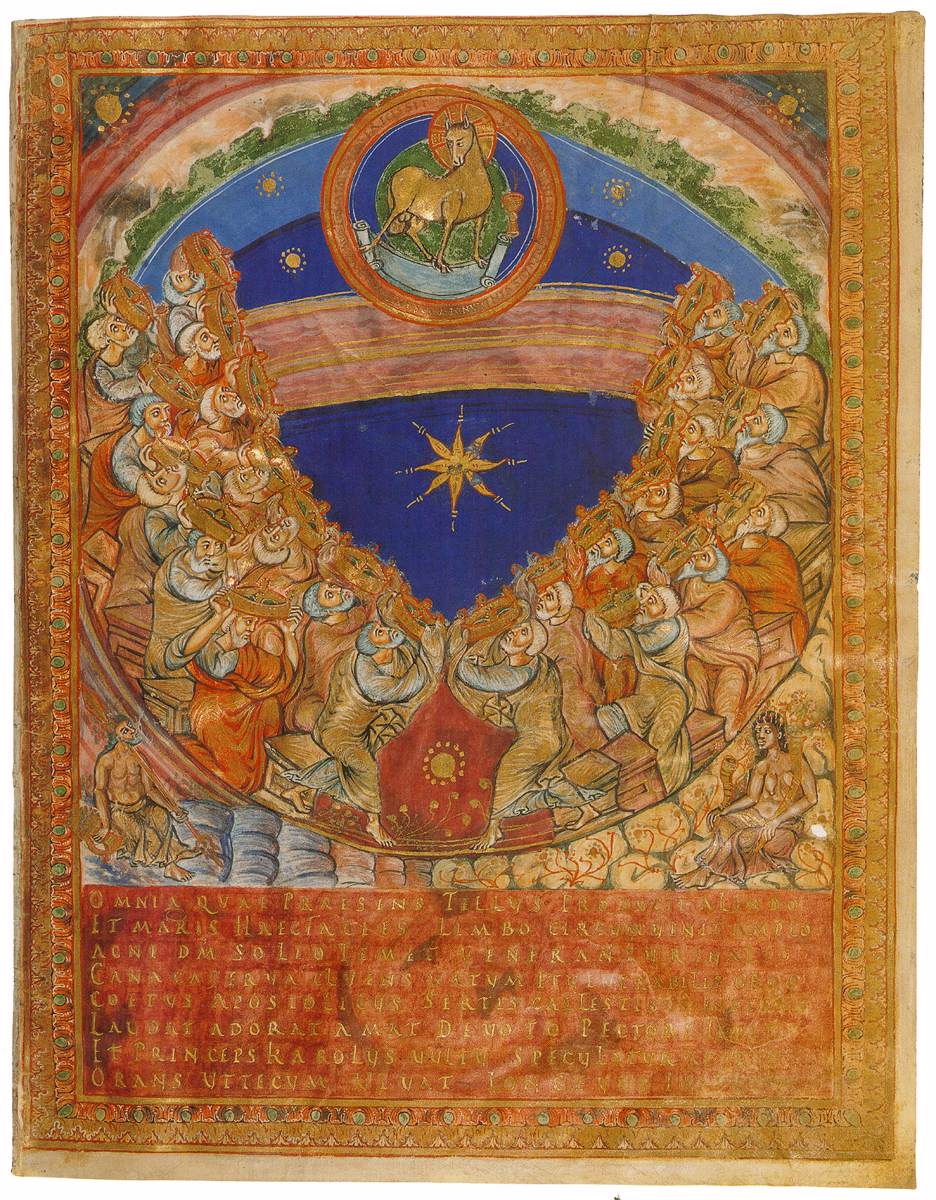
Codex Aureus 870 Manuscriptcollective term for books or other documents written by hand; in a specific sense, the hand-written medieval book, the Codex manuscriptus, often ornamented with decorative borders, illuminated initials and miniatures, and containing works of ancient philosophy or scholarly, ecclesiastical, and literary texts. Manuscripts were usually produced on commission. At first the scriptoria (writing rooms) of monasteries transcribed the contents of famous manuscripts and made copies. Monastic communities in the Netherlands and northern Germany began producing manuscripts around 1383/84. Flanders, Burgundy, and in particular Paris became major centres for the mass production of breviaries (prayer books) and Books of Hours. (Clm. 14000), 420 x 330 mm Bayerische Staatsbibliothek, Munich
This codex containing the four gospels (126 folios) was commissioned by Emperor Charles the Bald (reigned 840-877). The Latin text is illustrated by 7 full-page miniatures, 12 canon tables and 10 decorative pages. The codex is considered the masterpieceA term now loosely applied to the finest work by a particular artist or to any work of art of acknowledged greatness or of preeminence in its field. Originally it meant the piece of work by which a craftsman, having finished his training, gained the rank of'master' in his guild. of the second court school of Charles the Bald. The first scriptoriumthe room in a medieval monastery where manuscripts were copied; also applied to particular schools of writing or painting that can be identified by stylistic characteristics. was that at the monasterythe complex of buildings used by a community of monks. Among the main elements of the complex are the church, cloister, chapter house (used by the governing body), refectory (dining room) and dormitory (sleeping quarters). of St. Martin in Tours, which in 855 was destroyed by the Norsemen. Its place in the annals of book illuminationThe decoration of manuscripts, one of the most common forms of medieval art; because of its monastic origins, usually of religious texts. The practice extends from heavy decorations of initial letters and inter-woven margin patterns (as in Celtic examples) to miniatures and and full-page illuminations, often of a formal and grandiose kind (as in Byzantine manuscripts). Rich colors are a common feature, in particular a luxirious use of gold and silver. Illuminations survived the advent of printing for some time and only died out with the rise of printed illustration in the 16 century. was taken by Charles the Bald's second court school, the abbey of St. Denis in Paris.
Folio 5v shows the enthroned sovereign in costly regalia beneath a colourful baldachinOriginally a textile canopy supported on poles and carried dignitaries and relics. Later, an architectural canopy of stone or wood set over a high altar or bishop's throne.. He is attended by his men-in-arms bearing swords, lances and shields, and flanked by female personifications of parts of his empire, Francia and Gotica. The following page (folio 6r) shows a visionary representation of Charles with the twenty-four elders in adoration of the Lamb.
The manuscript was preserved in the Abbey of St. Emmeram, Regensburg by the eleventh century, where it was much admired and was copied for Henry II.
@online{wga-rb77d5bc15fa3c1,
  author       = {Krén, Emil and Marx, Daniel},
  title        = {Codex Aureus by MINIATURIST, French},
  organization = {{Web Gallery of Art}},
  date         = {2026-09-13},
  url          = {https://beta.wga.hu/artists/miniaturist-french-rd9e7509475278b/codex-aureus-rb77d5bc15fa3c1},
  urldate      = {2026-09-13},
  langid       = {english}
}
ACCESSED 2026-09-13. REPLACE THE AUTHOR FIELD WITH THE COMMENTARY AUTHOR WHERE ONE IS NAMED.


