03 — ARTWORK
Vita Annos
- MEDIUM
- Manuscript (Hs. 945)
- TYPE
- Historical
PALETTE
HOVER OR TAP A SWATCH FOR NAME, SHARE AND HEX. SAMPLED FROM THE IMAGE — INDICATIVE, NOT A PIGMENT ANALYSIS.
DEVELOPMENT BUILD — NOT FOR PUBLIC USE. CONTRIBUTE ON GITHUB.
03 — ARTWORK
PALETTE
HOVER OR TAP A SWATCH FOR NAME, SHARE AND HEX. SAMPLED FROM THE IMAGE — INDICATIVE, NOT A PIGMENT ANALYSIS.
COMMENTARY
UNDERLINED TERMS ARE DEFINED IN THE GLOSSARY.
VitaAn account of someone's life and work, a biography. The best-known writer of the vita in the Renaissance was Vasari, whose Le vite de'più eccellenti pittori, scultori e architetti italiani ("Lives of the Most Eminent Italian Painters, Sculptors and Architects"), published in 1550 and 1568, provides detailed accounts of the lives of many of the most important artists of the Renaissance. Annos c. 1183 Manuscriptcollective term for books or other documents written by hand; in a specific sense, the hand-written medieval book, the Codex manuscriptus, often ornamented with decorative borders, illuminated initials and miniatures, and containing works of ancient philosophy or scholarly, ecclesiastical, and literary texts. Manuscripts were usually produced on commission. At first the scriptoria (writing rooms) of monasteries transcribed the contents of famous manuscripts and made copies. Monastic communities in the Netherlands and northern Germany began producing manuscripts around 1383/84. Flanders, Burgundy, and in particular Paris became major centres for the mass production of breviaries (prayer books) and Books of Hours. (Hs. 945) Hessische Landes- und Hochschulbibliothek, Darmstadt
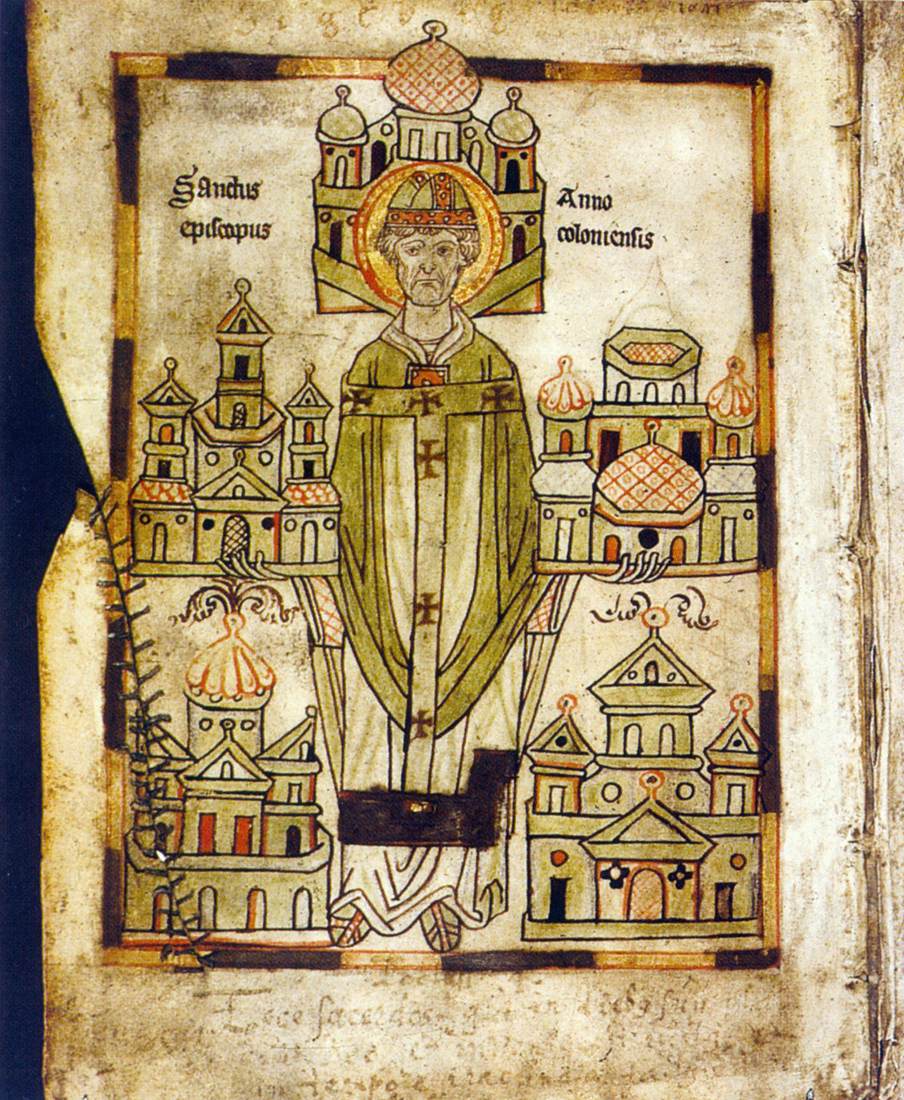
Folio 1v of the manuscript shows Anno II, Archbishop of Cologne with the five churches he founded. Archbishop Anno II (1056-1175) was the last great bishop-cum-builder in Cologne. His death saw the end of first great building boom in the city which gave Cologne its high rank amongst the principal European cities during the RomanesqueStyle of art and architecture prevailing throughout most of Europe in the 11th and 12th centuries, the first style to achieve such international currency. The dominant art of the Middle Ages was architecture, and 'Romanesque', like 'Gothic', is primarily an architectural term that has been extended to the other arts of the period. As the name suggests, it indicates a derivation from Roman art, and sometimes Romanesque is used to cover all the developments from Roman architecture in the period from the collapse of the Roman Empire until the flowering of the Gothic roughly AD 500-1200. More usually, however, it is applied to a distinctive style that emerged, almost simultaneously, in several countries - France, Germany, Italy, Spain - in the 11th century. It is characterized most obviously by a new massiveness of scale, reflecting the greater political and economic stability that followed a period when Christian civilization seemed in danger of extinction. Romanesque painting and sculpture are generally strongly stylized, with little of the naturalism and humanistic warmth of classical or later Gothic art. The forms of nature are freely translated into linear and sculptural designs which are sometimes majestically calm and severe and at others are agitated by a visionary excitement that can become almost delirious. Because of its expressionistic distortion of natural form, Romanesque art, as with other great non-naturalistic styles of the past, has had to wait for the revolution in sensibility brought about by the development of modern art in order to be widely appreciated. period.
@online{wga-rb87bcfb5352c94,
  author       = {Krén, Emil and Marx, Daniel},
  title        = {Vita Annos by MINIATURIST, German},
  organization = {{Web Gallery of Art}},
  date         = {2026-09-13},
  url          = {https://beta.wga.hu/artists/miniaturist-german-rfa72df76584104/vita-annos-rb87bcfb5352c94},
  urldate      = {2026-09-13},
  langid       = {english}
}
ACCESSED 2026-09-13. REPLACE THE AUTHOR FIELD WITH THE COMMENTARY AUTHOR WHERE ONE IS NAMED.


