03 — ARTWORK
Codex Manesse
- MEDIUM
- Manuscript (Codex Pal. Germ. 848), 355 x 250 mm
- TYPE
- Other
PALETTE
HOVER OR TAP A SWATCH FOR NAME, SHARE AND HEX. SAMPLED FROM THE IMAGE — INDICATIVE, NOT A PIGMENT ANALYSIS.
DEVELOPMENT BUILD — NOT FOR PUBLIC USE. CONTRIBUTE ON GITHUB.
03 — ARTWORK
PALETTE
HOVER OR TAP A SWATCH FOR NAME, SHARE AND HEX. SAMPLED FROM THE IMAGE — INDICATIVE, NOT A PIGMENT ANALYSIS.
COMMENTARY
UNDERLINED TERMS ARE DEFINED IN THE GLOSSARY.
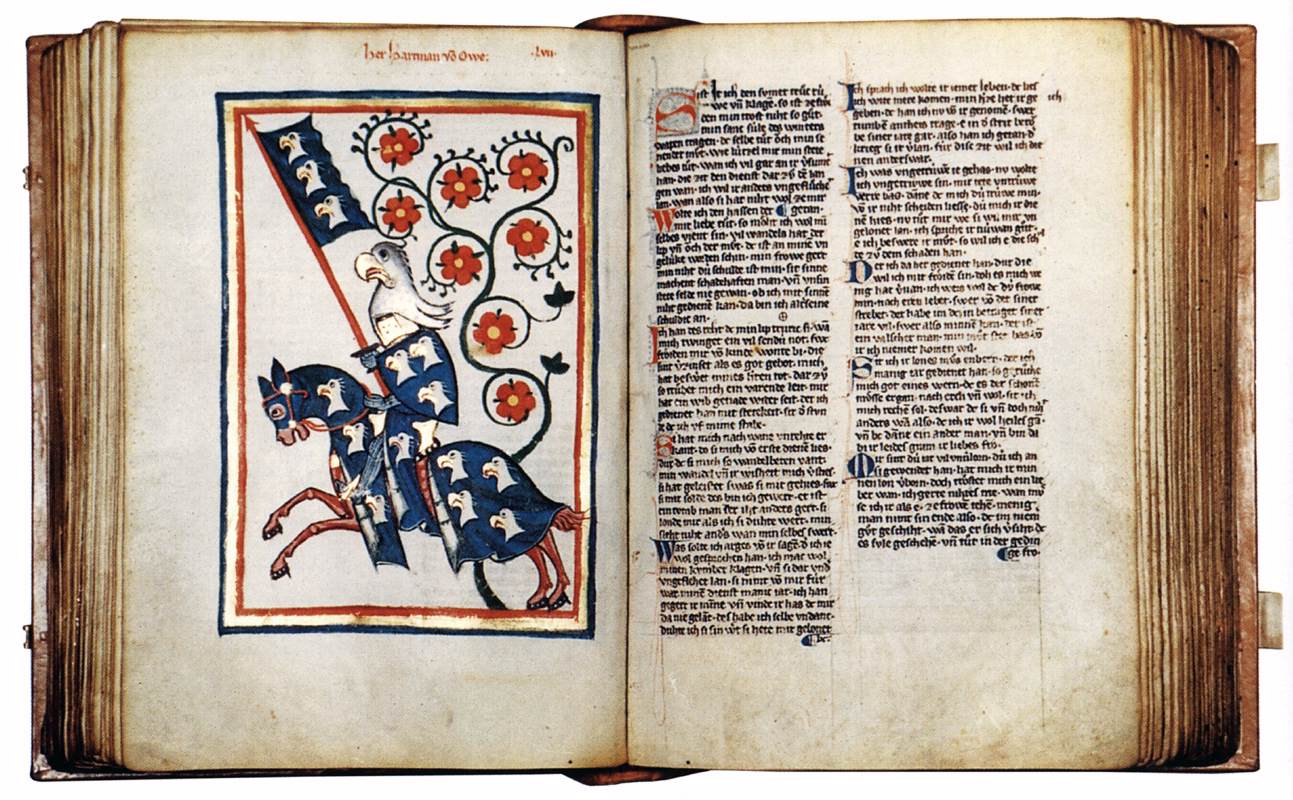
Codex Manesse 1310-40 Manuscriptcollective term for books or other documents written by hand; in a specific sense, the hand-written medieval book, the Codex manuscriptus, often ornamented with decorative borders, illuminated initials and miniatures, and containing works of ancient philosophy or scholarly, ecclesiastical, and literary texts. Manuscripts were usually produced on commission. At first the scriptoria (writing rooms) of monasteries transcribed the contents of famous manuscripts and made copies. Monastic communities in the Netherlands and northern Germany began producing manuscripts around 1383/84. Flanders, Burgundy, and in particular Paris became major centres for the mass production of breviaries (prayer books) and Books of Hours. (Codex Pal. Germ. 848), 355 x 250 mm Universitätsbibliothek, Heidelberg
The Codex Manesse is the most famous mediaeval manuscript produced in German, and also the most widely known, thanks to innumerable reproductions. It is also a significant textual document, since it is the most extensive collection and most important source of the courtly lyric poetry known according to its content and form of presentation as "Minnesang" (love song). On 852 pages the codex contains the work of 140 authors of the period from 1160 to 1330. The authors include, among others, Walther von der Vogelweide, Wolfram von Eschenbach, Hartmann von Aue, Emperor Henry VI, and Conradin, the last of the Hohenstaufen dynasty. The text is illustrated by 137 full-page miniatures, of which 110 come from the hand of the so-called Foundation Master.
The manuscript is named after the Zurich patricianoriginally a member of the ancient Roman nobility; from the Middle Ages onwards a term for a noble, wealthy citizen. family Manesse with whom the patron was associated.
The picture shows the open double page (folios 184v and 185r) of the codex. As throughout, a full-page miniatureTerm originally applied to the art of manuscript illumination but later used of paintings, usually portraits, executed on a very small scale. The earliest miniaturists (16th century) continued to use the materials of the illuminators, painting in gouache on vellum or card. devoted to the poet is placed opposite the beginning of his songs or gnomic poems. Here we see the first two songs by the Alemanic poet Hartmann von Aue (c. 1160-c. 1210) who was most famous for his verse romances based on the Arthurian cycle and religious legends.
@online{wga-rbe0834808296ab,
  author       = {Krén, Emil and Marx, Daniel},
  title        = {Codex Manesse by MINIATURIST, Swiss},
  organization = {{Web Gallery of Art}},
  date         = {2026-09-09},
  url          = {https://beta.wga.hu/artists/miniaturist-swiss-r2fe0015555f442/codex-manesse-rbe0834808296ab},
  urldate      = {2026-09-09},
  langid       = {english}
}
ACCESSED 2026-09-09. REPLACE THE AUTHOR FIELD WITH THE COMMENTARY AUTHOR WHERE ONE IS NAMED.


