03 — ARTWORK
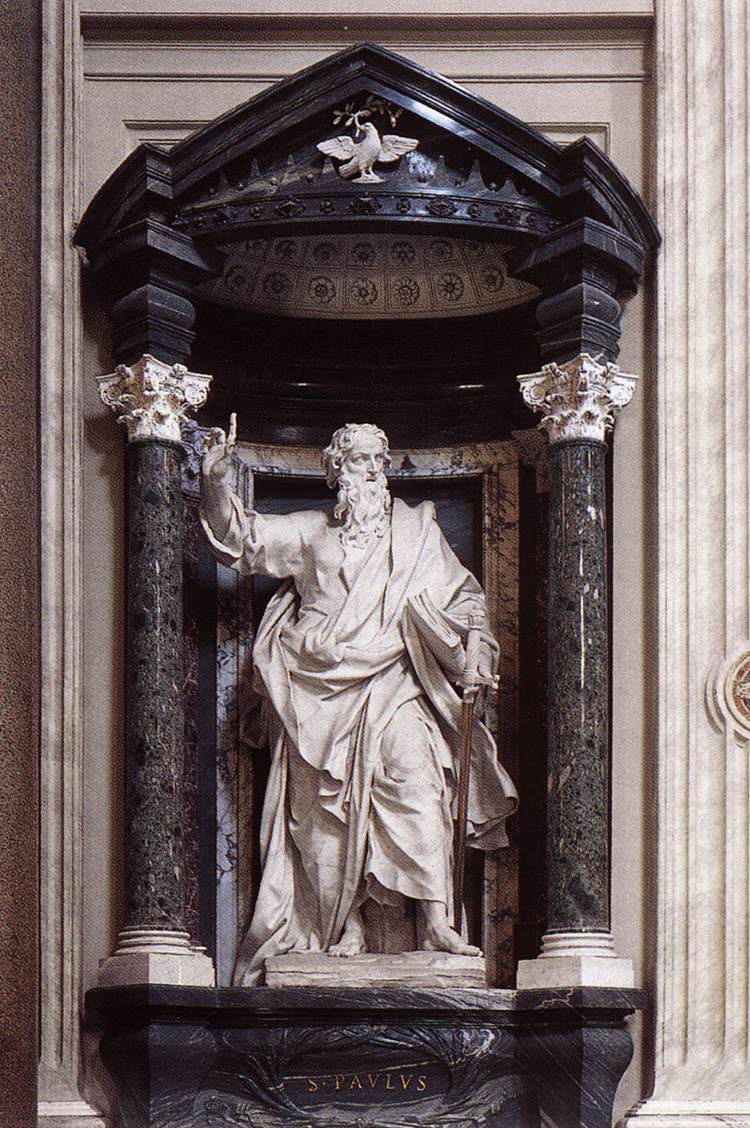
St Paul
MONNOT, Pierre Etienne · 1718 →
- MEDIUM
- Marble, height 425 cm
- TYPE
- Religious
PALETTE
HOVER OR TAP A SWATCH FOR NAME, SHARE AND HEX. SAMPLED FROM THE IMAGE — INDICATIVE, NOT A PIGMENT ANALYSIS.
DEVELOPMENT BUILD — NOT FOR PUBLIC USE. CONTRIBUTE ON GITHUB.
CURRENT LOCATION · San Giovanni in Laterano
03 — ARTWORK
MONNOT, Pierre Etienne · 1718 →
PALETTE
HOVER OR TAP A SWATCH FOR NAME, SHARE AND HEX. SAMPLED FROM THE IMAGE — INDICATIVE, NOT A PIGMENT ANALYSIS.
COMMENTARY
UNDERLINED TERMS ARE DEFINED IN THE GLOSSARY.
The significant sculptural undertaking that inaugurated the eighteenth century in Rome was the realization of the colossal statues of the Apostles in twelve monumental, green marbleloosely applied to any hard limestone that can be sawn into thin slabs and will take a good polish so that it is suitable for decorative work; more strictly, it refers to metamorphosed limestones whose structure has been recrystallized by heat or pressure. Marbles are widely disseminated and occur in a great variety of colours and patterns, but certain types have been particularly prized by sculptors. The most famous of Greek white marbles in the ancient world was the close-grained Pentelic, which was quarried at Mount Pentelicon in Attica. The Elgin Marbles are carved in Pentelic. Widely used also were the somewhat coarser-grained translucent white marbles from the Aegean islands of Paros and Naxos. Parian marble was used for the celebrated Mausoleum at Halicarnassus. The pure white Carrara marble, quarried at Massa, Carrara, and Pietra Santa in Tuscany from the 3rd century BC, is the most famous of all sculptors' stones. It was used for the Apollo Belvedere, and was much favoured in the Renaissance, particularly by Michelangelo, who often visited the quarries to select material for his work. Neoclassical sculptors also favoured Carrara marble because of its ability to take a smooth, sleek surface, but it can look rather 'dead' compared with some of the finest Greek marbles. niches, decorated by the dove symbol of the Pamphilj family, which Francesco Borromini built during the reconstruction of the interior of San Giovanni in Laterano. The statues, the completion of Borromini's project, were executed before 1718 by the most important sculptors of the time from Rome and elsewhere. The sculptors included Camillo Rusconi (Andrew, Matthew, James the Greater, John the Evangelist), Francesco Moratti (Simon), Angelo de' Rossi (James the Less), Giuseppe Mazzuoli (Philip), Lorenzo Ottoni (Thaddeus), as well as the Frenchmen Pierre-Étienne Monnot (Peter, Paul) and Pierre Le Gros (Bartholomew, Thomas).
Among these sculptors Camillo Rusconi was the most noted sculptor of the first half of the century. The only one who effectively rivaled him was Pierre Le Gros, although Pierre-Étienne Monnot, to whom are owed St Peter and St Paul, also created magnificent works.
The apostleone of the twelve disciples of Jesus, chosen personally by him from amongst his large crowd of followers in order to continue his work and preach the gospels.'s gesture of reaching out is balanced by his attributes of a book and a sword.
@online{wga-r7c0f447a891dba,
  author       = {Krén, Emil and Marx, Daniel},
  title        = {St Paul by MONNOT, Pierre Etienne},
  organization = {{Web Gallery of Art}},
  date         = {2026-09-13},
  url          = {https://beta.wga.hu/artists/monnot-pierre-etienne-r030c836c2d64be/st-paul-r7c0f447a891dba},
  urldate      = {2026-09-13},
  langid       = {english}
}
ACCESSED 2026-09-13. REPLACE THE AUTHOR FIELD WITH THE COMMENTARY AUTHOR WHERE ONE IS NAMED.


