03 — ARTWORK
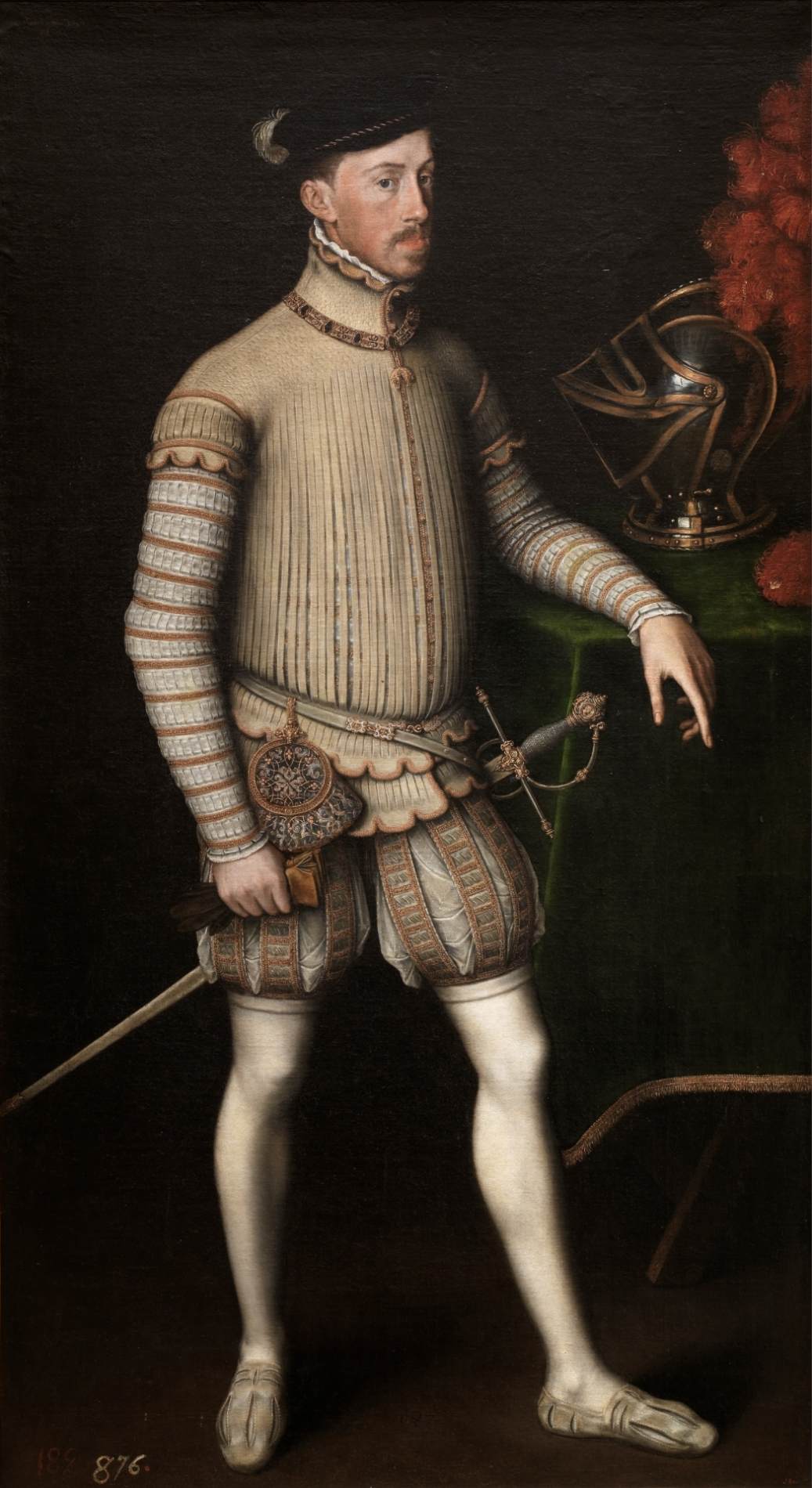
Emperor Maximilian II
MOR VAN DASHORST, Anthonis · 1550 →
- MEDIUM
- Oil on canvas, 184 x 100 cm
- TYPE
- Portrait
PALETTE
HOVER OR TAP A SWATCH FOR NAME, SHARE AND HEX. SAMPLED FROM THE IMAGE — INDICATIVE, NOT A PIGMENT ANALYSIS.
DEVELOPMENT BUILD — NOT FOR PUBLIC USE. CONTRIBUTE ON GITHUB.
03 — ARTWORK
MOR VAN DASHORST, Anthonis · 1550 →
PALETTE
HOVER OR TAP A SWATCH FOR NAME, SHARE AND HEX. SAMPLED FROM THE IMAGE — INDICATIVE, NOT A PIGMENT ANALYSIS.
COMMENTARY
UNDERLINED TERMS ARE DEFINED IN THE GLOSSARY.
Maximilian II (1527-1576) was the son of Ferdinand of Austria, then King of Romans and next emperor (1556-1564) of the Germanic Holy Roman Empire. He was educated in Spain alongside his cousin, the future Philip II, and from an early age practiced the profession of arms, later on entering combat on the side of Emperor Charles V (1519-1556) against the association of Protestant princes known as the Schmalkaldic League, which was defeated at the battle of Mühlberg. The monarch chose him as a husband for his daughter Maria of Austria. Maximilian and Maria married in 1548 and were regents of the Spanish kingdoms in the absence of the heir during his long journey around Italy, the Netherlands and Germany between 1548 and 1551. Chosen as King of Romans in 1562, he inherited the sovereignty of Bohemia that same year and was crowned king of Hungary in 1563. When Ferdinand I died in 1564 he acceded to the imperial throne, remaining there until his death in Regensburg in 1576. His rule was characterised by a particular policy of tolerance towards Protestantism.
This portraitThe Roman portrait bust survived in the form of life-sized reliquaries of saints, but it was in 15th century Florence that the individual features and character of a contemporary sitter were accurately recorded by sculptors such as Donatello, Desiderio da Settignano, Mino da Fiesole and the Rossellino. A similar degree of realism occurs in 15th century tomb sculpture. The equestrian portrait, based on antique statues such as the Marcus Aurelius monument (Rome, Campidoglio), was revived in the 14th century. Two examples in fresco are Simone Martini's Guidoriccio (c. 1328; Siena, Palazzo Pubblico) and the posthumous portrait of Sir John Hawkwood (1436; Florence, Cathedral) by Uccello, which gives the illusion of a 3-dimensional statue seen from below. The Venetian Republic ordered imposing monuments from Donatello (1447; Gattarnelata, Padua) and Verrocchio (14799; Colleoni, Venice), whilst other statesmen ordered their own images to be erected in public places, directly relating themselves to the military heroes of ancient Rome. Another form of political portraiture derived from antiquity was the commemorative portrait medal designed by artists such as Pisanello. The carved or painted profile portrait became popular in the 1450s. The realism of the clear, flattened image, painted under the influence of Flemish examples by the Pollaiuolo brothers, Piero della Francesca and Botticelli, was superseded by the three-quarter and frontal portrait, psychologically more complex, such as Leonardo's enigmatic Mona Lisa (Paris, Louvre) with her momentary smile or Andrea del Sarto's arresting Portrait of a Man (London, National Gallery). The 16th century portrait became generalized, Lotto's Andrea Odoni (1527; Royal Collection) being an idealized concept of a collector rather than an individual. Group portraits, decorating whole rooms, include the narrative scenes of the Gonzaga court painted by Mantegna (completed 1474; Mantua, Palazzo Ducale) and the elaborate schemes commissioned by the Farnese family in Rome from Vasari (1546; Palazzo della Cancelleria) and Salviati (after 1553; Palazzo Farnese). Portraits were also incorporated into religious narratives, as in Ghirlandaio's fresco cycle painted for Giovanni Tornabuoni in S. Maria Novella, Florence (1486-90)., which forms a pair with one of his wife, was designed to be similar to that which Titian painted of Philip II in Milan in 1548, albeit reducing the space and adding a detailed description of the textures of all the motifs visible in the painting with an immaculate precision of detail. The future emperor is portrayed standing, full length and life size in a three-quarter position with his head turned to the left and silhouetted against a dark background, which enhances the volume of the figure. He carries a sword and is dressed in white with a rich leather travelling jacket and breeches; the black cap on his head is adorned with a feather and he wears the collar of the Order of the Golden Fleecea noble chivalric order, still in existence today, founded by Duke Philip the Good of Burgundy in 1430 in honor of the Apostle Andrew, for the defence of the Christian faith and the Church. In allusion to the legend of Jason and the Argonauts, the symbol of the order is a golden ram's fleece drawn through a gold ring.. He holds his gloves in his right hand and leans his left forearm on a table with a green velvet covering on which rests a finely chiseled visored battle helmet adorned with a crest of reddish feathers.
@online{wga-r89dc7edd2873d6,
  author       = {Krén, Emil and Marx, Daniel},
  title        = {Emperor Maximilian II by MOR VAN DASHORST, Anthonis},
  organization = {{Web Gallery of Art}},
  date         = {2026-09-13},
  url          = {https://beta.wga.hu/artists/mor-van-dashorst-anthonis-r3e04cd5f9f604b/emperor-maximilian-ii-r89dc7edd2873d6},
  urldate      = {2026-09-13},
  langid       = {english}
}
ACCESSED 2026-09-13. REPLACE THE AUTHOR FIELD WITH THE COMMENTARY AUTHOR WHERE ONE IS NAMED.


