Scottish sculptor, active in England. Son of a stone mason, the talented Alexander Munro was noticed by his father's wealthy employer, the Duchess of Sutherland, and brought to London in 1848 to study sculpture under Charles Barry. He exhibited at the Royal Academy from 1849-70, and in the Great Exhibition of 1851. Munro became a specialist in portraitGLOSSARYThe Roman portrait bust survived in the form of life-sized reliquaries of saints, but it was in 15th century Florence that the individual features and character of a contemporary sitter were accurately recorded by sculptors such as Donatello, Desiderio da Settignano, Mino da Fiesole and the Rossellino. A similar degree of realism occurs in 15th century tomb sculpture. The equestrian portrait, based on antique statues such as the Marcus Aurelius monument (Rome, Campidoglio), was revived in the 14th century. Two examples in fresco are Simone Martini's Guidoriccio (c. 1328; Siena, Palazzo Pubblico) and the posthumous portrait of Sir John Hawkwood (1436; Florence, Cathedral) by Uccello, which gives the illusion of a 3-dimensional statue seen from below. The Venetian Republic ordered imposing monuments from Donatello (1447; Gattarnelata, Padua) and Verrocchio (14799; Colleoni, Venice), whilst other statesmen ordered their own images to be erected in public places, directly relating themselves to the military heroes of ancient Rome. Another form of political portraiture derived from antiquity was the commemorative portrait medal designed by artists such as Pisanello. The carved or painted profile portrait became popular in the 1450s. The realism of the clear, flattened image, painted under the influence of Flemish examples by the Pollaiuolo brothers, Piero della Francesca and Botticelli, was superseded by the three-quarter and frontal portrait, psychologically more complex, such as Leonardo's enigmatic Mona Lisa (Paris, Louvre) with her momentary smile or Andrea del Sarto's arresting Portrait of a Man (London, National Gallery). The 16th century portrait became generalized, Lotto's Andrea Odoni (1527; Royal Collection) being an idealized concept of a collector rather than an individual. Group portraits, decorating whole rooms, include the narrative scenes of the Gonzaga court painted by Mantegna (completed 1474; Mantua, Palazzo Ducale) and the elaborate schemes commissioned by the Farnese family in Rome from Vasari (1546; Palazzo della Cancelleria) and Salviati (after 1553; Palazzo Farnese). Portraits were also incorporated into religious narratives, as in Ghirlandaio's fresco cycle painted for Giovanni Tornabuoni in S. Maria Novella, Florence (1486-90). sculpture, and in statues of children. He was close to the Pre-RaphaelitesGLOSSARYA group of English artists, among them Holman Hunt, Millais and Rossetti, who in 1848 formed the Pre-Raphaelite brotherhood, aiming to produce work in the spirit which imbued Italian artists before Raphael's move to Rome. The movement was a mixture of romantic medievalism and the desire to return to a realistic depiction of nature, disregarding what they considered to be the arbitrary rules of academic art. These preoccupations were unified by a kind of seriousness which turned painting into a moral as well as an aesthetic act. The group also had an impact on the decorative arts through painted furniture, tapestries, stained glass and designs for fabric and wallpaper..
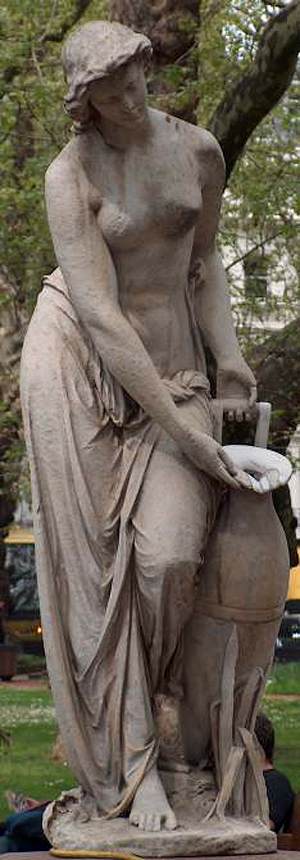
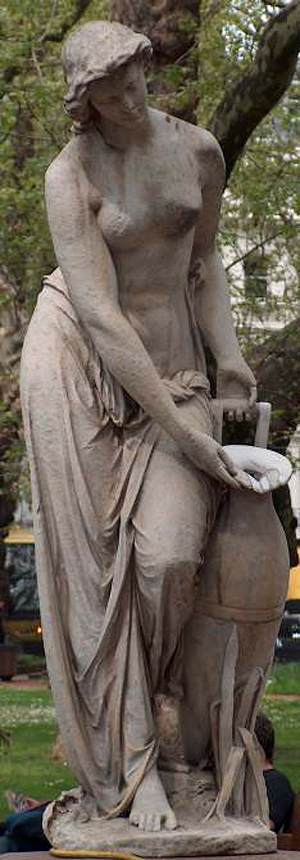
His works in London include the fountains in Berkeley Square and by Hyde Park Corner (Boy and Dolphin). In Birmingham is a statue of James Watt (1866) and, in the Museum, The Sleeping Child, one of his Great Exhibition works. In Oxford there is a medallionGLOSSARYIn architecture, a large ornamental plaquc or disc. of Millais at the Ashmolean, and apparently architectural statuary on the University Museum.
Munro is one of five sculptors whose work can be considered to represent Pre-Raphaelitism in sculpture. He produced work in accord with the ideas of early Pre-Raphaelitism: like Thomas Woolner, the one sculptor who was a member of the actual Brotherhood, he made medallion portraits, of a formal purism that harks back to Italian Early Renaissance medalsGLOSSARYThe medal came to artistic maturity within a remarkably short time of its introduction in 15th century Italy. This was partly because ancient Roman coins, which were beginning to be reverently collected, suggested (on a smaller scale) its form: profile portrait bust on the obverse, a different design on the reverse, an inscription running round the rim. Like the finest Imperial coins, the medal's purpose was commemorative. Without monetary value, and of non-precious metal (bronze or lead), it was a way of circulating a likeness to a chosen few; it anticipated the use of miniatures and was indeed frequently worn round the neck. And while the reverse could record a historical event or make a propaganda point related to its subject's career, more commonly it bore a design that purported to convey the 'essence', as it were, of the person portrayed on the other side. Given the admiration for the men and artefacts of ancient Rome, the stress on individual character, the desire for fame and the penchant for summing up temperament in symbols and images, it is easy to understand how quickly the fashion for commissioning medals spread. Its pioneer executant was Pisanello. The precedents before he began to cast medals in 1438-39 had been few and excessively coin-like. Within 10 years he had established the form the medal was to retain until the influence was registered of the reverseless, hollow-cast and wafer-thin medals of the 1560s and 70s made by Bombarda (Andrea Cambi). Pisanello's approach was first echoed by the Veronese Matteo de' Pasti (d. 1467-688). It was, perhaps oddly, not until the works from 1485 of Niccolò Fiorentino (Niccolò di Forzore Spinelli, 1430-1514) that Florence produced a medallist of the highest calibre. Other specialists in the medium included Sperandio (Sperandio Savelli, c. 1425-1504), L'Antico (Pier Jacopo Alari Bonacolsi, c. 1460-1528), Caradosso (Cristoforo Caradosso Foppa, 1452-1526/27). The work of these men, and of the many, often anonymous, who reflected them, is still coveted because it avoided the two medallistic errors: making a medal look like either an enlarged piece of money or a small sculptured plaque.. In addition, his Paolo and Francesca depicts two intense-looking sharp-featured lovers from Dante - lovers who had particular importance in Rossetti's imagination and whom he depicted in one of his most famous early works.
Munro's later portrait busts have a formal simplicity and purism that relates to the theory of Pre-Raphaelitism, taking as models works of art from periods before a more developed maturity has pushed out that breath of juvenile springtime. Munro follows the hard-edge realismGLOSSARYRealism (with an upper case "R"), also known as the Realist school, denotes a mid-nineteenth century art movement and style in which artists discarded the formulas of Neoclassicism and the theatrical drama of Romanticism to paint familiar scenes and events as they actually looked. Typically it involved some sort of sociopolitical or moral message, in the depiction of ugly or commonplace subjects. One of the main representatives and spokesmen was the painter Gustave Courbet. In the dispute about ways to represent reality, Realism rebelled against the idealistic and classicist tendencies in painting. of Hunt and early Millais, and in a few works employs Rossettian subjects. Like Hunt, he remained faithful to his early vision throughout his career.