03 — ARTWORK
Paradise
- MEDIUM
- Fresco
- TYPE
- Religious
PALETTE
HOVER OR TAP A SWATCH FOR NAME, SHARE AND HEX. SAMPLED FROM THE IMAGE — INDICATIVE, NOT A PIGMENT ANALYSIS.
DEVELOPMENT BUILD — NOT FOR PUBLIC USE. CONTRIBUTE ON GITHUB.
03 — ARTWORK
PALETTE
HOVER OR TAP A SWATCH FOR NAME, SHARE AND HEX. SAMPLED FROM THE IMAGE — INDICATIVE, NOT A PIGMENT ANALYSIS.
COMMENTARY
UNDERLINED TERMS ARE DEFINED IN THE GLOSSARY.
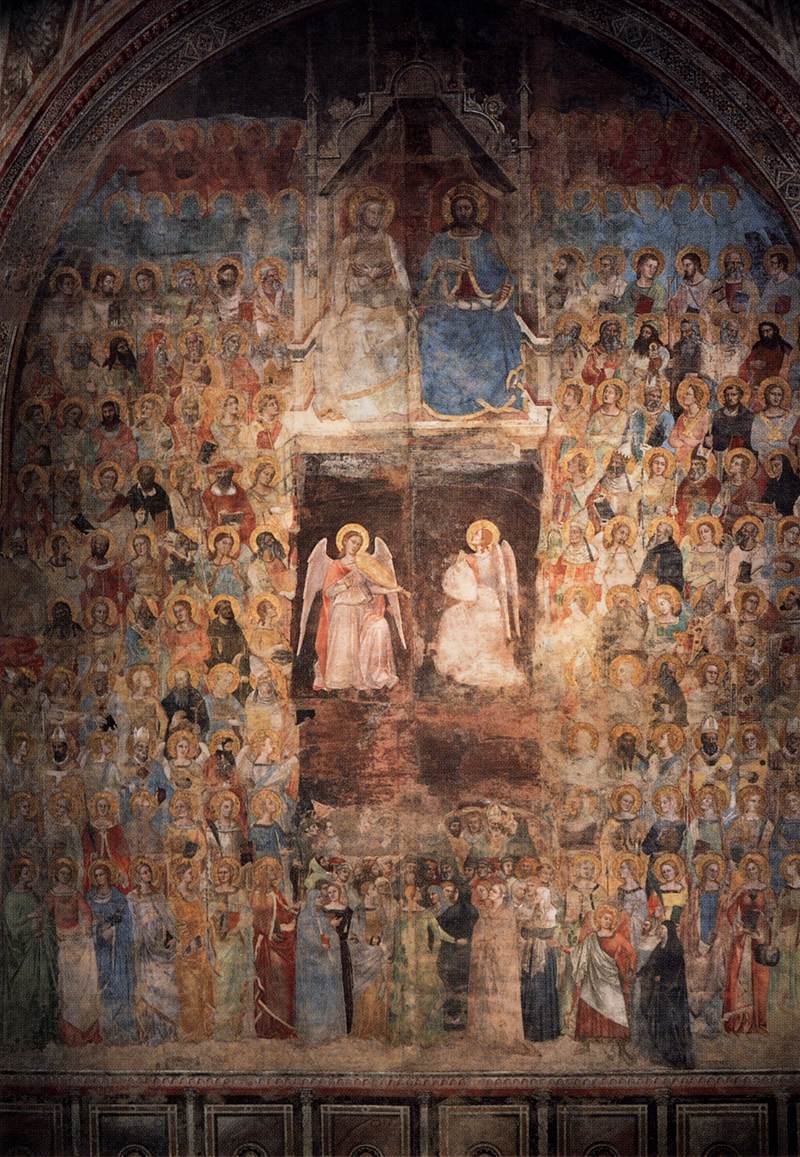
Paradise c. 1355 FrescoWall painting technique in which pigments are applied to wet (fresh) plaster (intonaco). The pigments bind with the drying plaster to form a very durable image. Only a small area can be painted in a day, and these areas, drying to a slightly different tint, can in time be seen. Small amounts of retouching and detail work could be carried out on the dry plaster, a technique known as a secco fresco. Cappella Strozzi di Mantova, Santa Maria Novella, Florence
At the north end of the transeptsection of a church at right-angles to the nave and in front of the choir. of Santa Maria Novella two brothers who were heads of a very large and active workshop, Andrea di Cione (known as Orcagna) and Nardo di Cione provided the altarpieceA picture or sculpture that stands on or is set up behind an altar. The term reredos is used for an ornamental screen or partition, not directly attached to the altar table but affixed to the wall behind it. A diptych is an altarpiece consisting of two panels, a triptych one of three panels, and a polyptych one of four or more panels. From the 14th to 16th century, the altarpiece was one of the most important commissions in European art; it was through the altarpiece that some of the most decisive developments in painting and sculpture came about. and frescoes for the Strozzi Chapela small separate place for worship, either part of a large church or a separate building., one of the most important decorative programs of the time.
Dominican commitment to orthodoxy, order, and the institutional church is evident on the left wall of the chapel where a Paradise shows the elect arranged row upon row, around and beneath the figures of the enthroned Divinity and the Virgin. Both figures are crowned; the figure of God even holds a sceptre. In this configuration the Virgin - or metaphorically Maria Ecclesia (the Church) - shares unmistakably the power of the Godhead on the model familiar from Roman thirteenth-century mosaics.
@online{wga-r2a4c5fc816caf0,
  author       = {Krén, Emil and Marx, Daniel},
  title        = {Paradise by NARDO DI CIONE},
  organization = {{Web Gallery of Art}},
  date         = {2026-09-13},
  url          = {https://beta.wga.hu/artists/nardo-di-cione-r819a4d04477b9b/paradise-r2a4c5fc816caf0},
  urldate      = {2026-09-13},
  langid       = {english}
}
ACCESSED 2026-09-13. REPLACE THE AUTHOR FIELD WITH THE COMMENTARY AUTHOR WHERE ONE IS NAMED.


