03 — ARTWORK
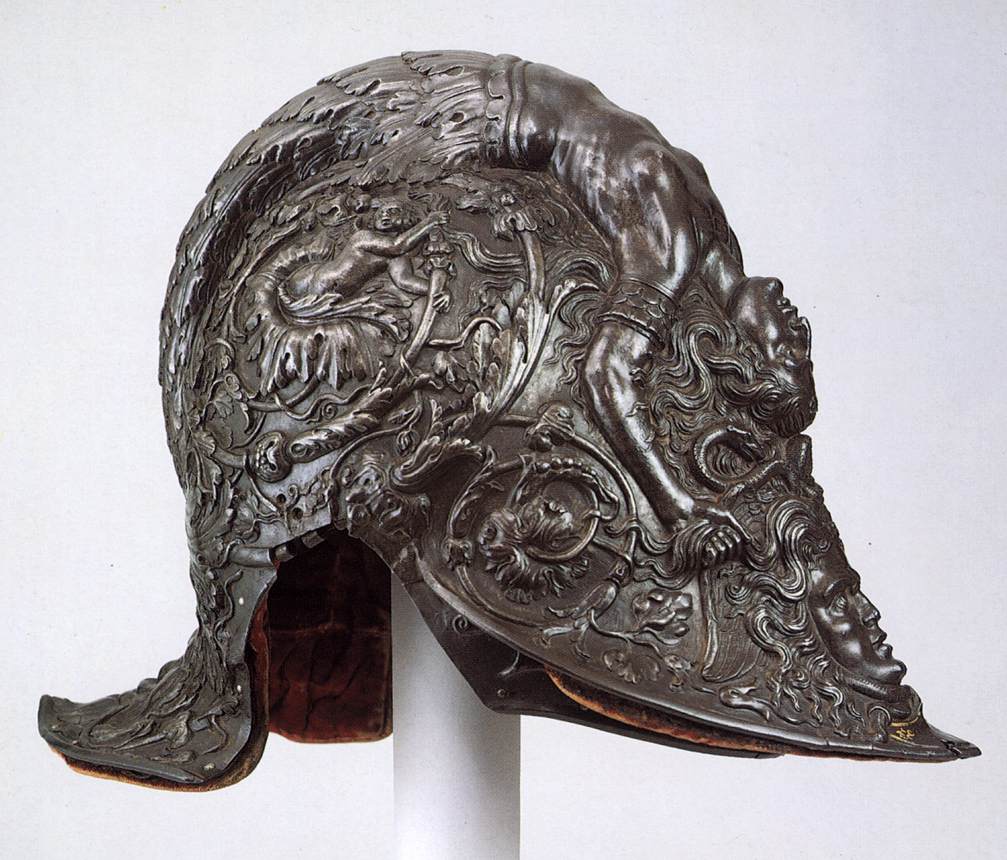
Parade Helmet
- MEDIUM
- Steel and gold, height 24 cm
- TYPE
- Other
PALETTE
HOVER OR TAP A SWATCH FOR NAME, SHARE AND HEX. SAMPLED FROM THE IMAGE — INDICATIVE, NOT A PIGMENT ANALYSIS.
DEVELOPMENT BUILD — NOT FOR PUBLIC USE. CONTRIBUTE ON GITHUB.
03 — ARTWORK
PALETTE
HOVER OR TAP A SWATCH FOR NAME, SHARE AND HEX. SAMPLED FROM THE IMAGE — INDICATIVE, NOT A PIGMENT ANALYSIS.
COMMENTARY
UNDERLINED TERMS ARE DEFINED IN THE GLOSSARY.
This superb example of Italian Renaissance sculpture in steel was made by Filippo Negroli, the leading master of embossed armour in the antiquethe classical age of Greece and Rome began with the Greek migrations of the 2nd millennium BC, and ended in the West in 476 AD with the deposition of the Roman emperor Romulus Augustulus (c. 475 AD); in the East it ended in 529 AD when the Platonic Academy was closed by Justinian (482 - 565 AD). style. The embossed ornament of acanthusa thistle species very common in the Mediterranean. Its large, jagged leaves, curving in slightly at the tips, have been a favorite ornamental pattern since classical antiquity. scrolls inhabited by putti is inspired by classicalRelating to the culture of ancient Greece and Rome (classical Antiquity). The classical world played a profoundly important role in the Renaissance, with Italian scholars, writers, and artists seeing their own period as the rebirth (the "renaissance") of classical values after the Middle Ages. The classical world was considered the golden age for the arts, literature, philosophy, and politics. Concepts of the classical, however, changed greatly from one period to the next. Roman literature provided the starting point in the 14th century, scholars patiently finding, editing and translating a wide range of texts. In the 15th century Greek literature, philosophy and art - together with the close study of the remains of Roman buildings and sculptures-expanded the concept of the classical and ensured it remained a vital source of ideas and inspiration. prototypes. The reclining mermaid forming the comb of the helmet holds the head of MedusaIn Greek mythology, a Gorgon, the daughter of Phorkys and Kreto. A mortal monster with serpents in her hair and a gaze that turned people to stone. When Perseus cuts off her head, Chrysaor and Pegasos spring from her body. Her head features on Minerva's shield, supposedly to petrify her enemies., whose stare was reputed to turn the onlooker into stone.
@online{wga-r76de3dce29fdc0,
  author       = {Krén, Emil and Marx, Daniel},
  title        = {Parade Helmet by NEGROLI, Filippo},
  organization = {{Web Gallery of Art}},
  date         = {2026-09-09},
  url          = {https://beta.wga.hu/artists/negroli-filippo-r86db06e761424a/parade-helmet-r76de3dce29fdc0},
  urldate      = {2026-09-09},
  langid       = {english}
}
ACCESSED 2026-09-09. REPLACE THE AUTHOR FIELD WITH THE COMMENTARY AUTHOR WHERE ONE IS NAMED.
The archive catalogues no further works by this artist.
TRY SAME COLLECTION →