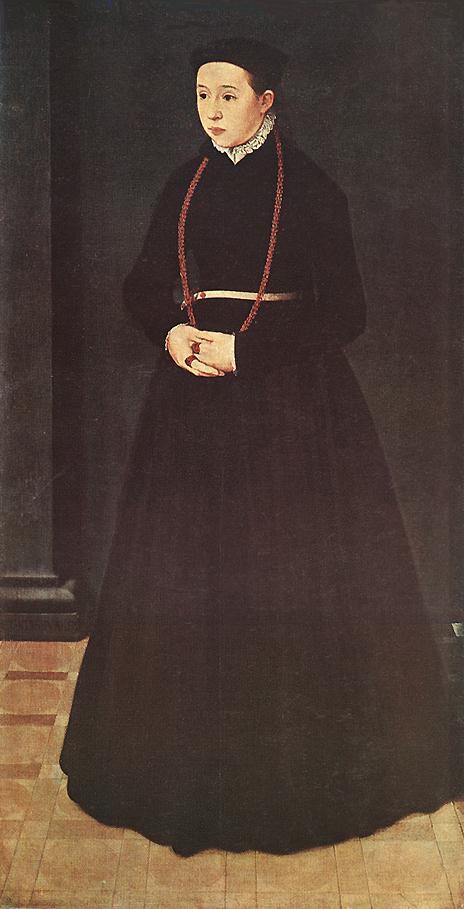
Flemish painter and draughtsman, active in Germany. He was one of the leading portraitGLOSSARYThe Roman portrait bust survived in the form of life-sized reliquaries of saints, but it was in 15th century Florence that the individual features and character of a contemporary sitter were accurately recorded by sculptors such as Donatello, Desiderio da Settignano, Mino da Fiesole and the Rossellino. A similar degree of realism occurs in 15th century tomb sculpture. The equestrian portrait, based on antique statues such as the Marcus Aurelius monument (Rome, Campidoglio), was revived in the 14th century. Two examples in fresco are Simone Martini's Guidoriccio (c. 1328; Siena, Palazzo Pubblico) and the posthumous portrait of Sir John Hawkwood (1436; Florence, Cathedral) by Uccello, which gives the illusion of a 3-dimensional statue seen from below. The Venetian Republic ordered imposing monuments from Donatello (1447; Gattarnelata, Padua) and Verrocchio (14799; Colleoni, Venice), whilst other statesmen ordered their own images to be erected in public places, directly relating themselves to the military heroes of ancient Rome. Another form of political portraiture derived from antiquity was the commemorative portrait medal designed by artists such as Pisanello. The carved or painted profile portrait became popular in the 1450s. The realism of the clear, flattened image, painted under the influence of Flemish examples by the Pollaiuolo brothers, Piero della Francesca and Botticelli, was superseded by the three-quarter and frontal portrait, psychologically more complex, such as Leonardo's enigmatic Mona Lisa (Paris, Louvre) with her momentary smile or Andrea del Sarto's arresting Portrait of a Man (London, National Gallery). The 16th century portrait became generalized, Lotto's Andrea Odoni (1527; Royal Collection) being an idealized concept of a collector rather than an individual. Group portraits, decorating whole rooms, include the narrative scenes of the Gonzaga court painted by Mantegna (completed 1474; Mantua, Palazzo Ducale) and the elaborate schemes commissioned by the Farnese family in Rome from Vasari (1546; Palazzo della Cancelleria) and Salviati (after 1553; Palazzo Farnese). Portraits were also incorporated into religious narratives, as in Ghirlandaio's fresco cycle painted for Giovanni Tornabuoni in S. Maria Novella, Florence (1486-90). painters in Germany in the 1560s, and it is likely that he was the 'Colyn van Nieucasteel' listed in the archives of Antwerp's GuildGLOSSARYAn association of the masters of a particular craft, trade or profession (painters, goldsmiths, surgeons, and so on) set up to protect its members' rights and interests. Such guilds existed in virtually every European city in the 16th century. The guild also monitored standards of work, acted as a court for those who brought their trade into disrepute, and provided assistance to members in need. of St Luke in 1539 as a pupil of Pieter Coecke van Aelst. Although his teacher was not a portrait painter, in Antwerp Neufchatel was exposed to the art of Frans Floris, the young Willem Key and the Master of the 1540s, whose work has been postulated as Neufchatel's juvenilia. Joachim von Sandrart, writing in 1675, thought that Neufchatel trained and worked in Mons c. 1540.
Between 1561 and 1567 he was documented as living in Nuremberg, the last secure reference occurring on 23 July 1567, when the city council, angered by a disturbance near the church of St Egidius, ordered him not to engage in any further Calvinist agitation. This episode suggests that Neufchatel, like so many of his countrymen, had moved to Germany for religious reasons. He seems to have remained in Nuremberg at least until 1573, the date on his portrait of Johann Gregor van der Schardt (Trieste, Museo Storico CastelloGLOSSARY"castle", palace. di Miramare), after which there is no further trace of him. Johann Gabriel Doppelmayr, in his Historische Nachricht von den Nürnbergischen Mathematicis und Künstlern (Nuremberg, 1730), mistakenly offered 1597 as Neufchatel's death date.