02 — ARTIST
PARMIGIANINO
b. 1503 Parma · d. 1540 Casal Maggiore
DEVELOPMENT BUILD — NOT FOR PUBLIC USE. CONTRIBUTE ON GITHUB.
02 — ARTIST
b. 1503 Parma · d. 1540 Casal Maggiore
BIOGRAPHY
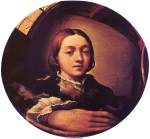
Italian Mannerist painter and etcher (real name: Girolamo Francesco Mazzola), born in Parma, from which he takes his nickname. He was a precocious artist, and as early as 1522-23 painted accomplished frescoes in two chapels in S. Giovanni Evangelista, Parma, showing his admiration for Correggio, who had worked in the same church a year or two before. The originality and sophistication he displayed from the beginning, particularly his love of unusual spatial effects, is, however, most memorably seen in his Self-Portrait in a Convex Mirror (1524, Kunsthistorisches Museum, Vienna), in which Vasari said he looks 'so beautiful that he seemed an angel rather than a man'.
In 1524 Parmigianino moved to Rome, possibly via Florence, and his work became both grander and more graceful under the influence of Raphael and Michelangelo. The Vision of St Jerome (National Gallery, London, 1526-27) is his most important work of this time, showing the disturbing emotional intensity he created with his elongated forms, disjointed sense of space, chill lighting, and lascivious atmosphere.
Parmigianino left Rome after it was sacked by German troops in 1527 and moved to Bologna. In 1531 he returned to Parma and contracted to paint frescoes in Sta Maria della Steccata. He failed to complete the work, however, and was eventually imprisoned for breach of contract. Vasari says he neglected the work because he was infatuated with alchemy — 'he allowed his beard to grow long and disordered ... he neglected himself and grew melancholy and eccentric.' His later paintings show no falling off in his powers, however, and his work reaches its apotheosis in his celebrated Madonna of the Long Neck (Uffizi, Florence, c. 1535). The forms of the figures are extraordinarily elongated and tapering and the painting has a refinement and grace that place it among the archetypal works of Mannerism.
Parmigianino's range extended beyond religious works. He painted a highly erotic Cupid Carving his Bow (Kunsthistorisches Museum, Vienna, 1535), and was one of the subtlest portraitists of his age (two superb examples are in the Museo di Capodimonte, Naples). The landscape backgrounds to his religious works have a mysterious and visionary quality that influenced Niccolo dell' Abbate and through him French art. Parmigianino, whose draughtsmanship was exquisite, also made designs for engravings and chiaroscuro woodcuts and seems to have been the first Italian artist to produce original etchings from his own designs.
13 SELECTED · 45 CATALOGUED
A small room (the Camerino) in the castle of Fontanellato (Rocca Sanvitale) contains a fascinating fresco decoration by Parmigianino. It depicts the famous story told by Ovid of the hunter Actaeon, who happened innocently to catch sight of Diana bathing, was transformed into a stag by the enraged goddess, and eventually killed by his own dogs.
The Camerino has a vaulted ceiling with fourteen lunettes. The painter could not or did not wish to include the lower parts of the wall for the narrative painting.
11 SELECTED · 45 CATALOGUED
Commentary is unavailable for this selection.
18 SELECTED · 45 CATALOGUED
Commentary is unavailable for this selection.
12 OF 45 RECORDS


@online{wga-parmigianino,
  author       = {Krén, Emil and Marx, Daniel},
  title        = {PARMIGIANINO},
  organization = {{Web Gallery of Art}},
  date         = {2026-09-09},
  url          = {https://beta.wga.hu/artists/parmigianino-rb848eb9bd0adc5},
  urldate      = {2026-09-09},
  langid       = {english}
}
ACCESSED 2026-09-09. REPLACE THE AUTHOR FIELD WITH THE COMMENTARY AUTHOR WHERE ONE IS NAMED.


