03 — ARTWORK
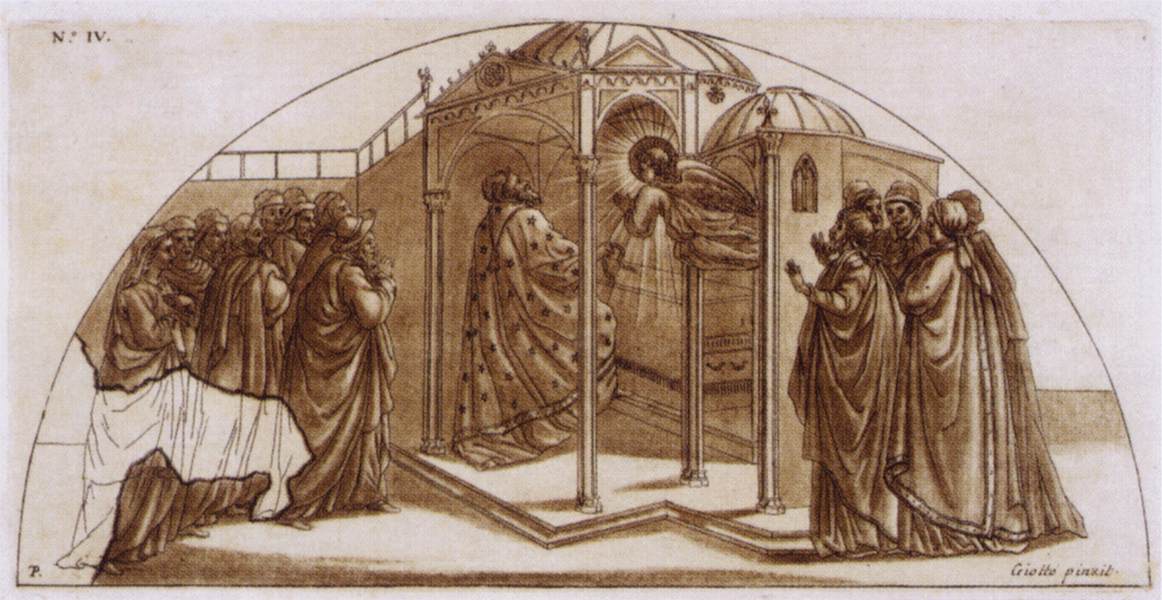
Fresco scenes from the Manetti Chapel (1)
- MEDIUM
- Engraving
- TYPE
- Religious
PALETTE
HOVER OR TAP A SWATCH FOR NAME, SHARE AND HEX. SAMPLED FROM THE IMAGE — INDICATIVE, NOT A PIGMENT ANALYSIS.
DEVELOPMENT BUILD — NOT FOR PUBLIC USE. CONTRIBUTE ON GITHUB.
03 — ARTWORK
PALETTE
HOVER OR TAP A SWATCH FOR NAME, SHARE AND HEX. SAMPLED FROM THE IMAGE — INDICATIVE, NOT A PIGMENT ANALYSIS.
COMMENTARY
UNDERLINED TERMS ARE DEFINED IN THE GLOSSARY.
In 1348, (Gio)Vanni Manetti del Buono wrote instructions in his will that his chapela small separate place for worship, either part of a large church or a separate building. dedicated to John the Baptist (his name saint) in Santa Maria del Carmine, Florence should be painted. The frescoWall painting technique in which pigments are applied to wet (fresh) plaster (intonaco). The pigments bind with the drying plaster to form a very durable image. Only a small area can be painted in a day, and these areas, drying to a slightly different tint, can in time be seen. Small amounts of retouching and detail work could be carried out on the dry plaster, a technique known as a secco fresco. cycle devoted to scenes from the life of St John the Baptist in the Manetti Chapel was identified on the basis of engravings made by Thomas Patch in 1772.
The decoration of the chapel, situated to the right of the choirthe part of a church interior, usually raised and set apart from the rest of the church, reserved for the clergy to pray together, or for choral singing. Since Carolingian times, "choir" has been the word for the part of the central nave of the church extending over the crossing (the place where nave and transept intersect), and including the apse (a niche in the wall, roofed with a half dome) that often stands at the end of this area., consisted of six scenes from the life of St John the Baptist: the Annunciationthe term for the event described in the Gospel according to St. Luke, when the Angel Gabriel brings the Virgin Mary the news that she is to bear her son, Jesus Christ. The Annunciation was among the most widespread pictorial subjects of European art during the Middle Ages and the Renaissance. to Zacharias; the Visitation; the Birth and Naming of John the Baptist; the Baptist preaching in the Desert and the Baptism; the Decollation and Burial of the Baptist; the Baptist visited in Prison by Two Apostles and the Feast of Herod.
The frescoes were already in poor condition in 1763-64 when they were restored. When the church of the Carmine was largely destroyed by fire in 1771, they suffered comparatively little. Patch made the engravings in 1772 and removed some fragments from the wall, the rest was presumably destroyed in the reconstruction of the church. There are twelve fragments to survive.
Patch's engravings are a very rough rendering of the style of the originals, but he copied the compositions with considerable exactness. The picture shows the first scene: the Annunciation to Zacharias.
@online{wga-rb34cb67352cb4c,
  author       = {Krén, Emil and Marx, Daniel},
  title        = {Fresco scenes from the Manetti Chapel (1) by PATCH, Thomas},
  organization = {{Web Gallery of Art}},
  date         = {2026-09-13},
  url          = {https://beta.wga.hu/artists/patch-thomas-r2fe98ef966e3fd/fresco-scenes-from-the-manetti-chapel-1-rb34cb67352cb4c},
  urldate      = {2026-09-13},
  langid       = {english}
}
ACCESSED 2026-09-13. REPLACE THE AUTHOR FIELD WITH THE COMMENTARY AUTHOR WHERE ONE IS NAMED.


