03 — ARTWORK
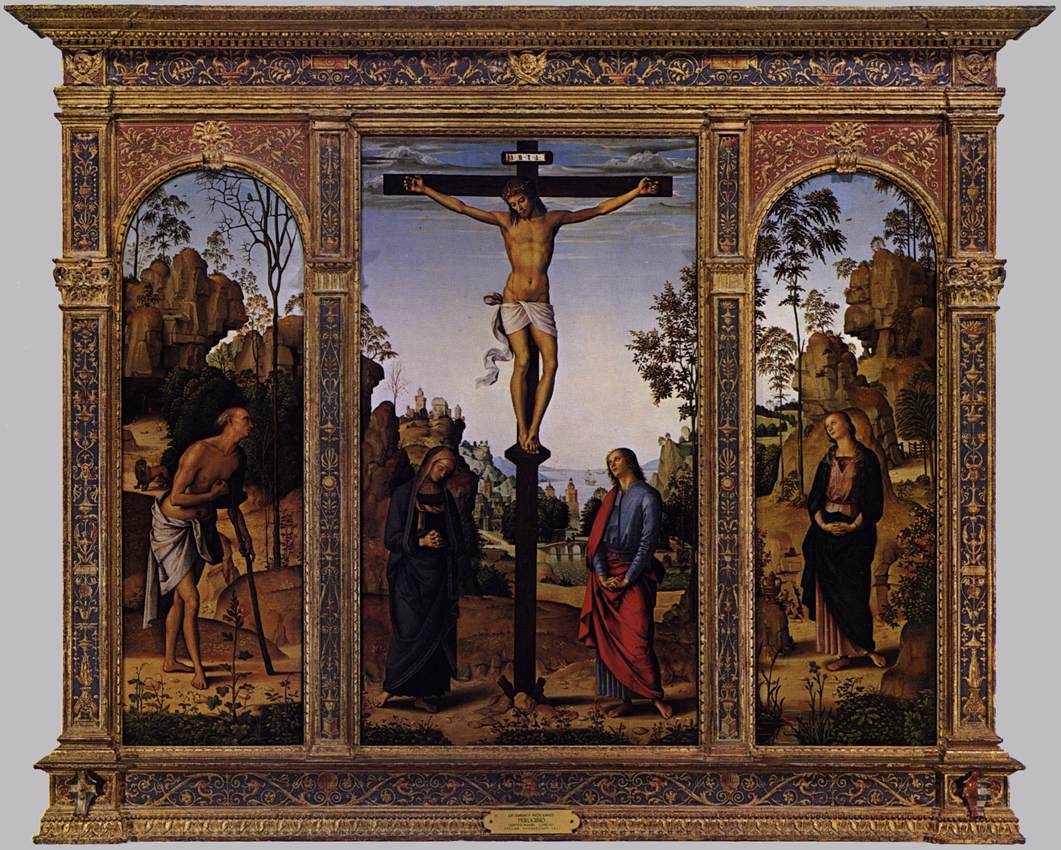
The Galitzin Triptych
- MEDIUM
- Tempera on canvas, transferred from wood
- TYPE
- Religious
PALETTE
HOVER OR TAP A SWATCH FOR NAME, SHARE AND HEX. SAMPLED FROM THE IMAGE — INDICATIVE, NOT A PIGMENT ANALYSIS.
DEVELOPMENT BUILD — NOT FOR PUBLIC USE. CONTRIBUTE ON GITHUB.
CURRENT LOCATION · National Gallery of Art
03 — ARTWORK
PALETTE
HOVER OR TAP A SWATCH FOR NAME, SHARE AND HEX. SAMPLED FROM THE IMAGE — INDICATIVE, NOT A PIGMENT ANALYSIS.
COMMENTARY
UNDERLINED TERMS ARE DEFINED IN THE GLOSSARY.
The triptychA painting in three sections, usually an altarpiece, consisting of a central panel and two outer panels, or wings. In many medieval triptychs the two outer wings were hinged so that could be closed over the center panel. Early triptychs were often portable. was executed for the church San Domenico at San Gimignano. During the Napoleonic invasion it was substituted by a copy while the original, passing through several private hands, went to the possession of Prince Galitzin in Moscow. In 1886 it was donated to the Hermitage from where it was acquisited by the Mellon collection.
The three parts of the triptych:
A. Saint Jerome, 95 x 30 cm
B. Christ on the Cross between the Virgin and Saint John the Evangelist, 101 x 56 cm
C. Saint Mary Magdalen, 95 x 30 cm
Perugino emphasizes in this painting the theological and intellectual aspects of the CrucifixionAn important method of capital punishment, particularly among the Persians, Seleucids, Jews, Carthaginians, and Romans from about the 6th century BC to the 4th century AD. Constantine the Great, the first Christian emperor, abolished it in the Roman Empire in AD 337, out of veneration for Jesus Christ, the most famous victim of crucifixion. There were various methods of performing the execution. Usually, the condemned man, after being whipped, or "scourged," dragged the crossbeam of his cross to the place of punishment, where the upright shaft was already fixed in the ground. Stripped of his clothing either then or earlier at his scourging, he was bound fast with outstretched arms to the crossbeam or nailed firmly to it through the wrists. The crossbeam was then raised high against the upright shaft and made fast to it about 9 to 12 feet (approximately 3 metres) from the ground. Next, the feet were tightly bound or nailed to the upright shaft. A ledge inserted about halfway up the upright shaft gave some support to the body; evidence for a similar ledge for the feet is rare and late. Over the criminal's head was placed a notice stating his name and his crime. Death, apparently caused by exhaustion or by heart failure, could be hastened by shattering the legs (crurifragium) with an iron club, so that shock and asphyxiation soon ended his life. rather than the physical and emotional. The traditional figures of Mary and Saint John the Evangelist at the foot of the Cross are joined by Saint Jerome, with his attributeA symbolic object which is conventionally used to identify a particular person, usually a saint. In the case of martyrs, it is usually the nature of their martyrdom. the lion, and Saint Mary Magdalen, with her attribute, the jar of ointment. The human figures, plants, trees, and other elements of nature are rendered with complete realismRealism (with an upper case "R"), also known as the Realist school, denotes a mid-nineteenth century art movement and style in which artists discarded the formulas of Neoclassicism and the theatrical drama of Romanticism to paint familiar scenes and events as they actually looked. Typically it involved some sort of sociopolitical or moral message, in the depiction of ugly or commonplace subjects. One of the main representatives and spokesmen was the painter Gustave Courbet. In the dispute about ways to represent reality, Realism rebelled against the idealistic and classicist tendencies in painting., while the placing of the figures and the design of the landscape are clearly defined and ordered according to rules of perspectiveThe method of representing three-dimensional objects on a flat surface. Perspective gives a picture a sense of depth. The most important form of perspective in the Renaissance was linear perspective (first formulated by the architect Brunelleschi in the early 15th century), in which the real or suggested lines of objects converge on a vanishing point on the horizon, often in the middle of the composition (centralized perspective). The first artist to make a systematic use of linear perspective was Masaccio, and its principles were set out by the architect Alberti in a book published in 1436. The use of linear perspective had a profound effect on the development of Western art and remained unchallenged until the 20th century. and the use of geometric shapes for composition. Note that the three figures, and that the lines of the rocky landscape and the heads of the saints form the sides of a "V" which converges at the basemolded foot of a pillar or column providing the transition from the plinth to the shaft. of the Cross and emphasizes the figure of Christ silhouetted against the sky.
@online{wga-r5513616793443c,
  author       = {Krén, Emil and Marx, Daniel},
  title        = {The Galitzin Triptych by PERUGINO, Pietro},
  organization = {{Web Gallery of Art}},
  date         = {2026-09-13},
  url          = {https://beta.wga.hu/artists/perugino-pietro-r7715b5f56f6287/the-galitzin-triptych-r5513616793443c},
  urldate      = {2026-09-13},
  langid       = {english}
}
ACCESSED 2026-09-13. REPLACE THE AUTHOR FIELD WITH THE COMMENTARY AUTHOR WHERE ONE IS NAMED.


