03 — ARTWORK
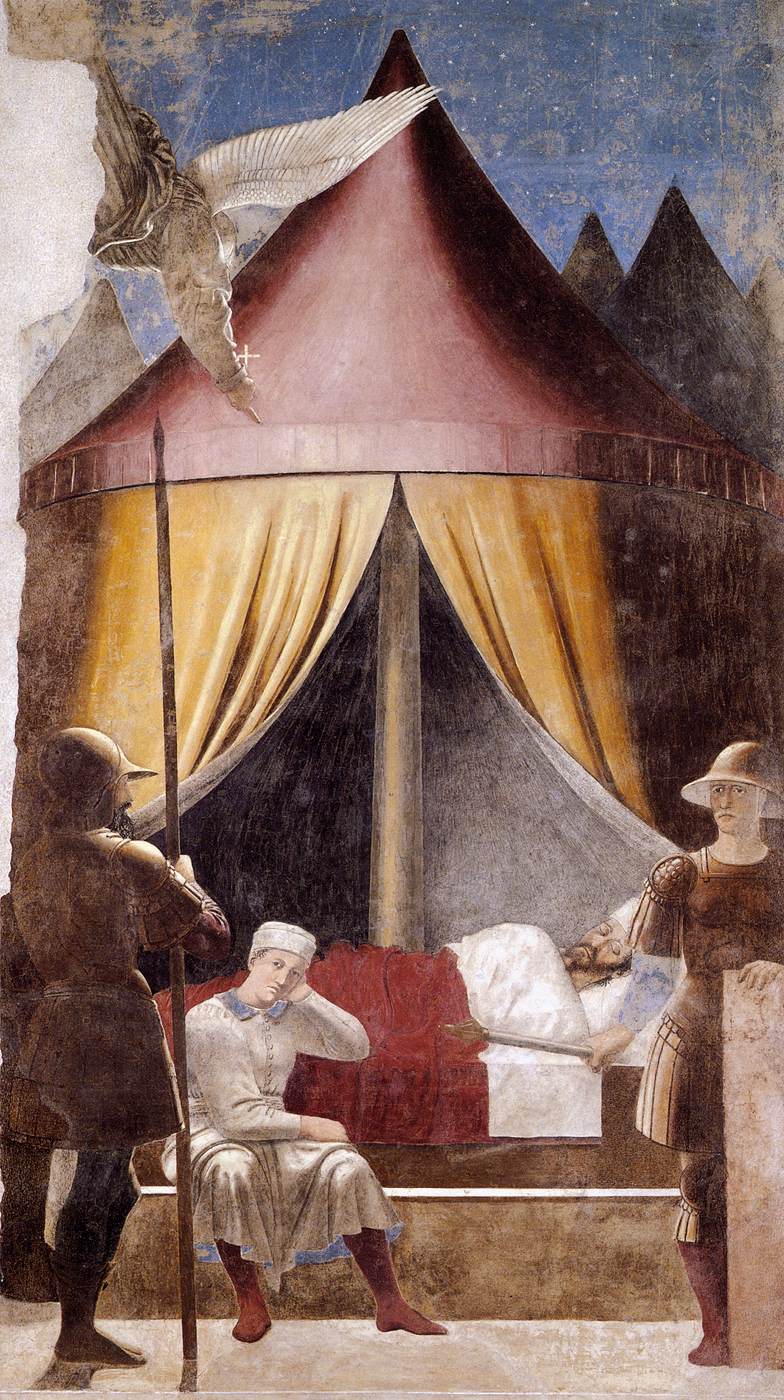
4. Vision of Constantine
PIERO della FRANCESCA · 1466 →
- MEDIUM
- Fresco, 329 x 190 cm
- TYPE
- Religious
PALETTE
HOVER OR TAP A SWATCH FOR NAME, SHARE AND HEX. SAMPLED FROM THE IMAGE — INDICATIVE, NOT A PIGMENT ANALYSIS.
DEVELOPMENT BUILD — NOT FOR PUBLIC USE. CONTRIBUTE ON GITHUB.
CURRENT LOCATION · San Francesco (Arezzo)
03 — ARTWORK
PIERO della FRANCESCA · 1466 →
PALETTE
HOVER OR TAP A SWATCH FOR NAME, SHARE AND HEX. SAMPLED FROM THE IMAGE — INDICATIVE, NOT A PIGMENT ANALYSIS.
COMMENTARY
UNDERLINED TERMS ARE DEFINED IN THE GLOSSARY.
PIERO DELLA FRANCESCA (b. 1416, Borgo San Sepolcro, d. 1492, Borgo San Sepolcro)
4. Vision of Constantine 1452-66 FrescoWall painting technique in which pigments are applied to wet (fresh) plaster (intonaco). The pigments bind with the drying plaster to form a very durable image. Only a small area can be painted in a day, and these areas, drying to a slightly different tint, can in time be seen. Small amounts of retouching and detail work could be carried out on the dry plaster, a technique known as a secco fresco., 329 x 190 cm San Francesco, Arezzo
The story continues in the lower picture compartment to the right of the altar with the Vision of Constantine.
Constantine the Great (c. 280-337), was a Roman Emperor, the son of Helena. He came to overall power in 312 after defeating the Emperor Maxentius at the battle of the Milvian bridge on the Tiber, an event traditionally regarded as the turning point in the establishment of Christianity within the empire. According to Eusebius' Life of Constantine (1:27-32), on the eve of the battle Constantine saw in a dream a cross in the sky, and heard a voice saying, 'In hoc signo vinces' - 'By this sign shalt thou conquer.' Henceforth, it is said, he substituted the emblem for the Roman eagle on the standard, or laborum, of the legions.
Earlier it was thought to be a nocturnal scene. However, the recent restoration revealed it is not a night scene but a dawn, captured at its first stirrings, when still glitter in the sky. Inside his large tent, the Emperor lies asleep. Seated on a bench bathed in light, a servant watches over him and gazes dreamily out towards the onlooker, as though in silent conversation. With a daring innovation, that almost seems to anticipate Caravaggio's modern concept of light, the two sentries in the foreground stand out from the darkness, lit only from the sides by the light projected from the angel above. The divine messenger descends from on high, showing the Cross made of light to the emperor deep in sleep, to whom he communicates the certainty of victory if the army moves under the sign of the Cross: "In hoc signo vinces".
@online{wga-r1add1ef4239021,
  author       = {Krén, Emil and Marx, Daniel},
  title        = {4. Vision of Constantine by PIERO della FRANCESCA},
  organization = {{Web Gallery of Art}},
  date         = {2026-09-13},
  url          = {https://beta.wga.hu/artists/piero-della-francesca-rbce83e1615e0dd/4-vision-of-constantine-r1add1ef4239021},
  urldate      = {2026-09-13},
  langid       = {english}
}
ACCESSED 2026-09-13. REPLACE THE AUTHOR FIELD WITH THE COMMENTARY AUTHOR WHERE ONE IS NAMED.


