03 — ARTWORK
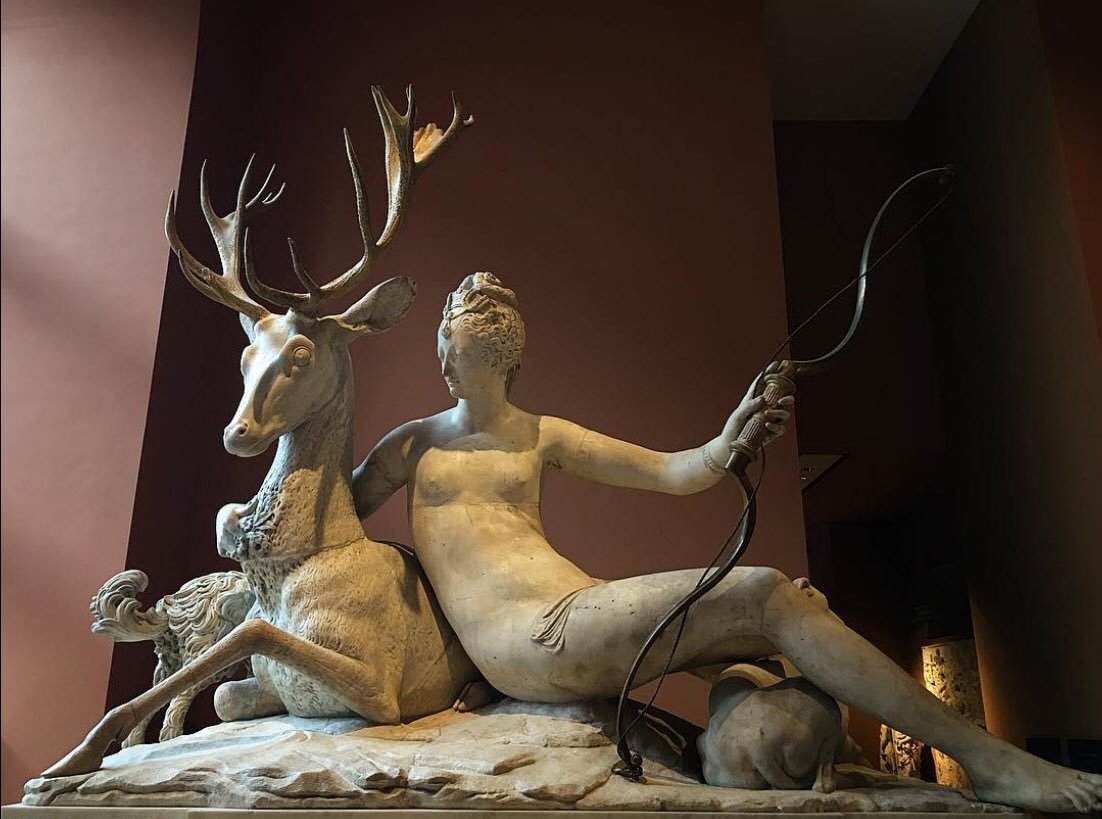
Diana with a Stag
- MEDIUM
- Marble, 211 x 258 x 135 cm
- TYPE
- Mythological
PALETTE
HOVER OR TAP A SWATCH FOR NAME, SHARE AND HEX. SAMPLED FROM THE IMAGE — INDICATIVE, NOT A PIGMENT ANALYSIS.
DEVELOPMENT BUILD — NOT FOR PUBLIC USE. CONTRIBUTE ON GITHUB.
CURRENT LOCATION · Musée du Louvre
03 — ARTWORK
PALETTE
HOVER OR TAP A SWATCH FOR NAME, SHARE AND HEX. SAMPLED FROM THE IMAGE — INDICATIVE, NOT A PIGMENT ANALYSIS.
COMMENTARY
UNDERLINED TERMS ARE DEFINED IN THE GLOSSARY.
At the end of the 18th century, Alexandre Lenoir attributed the Diana from the château of Anet, Eure-et-Loire, sometimes identified as Diane de Poitiers, to Jean Goujon. It is impossible that Goujon, burdened as he was by his responsibilities in Paris, could have worked at the château of Anet, which was begun in 1548 and completed in 1555 by Philibert Delorme.
Goujon's style has wrongly been seen as a slow but continuous progression from a MannerismA movement in Italian art from about 1520 to 1600. Developing out of the Renaissance, Mannerism rejected Renaissance balance and harmony in favor of emotional intensity and ambiguity. In Mannerist painting, this was expressed mainly through severe distortions of perspective and scale; complex and crowded compositions; strong, sometimes harsh or discordant colors; and elongated figures in exaggerated poses. In architecture, there was a playful exaggeration of Renaissance forms (largely in scale and proportion) and the greater use of bizarre decoration. Mannerism gave way to the Baroque. Leading Mannerists include Pontormo, Bronzino, Parmigianino, El Greco and Tintoretto. influenced by Parmigianino to a classicism influenced by antiquethe classical age of Greece and Rome began with the Greek migrations of the 2nd millennium BC, and ended in the West in 476 AD with the deposition of the Roman emperor Romulus Augustulus (c. 475 AD); in the East it ended in 529 AD when the Platonic Academy was closed by Justinian (482 - 565 AD). models. It has also been common to attributeA symbolic object which is conventionally used to identify a particular person, usually a saint. In the case of martyrs, it is usually the nature of their martyrdom. indiscriminately to him any elegant female figure of the period, most notably the famous marbleloosely applied to any hard limestone that can be sawn into thin slabs and will take a good polish so that it is suitable for decorative work; more strictly, it refers to metamorphosed limestones whose structure has been recrystallized by heat or pressure. Marbles are widely disseminated and occur in a great variety of colours and patterns, but certain types have been particularly prized by sculptors. The most famous of Greek white marbles in the ancient world was the close-grained Pentelic, which was quarried at Mount Pentelicon in Attica. The Elgin Marbles are carved in Pentelic. Widely used also were the somewhat coarser-grained translucent white marbles from the Aegean islands of Paros and Naxos. Parian marble was used for the celebrated Mausoleum at Halicarnassus. The pure white Carrara marble, quarried at Massa, Carrara, and Pietra Santa in Tuscany from the 3rd century BC, is the most famous of all sculptors' stones. It was used for the Apollo Belvedere, and was much favoured in the Renaissance, particularly by Michelangelo, who often visited the quarries to select material for his work. Neoclassical sculptors also favoured Carrara marble because of its ability to take a smooth, sleek surface, but it can look rather 'dead' compared with some of the finest Greek marbles. group of Diana with a Stag. This work is more likely to be by Germain Pilon, who dominated French sculpture in the second half of the 16th century.
The statue type itself was established in France by Cellini in 1543 at Fontainebleau.
@online{wga-r0c659f72126bf8,
  author       = {Krén, Emil and Marx, Daniel},
  title        = {Diana with a Stag by PILON, Germain},
  organization = {{Web Gallery of Art}},
  date         = {2026-09-13},
  url          = {https://beta.wga.hu/artists/pilon-germain-rb87024ffd31842/diana-with-a-stag-r0c659f72126bf8},
  urldate      = {2026-09-13},
  langid       = {english}
}
ACCESSED 2026-09-13. REPLACE THE AUTHOR FIELD WITH THE COMMENTARY AUTHOR WHERE ONE IS NAMED.


