03 — ARTWORK
Pulpit
- MEDIUM
- Marble, height 460 cm
- TYPE
- Religious
PALETTE
HOVER OR TAP A SWATCH FOR NAME, SHARE AND HEX. SAMPLED FROM THE IMAGE — INDICATIVE, NOT A PIGMENT ANALYSIS.
DEVELOPMENT BUILD — NOT FOR PUBLIC USE. CONTRIBUTE ON GITHUB.
CURRENT LOCATION · Duomo (Siena)
03 — ARTWORK
PALETTE
HOVER OR TAP A SWATCH FOR NAME, SHARE AND HEX. SAMPLED FROM THE IMAGE — INDICATIVE, NOT A PIGMENT ANALYSIS.
COMMENTARY
UNDERLINED TERMS ARE DEFINED IN THE GLOSSARY.
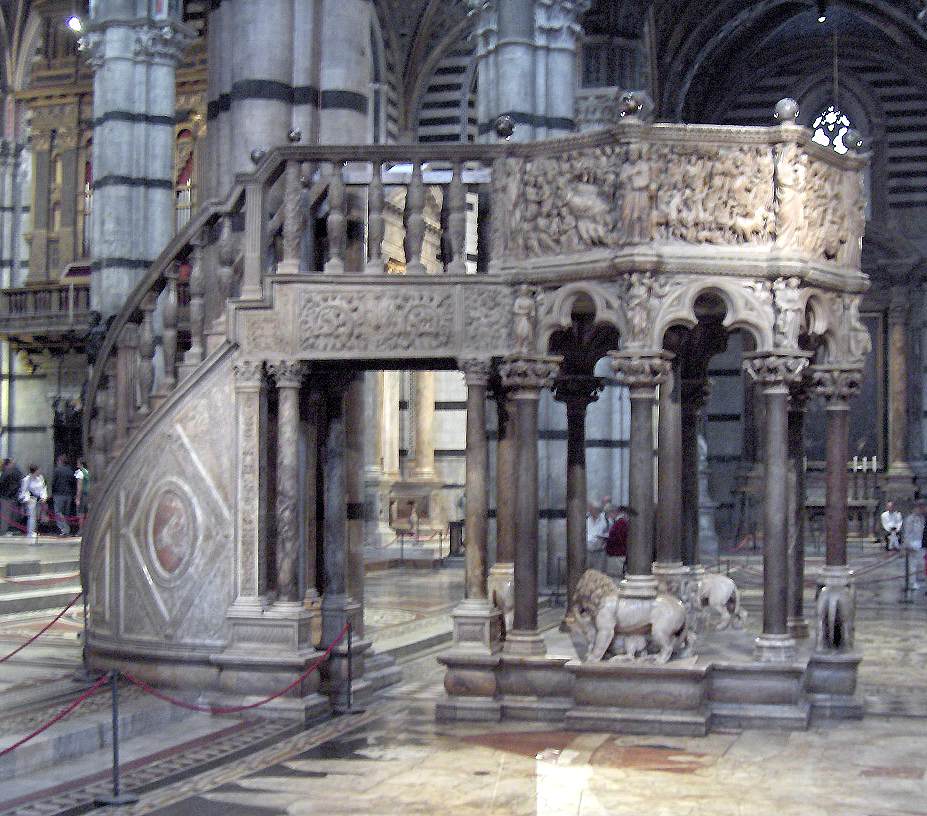
Presumably, due to the success and fame of the Pisa pulpit, Nicola was commissioned in 1265 to sculpt another in Carrara marbleloosely applied to any hard limestone that can be sawn into thin slabs and will take a good polish so that it is suitable for decorative work; more strictly, it refers to metamorphosed limestones whose structure has been recrystallized by heat or pressure. Marbles are widely disseminated and occur in a great variety of colours and patterns, but certain types have been particularly prized by sculptors. The most famous of Greek white marbles in the ancient world was the close-grained Pentelic, which was quarried at Mount Pentelicon in Attica. The Elgin Marbles are carved in Pentelic. Widely used also were the somewhat coarser-grained translucent white marbles from the Aegean islands of Paros and Naxos. Parian marble was used for the celebrated Mausoleum at Halicarnassus. The pure white Carrara marble, quarried at Massa, Carrara, and Pietra Santa in Tuscany from the 3rd century BC, is the most famous of all sculptors' stones. It was used for the Apollo Belvedere, and was much favoured in the Renaissance, particularly by Michelangelo, who often visited the quarries to select material for his work. Neoclassical sculptors also favoured Carrara marble because of its ability to take a smooth, sleek surface, but it can look rather 'dead' compared with some of the finest Greek marbles. for the Duomo of Siena. This second pulpit was complete by 1268 and is far more ambitious than its Pisan predecessor; it is octagonal and therefore has seven historiated reliefs. The dark colonnettes framing the Pisa panels have been exchanged for figures in white marble at the angles, allowing the narrative to flow while diminishing the classicalRelating to the culture of ancient Greece and Rome (classical Antiquity). The classical world played a profoundly important role in the Renaissance, with Italian scholars, writers, and artists seeing their own period as the rebirth (the "renaissance") of classical values after the Middle Ages. The classical world was considered the golden age for the arts, literature, philosophy, and politics. Concepts of the classical, however, changed greatly from one period to the next. Roman literature provided the starting point in the 14th century, scholars patiently finding, editing and translating a wide range of texts. In the 15th century Greek literature, philosophy and art - together with the close study of the remains of Roman buildings and sculptures-expanded the concept of the classical and ensured it remained a vital source of ideas and inspiration. containment. The richly carved cornicea molded horizontal ledge along the top of a building or wall; a decorative molding between wall and roof. adds to the feeling of surface excitement and unity; it encourages a continuous scroll-like reading of the narratives, which is accentuated by a line of inlay above the lower cornice.
The larger dimensions and layout of the Siena pulpit resulted from both practical and aesthetic considerations. The scenes of the Pisa BaptisteryHall or chapel situated close to, or connected with, a church, in which the sacrament of baptism is administered. The form of the baptistery originally evolved from small, circular Roman buildings that were designated for religious purposes (e.g., the Temple of Venus, Baalbek, Lebanon, AD 273, and the Mausoleum of Diocletian, Spalato [Split, Croatia], AD 300); but because baptism originally was performed on only three holidays, Easter, Pentecost, and Epiphany, enlargement of the older Roman buildings became necessary to accommodate the growing numbers of converts. Baptisteries were among the most symbolic of all Christian architectural forms; and the characteristic design that was developed by the 4th century AD can be seen today in what is probably the earliest extant example, the baptistery of the Lateran palace in Rome, built by Sixtus III, pope between 432 and 440. The baptistery was commonly octagonal in plan, a visual metaphor for the number eight, which symbolized in Christian numerology a new beginning. As eight follows the "complete" number, seven, so the beginning of the Christian life follows baptism. Customarily, a baptistery was roofed with a dome, the symbol of the heavenly realm toward which the Christian progresses after the first step of baptism. The baptismal font was usually octagonal, set beneath a domical ciborium, or canopy, and encircled by columns and an ambulatory--features that were first used in the baptistery by the Byzantines when they altered Roman structures. Baptisteries commonly adjoined the atrium, or forecourt, of the church and were often large and richly decorated, such as those at Pisa, Florence, Parma, and Nocera in Italy; el Kantara, Alg.; and Poitiers, France. After the 6th century they were gradually reduced to the status of small chapels inside churches. In the 10th century, when baptism by affusion (pouring liquid over the head) became standard practice in the church, baptisteries, or baptismal chapels, were often omitted entirely. In most modern churches the font alone serves for baptism; something of earlier symbolism survives, however, in its usual location near the church door - an allusion to entering the Christian life. pulpit are clearly visible from any location within that small structure, but in the vast dark interior of the richly striated Sienese CathedralThe principal church of a province or diocese, where the throne of the bishop is placed. For reasons lost to time and tradition, a cathedral always faces west - toward the setting sun. The altar is placed at the east end. The main body, or nave, of the cathedral is usually divided into one main and two side aisles. These lead up to the north and south transepts, or arms of the cross, the shape in which a cathedral is usually formed. it is difficult to view individual scenes. Nicola must have been aware of these limitations and planned his pulpit accordingly. In addition, the number of "dramatis personae" in each scene has been increased, necessitating a reduction in their scale. Thus the serene simplicity of Pisa has been exchanged for a richness of surface, motion and narrative.
As at Pisa, the external columns rest alternately on the backs of lions (two males which devour their prey and two females which nurse cubs). The central columna vertical structural member having a circular cross-section and usually consisting of a base, a long shaft, and a capital. is surrounded not with grotesques but with figures of the liberal artsThese represented the subject matter of the secular 'arts' syllabus of the Middle Ages; first the preparatory trivium - grammar, rhetoric and dialectic, then the basis of a philosophical training, the quadrivium, comprising arithmetic, geometry, astronomy and music. By the 13th century each had been given a pictorial identity, together with identifying attributes (e.g. a measuring rod for geometry) and exemplars (e.g. Pythagoras for arithmetic, Tubal for music).While treated with a stylistic variety that reflected current pictorial concerns, whether with iconographic completeness (Andrea da Firenze in the Spanish Chapel at S. Maria Novella in Florence), or with narrative (Pinturicchio in the Vatican) or with the nude (Pollaiuolo's tomb of Sixtus IV in St Peter's), the theme was left remarkably intact by artists whose own activity (save through the mathematics of perspective) was excluded from it as manual rather than liberal., a refinement in thought and form. Seven reliefs narrate the Life of Christ, but with significant changes. In the first scene, the Visitation is substituted for the Annunciationthe term for the event described in the Gospel according to St. Luke, when the Angel Gabriel brings the Virgin Mary the news that she is to bear her son, Jesus Christ. The Annunciation was among the most widespread pictorial subjects of European art during the Middle Ages and the Renaissance.. In the second, the Journey of the Magi is added to the simple "Adoration". It is replete with a black magus, an entourage including mastiffs, and four trees to suggest a landscape. A new scene, the Massacre of the Innocents, surely by Giovanni, is introduced. Finally, the Last Judgment represents the Damned on the left of Christ and the Elect on the right. In 1329 the columns were replaced and in the sixteenth century stairs were added and the pulpit moved to its present location, raised on a basemolded foot of a pillar or column providing the transition from the plinth to the shaft. to afford greater visibility.
These significant differences arise from three factors. The first is an infusion of French GothicGothic, which may well have originated with Alberti as a derogatory term and which certainly corresponds to Vasari's 'maniera tedesca' ('German style'), is properly the descriptive term for an artistic style which achieved its first full flowering in the Ile de France and the surrounding areas in the period between c. 1200 and c. 1270, and which then spread throughout northern Europe. It is characterized by the hitherto unprecedented integration of the arts of sculpture, painting, stained glass and architecture which is epitomized in the great cathedrals of Chartres, Amiens, and Reims or in the Sainte Chapelle in Paris. In all the arts the predominantly planar forms of the Romanesque are replaced by an emphasis on line. There is a transcendental quality, whether in the soaring forms of the pointed arches or in the new stress on the humanity of Christ, which similarly distinguishes it from the preceding Romanesque style. In thinking of Nicola (d. c. 1284) or Giovanni Pisano (d. after 1314) there is same danger of forgetting what had happened in French sculpture half a century or more earlier, and likewise it is hard to remember that the spectacular achievements of early Renaissance art are a singularly localized eddy in the continuing stream of late gothic European art. By northern European standards few Italian works of art can be called gothic without qualification, and the story of 13th and 14th century Italian architecture is as much one of resistance to the new style as of its reception, whether directly from France or through German or central European intermediaries. In sculpture and in painting, the Italian reluctance to distort the human figure, conditioned by a never wholly submerged awareness of the omnipresent antique heritage, gives a special quality to the work of even those artists such as Giovanni Pisano or Simone Martini who most closely approached a pure gothic style. Nevertheless, the vitalizing role of Northern gothic art throughout the early Renaissance and the period leading up to it should never be underestimated. The artistic, like the cultural and commercial, interaction was continuous and much of the Italian achievement is incomprehensible if seen in isolation. It is not merely at the level of direct exchanges between one artist and another, or the influence of one building; painting, manuscript or piece of sculpture upon another, that the effects are to be felt. The streaming quality of line which is so characteristic of Brunelleschi's early Renaissance architecture surely reflects a sensitivity to the gothic contribution which is entirely independent of, and lies much deeper than, the superficial particularities of form. The counterflow of influence and inspiration from South to North must likewise not be underrated. In particular, the contribution of Italian painters from Duccio and Simone Martini onwards is central to the evolution of the so-called International Gothic style developing in Burgundy, Bohemia and north Italy in the late 14th and early 15th centuries. influence, seen in the beautiful Christ the Redeemer as well as in the decorative drapery and the proportions. Nicola was exposed to French Gothic ideas partly from contact with French ivories. Since a change in style often goes hand-in-hand with a change in imagery, the Classical figure of Hercules at Pisa is replaced by a more traditional female virtue. The impact of the native aesthetic of Siena is the second factor. Whereas Pisa had Classical connections, Siena, which also traced its origins back to Rome, was interested in narrative, decoration and landscape. In the Siena pulpit, Nicola catered to local taste. The third factor is the extensive participation of Giovanni and assistants.
A new composition for the narrative panels also appears in Siena. Rows of figures are set above each other to suggest depth and create a dense horror vacui. This compositional device reveals that Nicola had looked at later Roman sarcophagi, which also stimulated Giovanni. The increased surface pattern, the thin somatic types, the greater amount and depth of the drilling and the "bridge" (a small piece of stone connecting heads to the reliefA sculptural work in which all or part projects from the flat surface. There are three basic forms: low relief (bas-relief, basso rilievo), in which figures project less than half their depth from the background; medium relief (mezzo-rilievo), in which figures are seen half round; and high relief (alto rilievo), in which figures are almost detached from their background.) all signal late Roman sources. So too the increased emotion, violence and linear drapery betray a study of these precedents, coupled with a freedom of expression.
@online{wga-rd9a5116e9112c0,
  author       = {Krén, Emil and Marx, Daniel},
  title        = {Pulpit by PISANO, Nicola},
  organization = {{Web Gallery of Art}},
  date         = {2026-09-13},
  url          = {https://beta.wga.hu/artists/pisano-nicola-r5e9f258e7f0e16/pulpit-rd9a5116e9112c0},
  urldate      = {2026-09-13},
  langid       = {english}
}
ACCESSED 2026-09-13. REPLACE THE AUTHOR FIELD WITH THE COMMENTARY AUTHOR WHERE ONE IS NAMED.


