Italian sculptor, medallist, die-engraver, goldsmith, bronzeGLOSSARYAn alloy of copper (usually about 90 per cent) and tin, often also containing small amounts of other metals such as lead or zinc. Since antiquity it has been the metal most commonly used in cast sculpture because of its strength, durability, and the fact that it is easily workable - both hot and cold - by a variety of processes. It is easier to cast than copper because it has a lower melting-point, and its great tensile strength makes possible the protrusion of unsupported parts - an advantage over marble sculpture. The colour of bronze is affected by the proportion of tin or other metals present, varying from silverish to a rich, coppery red, and its surface beauty can be enhanced when it acquires a patina.-caster and poet, part of a family of artists. Michele Poggini (1487-1527) was a gem-engraver whose two sons Giampaolo Poggini (1518-1582) and Domenico Poggini worked together in Florence as goldsmiths and gem-carvers at the court of Cosimo I de' Medici. In 1556 the two brothers were appointed die-engravers at the Florentine Mint.
Domenico's earliest training probably came from his father Michele. Benvenuto Cellini (VitaGLOSSARYAn account of someone's life and work, a biography. The best-known writer of the vita in the Renaissance was Vasari, whose Le vite de'più eccellenti pittori, scultori e architetti italiani ("Lives of the Most Eminent Italian Painters, Sculptors and Architects"), published in 1550 and 1568, provides detailed accounts of the lives of many of the most important artists of the Renaissance.) describes a gold cup with low reliefs made c. 1545-46 by Domenico and his brother under his direction for Cosimo I de' Medici. A letter of 1548 from Domenico to Cosimo mentions a sword hilt and the reverse of a medal he had been working on for Cosimo. Domenico worked mostly with his brother until Giampaolo's departure between 1553 and 1555 to work for Philip II, King of Spain, in the Netherlands and Spain. In 1554 Domenico made a pair of silver candlesticks for Cosimo, and in 1556 he was appointed diecutter for the Florentine mint.
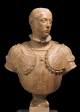
His earliest signed and dated marbleGLOSSARYloosely applied to any hard limestone that can be sawn into thin slabs and will take a good polish so that it is suitable for decorative work; more strictly, it refers to metamorphosed limestones whose structure has been recrystallized by heat or pressure. Marbles are widely disseminated and occur in a great variety of colours and patterns, but certain types have been particularly prized by sculptors. The most famous of Greek white marbles in the ancient world was the close-grained Pentelic, which was quarried at Mount Pentelicon in Attica. The Elgin Marbles are carved in Pentelic. Widely used also were the somewhat coarser-grained translucent white marbles from the Aegean islands of Paros and Naxos. Parian marble was used for the celebrated Mausoleum at Halicarnassus. The pure white Carrara marble, quarried at Massa, Carrara, and Pietra Santa in Tuscany from the 3rd century BC, is the most famous of all sculptors' stones. It was used for the Apollo Belvedere, and was much favoured in the Renaissance, particularly by Michelangelo, who often visited the quarries to select material for his work. Neoclassical sculptors also favoured Carrara marble because of its ability to take a smooth, sleek surface, but it can look rather 'dead' compared with some of the finest Greek marbles. sculpture, the BacchusGLOSSARYIn Greek and Roman mythology, the god of wine and fertility. Bacchic rites were often orgiastic. (1554; Metropolitan Museum of Art, New York), is from this period. In 1564 he modelled a terracottaGLOSSARYUnglazed fired clay. It is used for architectural features and ornaments, vessels, and sculptures. Poetry, which, along with similar figures of Painting, Sculpture and Architecture by three other sculptors, formed part of the temporary decorations for Michelangelo's catafalque. Later that year Domenico was a candidate to execute the figure of Sculpture for Michelangelo's permanent tomb (Santa Croce, Florence), but Valerio Cioli was chosen by Cosimo instead. Domenico also made temporary decorations for the wedding in 1565 of Cosimo's son Francesco I de' Medici to Joanna of Austria. A bust of Francesco (Uffizi, Florence), which is convincingly attributed to Domenico, probably dates from shortly before this time.
In 1570 eight bronzes were commissioned for Francesco's studioloGLOSSARYA room in a Renaissance palace in which the rich or powerful could retire to study their rare books and contemplate their works of art. The studiolo became a symbol of a person's humanist learning and artistic refinement. Among the best known are those of Duke Federico da Montefeltro in Urbino, and Isabella D'Este in Mantua. (PalazzoGLOSSARYPalaces: large urban dwellings, 'palazzo' in Italian carries no regal connotations. Alberti described the palace as a city in little, and, like cities, Italian Renaissance palaces vary in type according to differences of climate, tradition and social structure. On to these regional stocks were grafted new architectural strains, reflecting theoretical reinterpretations of antiquity and individually influential examples. The atrium and peristyle house described by Vitruvius and now known from Pompeii did not survive antiquity, and much of the interest of Renaissance designs lies in creative misunderstandings of Vitruvius's text. Medieval palace architecture probably inherited the insula type of ancient apartment house, related to the modest strip dwellings which never disappeared from Italian cities. In Florence a merchant palace developed from fortified beginnings, with vaulted shop openings on the ground floor, and the main apartments above, reached by internal stone staircases opening from an inner court. Renaissance developments regularized without changing the essential type, although large cloister-like courtyards were introduced, while shops came to be thought undignified. At Michelozzo's Medici Palace (1444) a square arcaded courtyard with axial entrance lies behind a façade of graduated rustication, with biforate windows, a classical cornice replacing the traditional wooden overhang. The apartments on the 'piano nobile' formed interconnecting suites of rooms of diminishing size and increasing privacy. The classical orders which Alberti introduced to the façade of the Palazzo Rucellai (c.1453) were not taken up by the conservative Florentines, who continued to build variations on the Medici Palace (Palazzo Pitti; Palazzo Strozzi). In the 16th century rustication was reduced to quoins and voussoirs, and large windows appeared on the ground floor, 'kneeling' on elongated volutes. At Urbino the Ducal Palace (1465) reflected Alberti's recommendations for the princely palace, and was in turn influential on late 15th century palaces in Rome (e.g. the Cancelleria). A harmonious Florentine courtyard and ample staircase replace the embattled spaces of medieval seigneurial castles, of which vestiges remain only in the towers flanking the balconies of the duke's private apartments, designed as a scholarly retreat. In the absence of a merchant class or a cultured nobility in 15th century Rome, the architectural pace was set by the papal court. Papal incentives to build, and large households, meant less compact plans for cardinals' palaces, often built next to their titular churches. Renaissance forms appear in the unfinished courtyard of the Palazzo Venezia (1460s), with its arcade system derived from the nearby Theatre of Marcellus, and in the delicately ordered stonework of the Cancelleria (1485). In the 16th century vestigial corner towers and shops disappear from cardinals' palaces, and Antonio da Sangallo's Palazzo Farnese (1516) introduces symmetrical planning and Vitrivuan elements, like the colonnaded vestibule, behind a sober Florentine façade, enlivened by Michelangelo's cornice. A smaller palace type supplied the needs of an enlarged papal bureaucracy, more ambitious for display than for domestic accommodation. Bramante's 'House of Raphael' sets the façade style not only for this new type, but also for Renaissance houses all over Europe. Raphael and Peruzzi made ingenious use of difficult sites (Palazzo da Brescia; Palazzo Massimi), and their sophisticated façades flattered the architectural pretensions of patron and pope (e.g. Palazzo Branconio dell'Aquila). Movement of patrons and architects, especially after the Sack of Rome, meant a diffusion of Roman forms to central and northern Italy, where Sanmicheli's palaces in Verona, and Palladio's in Vicenza, adapted Roman types to suit local conditions. Palladio's 4-columned atrium is a Vitruvian solution to the traditionally wide Veneto entrance hall, and his plan for the Palazzo da Porto-Festa contains explicit references to Vitruvius's House of the Greeks. In Venice, defended by its lagoon and a stable political system, the hereditary aristocracy built palaces open to trade and festivity on the Grand Canal. The traditional Venetian palace has a tripartite structure: long central halls above entrance vestibules used for unloading merchandise are lit on the canal façade by clusters of glazed windows (rare elsewhere), and at the back from small courts with external staircases (as in the Ca' d'Oro). Codussi's palaces introduced biforate windows and a grid of classical orders into the system, while Sansovino's Palazzo Cornaro retains vestiges of the Venetian type (small courtyard; tripartite façade) despite its Bramantesque coupled orders and licentious window surrounds. Other cities, like Genoa, evolved influential types. Through engravings and the illustrated treatises, Italian Renaissance ideas of palace planning, originally evolved in response to specific conditions, came to be applied all over Europe. Vecchio, Florence). Domenico's signed Pluto, made between February 1572 and July 1573, was one of these. It reflects an influence from the circle of Bartolomeo Ammanati, especially in the attempt to capture movement. Like the other works for the studiolo, especially Giambologna's Apollo, it is an attempt at the conventional figura serpentinataGLOSSARYIt is used to describe a human figure which spirals around a central axis, so that the lower limbs face in one direction and the torso almost in the opposite direction, in a graceful if sometimes contorted pose. The development of this pose is attributed to Michelangelo in his statue of 'Victory'. but is designed essentially for a single viewpoint. Poggini contributed to the decoration of the Cappella di San Luca in Santissima Annunziata with his stucco figure of St Peter.
Domenico's skill as a medallist was praised by Vasari. His medalsGLOSSARYThe medal came to artistic maturity within a remarkably short time of its introduction in 15th century Italy. This was partly because ancient Roman coins, which were beginning to be reverently collected, suggested (on a smaller scale) its form: profile portrait bust on the obverse, a different design on the reverse, an inscription running round the rim. Like the finest Imperial coins, the medal's purpose was commemorative. Without monetary value, and of non-precious metal (bronze or lead), it was a way of circulating a likeness to a chosen few; it anticipated the use of miniatures and was indeed frequently worn round the neck. And while the reverse could record a historical event or make a propaganda point related to its subject's career, more commonly it bore a design that purported to convey the 'essence', as it were, of the person portrayed on the other side. Given the admiration for the men and artefacts of ancient Rome, the stress on individual character, the desire for fame and the penchant for summing up temperament in symbols and images, it is easy to understand how quickly the fashion for commissioning medals spread. Its pioneer executant was Pisanello. The precedents before he began to cast medals in 1438-39 had been few and excessively coin-like. Within 10 years he had established the form the medal was to retain until the influence was registered of the reverseless, hollow-cast and wafer-thin medals of the 1560s and 70s made by Bombarda (Andrea Cambi). Pisanello's approach was first echoed by the Veronese Matteo de' Pasti (d. 1467-688). It was, perhaps oddly, not until the works from 1485 of Niccolò Fiorentino (Niccolò di Forzore Spinelli, 1430-1514) that Florence produced a medallist of the highest calibre. Other specialists in the medium included Sperandio (Sperandio Savelli, c. 1425-1504), L'Antico (Pier Jacopo Alari Bonacolsi, c. 1460-1528), Caradosso (Cristoforo Caradosso Foppa, 1452-1526/27). The work of these men, and of the many, often anonymous, who reflected them, is still coveted because it avoided the two medallistic errors: making a medal look like either an enlarged piece of money or a small sculptured plaque., some struck and some cast, number about 40. They include a series of struck depictions of Cosimo. Domenico also struck medals of Francesco I de' Medici and Joanna of Austria (British Museum, London). Among Domenico's last works was a series of struck medals of Pope Sixtus V, as well as one of the Pope's sister Camilla Peretti (British Museum, London). These were made in Rome, where the Pope called him around 1585 and where he became chief engraver of the mint.
Other widely-accepted attributions to Domenico include a marble statue of Lex (Florence, Palazzo Medici–Riccardi) and a marble bust of Virginia Pucci–Ridolfi (Bargello, Florence).