03 — ARTWORK
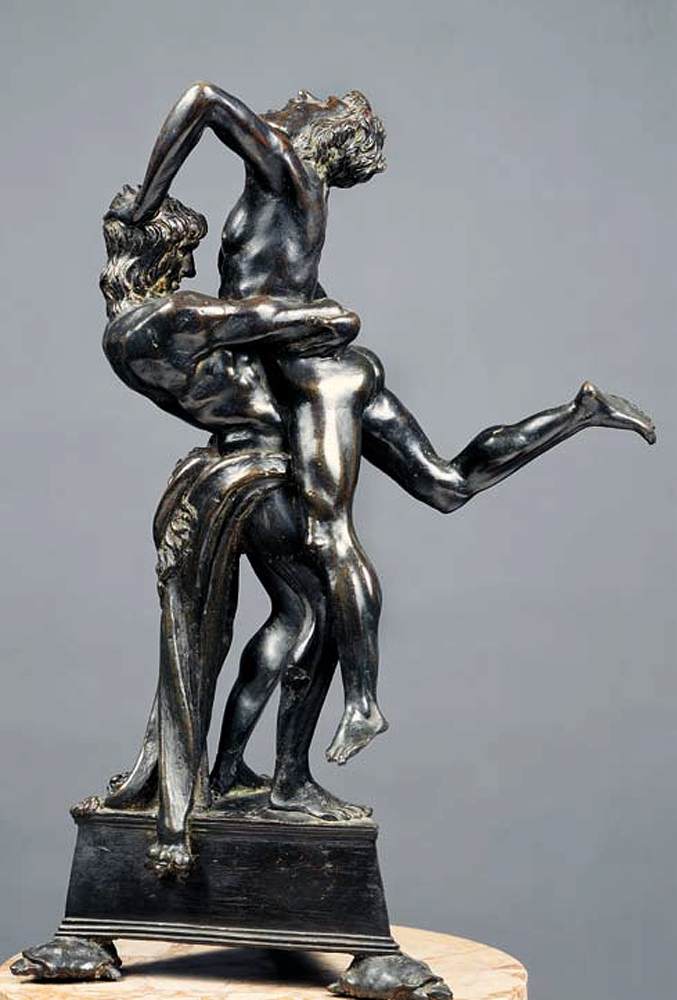
Hercules and Antaeus
- MEDIUM
- Bronze, height 45 cm
- TYPE
- Mythological
PALETTE
HOVER OR TAP A SWATCH FOR NAME, SHARE AND HEX. SAMPLED FROM THE IMAGE — INDICATIVE, NOT A PIGMENT ANALYSIS.
DEVELOPMENT BUILD — NOT FOR PUBLIC USE. CONTRIBUTE ON GITHUB.
03 — ARTWORK
PALETTE
HOVER OR TAP A SWATCH FOR NAME, SHARE AND HEX. SAMPLED FROM THE IMAGE — INDICATIVE, NOT A PIGMENT ANALYSIS.
COMMENTARY
UNDERLINED TERMS ARE DEFINED IN THE GLOSSARY.
The subject is taken from Apollodorus (2.5:11). On his way back from the Hesperides, Hercules engaged in a wrestling match with the giant Antaeus who was invincible as long as some part of him touched the earth, from which he drew his strength. Hercules held him in the air in a vice-like grip, until he weakened and died. Hercules is depicted with his arms locked round the waist of Antaeus, crushing the giant's body to his own.
Pollaiuolo's background as goldsmith equipped him to respondLong narrow column or engaged column, mainly in Gothic architecture, which supports the arches and ribs of groin vaults or the profiles of arcade arches. to the taste for small bronzes in the last third of the 15th century. The statuettes, frequently patinated to resemble antiquethe classical age of Greece and Rome began with the Greek migrations of the 2nd millennium BC, and ended in the West in 476 AD with the deposition of the Roman emperor Romulus Augustulus (c. 475 AD); in the East it ended in 529 AD when the Platonic Academy was closed by Justinian (482 - 565 AD). bronzes, were meant for conoisseurs.
The Hercules and Antaeus demonstrate Pollaiuolo's knowledge of anatomy (from dissecting corpses) and his ability to represent physical and emotional violence. The group was famous in the artist's own lifetime: Leonardo studied it and Michelangelo included a sketch of it on a sheet illustrating bronzeAn alloy of copper (usually about 90 per cent) and tin, often also containing small amounts of other metals such as lead or zinc. Since antiquity it has been the metal most commonly used in cast sculpture because of its strength, durability, and the fact that it is easily workable - both hot and cold - by a variety of processes. It is easier to cast than copper because it has a lower melting-point, and its great tensile strength makes possible the protrusion of unsupported parts - an advantage over marble sculpture. The colour of bronze is affected by the proportion of tin or other metals present, varying from silverish to a rich, coppery red, and its surface beauty can be enhanced when it acquires a patina. casting. It is one of the earliest appearences of a mythological subject in the round. The unusual poses of the protagonists correspond to those painted by Pollaiuolo on a panelTerm in painting for a support of wood, metal, or other rigid substance, as distinct from canvas. Until the adoption of canvas in the 15th century nearly all the movable paintings of Europe were executed on wood, and even up to the beginning of the 17th century it is probable that as much painting was done on the one support as on the other. Painters who worked on a small scale often used copper panels (Elsheimer is a leading example), and in the colonial art of South America copper and tin and even lead and zinc were used. On a larger scale, slate has occasionally been used as a support, notably by Rubens for his altarpiece for Sta Maria in Vallicella (the Chiesa Nuova) in Rome; the picture he originally painted was said to reflect the light unpleasantly and slate was used for the replacement to produce a more matt finish. For wood panels the Italian masters of the Renaissance preferred white poplar, while oak was the most common wood used in northern Europe. Many other types were used, however; analysis of the contents of art galleries has yielded a long list, including beech, cedar, chestnut, fir, larch, linden, mahogany, olive, and walnut. In the 20th century cedar, teak, and dark walnut are favourites, and modern painters have also used plywood, fibre-board, and other synthetic materials as supports. in the Uffizi, which is related to a larger lost painting for the Medici Palace.
@online{wga-r1d3a6133b71daf,
  author       = {Krén, Emil and Marx, Daniel},
  title        = {Hercules and Antaeus by POLLAIUOLO brothers},
  organization = {{Web Gallery of Art}},
  date         = {2026-09-09},
  url          = {https://beta.wga.hu/artists/pollaiuolo-brothers-r6ff80e77bb10ef/hercules-and-antaeus-r1d3a6133b71daf},
  urldate      = {2026-09-09},
  langid       = {english}
}
ACCESSED 2026-09-09. REPLACE THE AUTHOR FIELD WITH THE COMMENTARY AUTHOR WHERE ONE IS NAMED.


