03 — ARTWORK
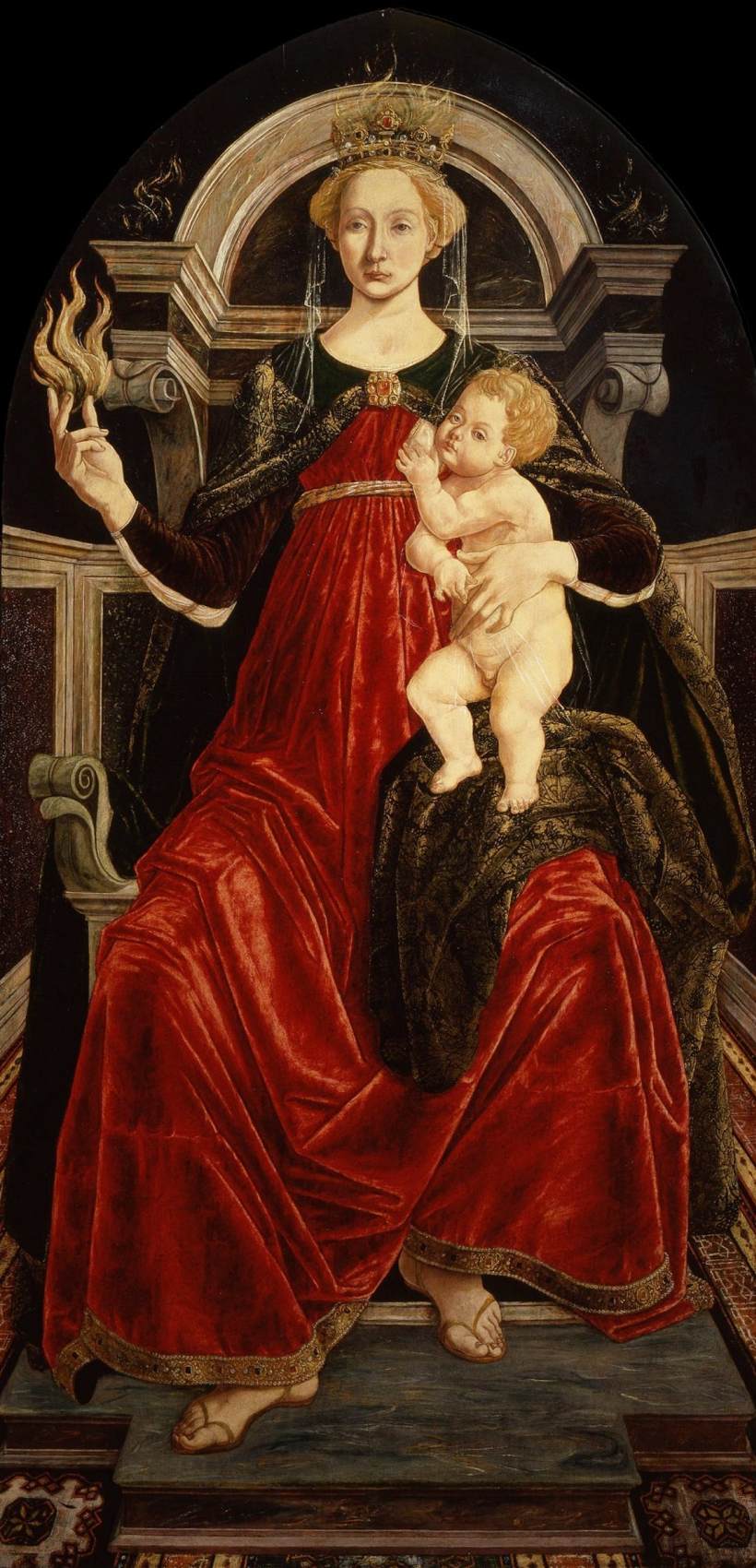
Charity
- MEDIUM
- Tempera grassa on panel, 168 x 91 cm
- TYPE
- Religious
PALETTE
HOVER OR TAP A SWATCH FOR NAME, SHARE AND HEX. SAMPLED FROM THE IMAGE — INDICATIVE, NOT A PIGMENT ANALYSIS.
DEVELOPMENT BUILD — NOT FOR PUBLIC USE. CONTRIBUTE ON GITHUB.
03 — ARTWORK
PALETTE
HOVER OR TAP A SWATCH FOR NAME, SHARE AND HEX. SAMPLED FROM THE IMAGE — INDICATIVE, NOT A PIGMENT ANALYSIS.
COMMENTARY
UNDERLINED TERMS ARE DEFINED IN THE GLOSSARY.
Seven paintings of the same size, representing the seven virtues, were commissioned from Piero del Pollaiuola in 1469 as the backs for chairs in the Audience Chamber in the Tribunale di Mercanzia in Piazza della Signoriafrom the late Middle Ages, the governing body of some of the Italian city states, usually presided over by individual families., Florence. Six of these - representing Charity, Faith, Hope, Justice, Prudence and Temperance - were executed by Piero, while the seventh - <a onclick="return OpenOther('/html/b/botticel/1early/09fortit.html')" href="/html/b/botticel/1early/09fortit.html">Fortitude</a> - was painted by the young Botticelli. The cycle was completed in 1472.
The Tribunale di Mercanzia was the body that decided on the business disputes between Florentine merchants and administered justice among the guildsGuilds were essentially associations of masters in particular crafts, trades, or professions. In Italy they go back a long way; there is documentary evidence of guilds in 6th century Naples. In origin they were clubs which observed religious festivals together and attended the funerals of their members, but in time they acquired other functions. Their economic function was to control standards and to enforce the guild's monopoly of particular activities in a particular territory. Their political function was to participate in the government of the city-state. In some cities, notably Florence in the 14th century, only guildsmen were eligible for civic office, thus excluding both noblemen (unless they swallowed their pride and joined, as some did), and unskilled workers like the woolcombers and dyers. In Florence in 1378 these groups demanded the right to form their own guilds, and there were similar movements of protest in Siena and Bologna. Guilds were also patrons of art, commissioning paintings for guildhalls, contributing to the fabric fund of cathedrals and collaborating on collective projects like the statues for Orsanmichele at Florence. The guilds were not equal. In Florence, the 7 'Greater Guilds', including such prestigious occupations as judges and bankers, outranked the 14 'Lesser Guilds', and in general the guild hierarchy was reflected in the order of precedence in processions. The great age of the guilds was the 13th and 14th centuries. The economic recession after 1348 meant fewer opportunities for journeymen to become masters, and greater hostility between master and man. The shift from trade to land in the 15th and 16th centuries meant a decline in the social standing of the crafts. In some towns, such as Brescia and Vicenza, guild membership actually became a disqualification instead of a qualification for municipal office. The guilds lost their independence and became instruments of state control. In 16th century Venice, for example, they were made responsible for supplying oarsmen for the galleys of the state., known as the Arts. In the 18th century, the wealth and heritage of this judiciary went to the Chamber of Commerce, including the seven paintings of the Virtues, taken to the Uffizi Galleries in 1777.
The allegoryA work of art which represents some abstract quality or idea, either by means of a single figure (personification) or by grouping objects and figures together. Renaissance allegories make frequent allusions both to both Greek and Roman legends and literature, and also to the wealth of Christian allegorical stories and symbols developed during the Middle Ages. of Charity is a young woman breastfeeding a child, to indicate mercy towards others. The flame between her fingers is the emblem of God's love. She is one of the three theological Virtues who, according to Christian belief, descend from God. The woman is sitting on a bench, in a non-distinct setting, but one that is bordered by classically inspired marbleloosely applied to any hard limestone that can be sawn into thin slabs and will take a good polish so that it is suitable for decorative work; more strictly, it refers to metamorphosed limestones whose structure has been recrystallized by heat or pressure. Marbles are widely disseminated and occur in a great variety of colours and patterns, but certain types have been particularly prized by sculptors. The most famous of Greek white marbles in the ancient world was the close-grained Pentelic, which was quarried at Mount Pentelicon in Attica. The Elgin Marbles are carved in Pentelic. Widely used also were the somewhat coarser-grained translucent white marbles from the Aegean islands of Paros and Naxos. Parian marble was used for the celebrated Mausoleum at Halicarnassus. The pure white Carrara marble, quarried at Massa, Carrara, and Pietra Santa in Tuscany from the 3rd century BC, is the most famous of all sculptors' stones. It was used for the Apollo Belvedere, and was much favoured in the Renaissance, particularly by Michelangelo, who often visited the quarries to select material for his work. Neoclassical sculptors also favoured Carrara marble because of its ability to take a smooth, sleek surface, but it can look rather 'dead' compared with some of the finest Greek marbles. mirrorsMirrors of glass 'silvered' on the back began to supplement those of polished metal in the 14th century, though it was only in the 16th century that high-quality glass ones were made (at Murano) on a scale that made them one of Venice's chief luxury exports. The connection between the increasing use of mirrors and the art of make-up (the mirror was a familiar symbol of vanity) and personal cleanliness is unexplored, but they had an influence on the development of the self-portrait in painting: Vasari assumed that Simone Martini (d. 1344) 'painted himself with two mirrors in order to get his head in profile'. Parmigianino (d. 1540) took self-scrutiny to a thoroughly introspective level in his Self-portrait in a (convex) Mirror.. The direct light from the right side shapes the volumes and highlights the expertly painted gold brocade on the cloak and velvet of the woman's dress.
Charity was the first of the seven Virtues to be painted and probably, to submit the work for the approval of the customers, Pollaiolo prepared the drawing of the Virtue that is still on the reverse side of the panelTerm in painting for a support of wood, metal, or other rigid substance, as distinct from canvas. Until the adoption of canvas in the 15th century nearly all the movable paintings of Europe were executed on wood, and even up to the beginning of the 17th century it is probable that as much painting was done on the one support as on the other. Painters who worked on a small scale often used copper panels (Elsheimer is a leading example), and in the colonial art of South America copper and tin and even lead and zinc were used. On a larger scale, slate has occasionally been used as a support, notably by Rubens for his altarpiece for Sta Maria in Vallicella (the Chiesa Nuova) in Rome; the picture he originally painted was said to reflect the light unpleasantly and slate was used for the replacement to produce a more matt finish. For wood panels the Italian masters of the Renaissance preferred white poplar, while oak was the most common wood used in northern Europe. Many other types were used, however; analysis of the contents of art galleries has yielded a long list, including beech, cedar, chestnut, fir, larch, linden, mahogany, olive, and walnut. In the 20th century cedar, teak, and dark walnut are favourites, and modern painters have also used plywood, fibre-board, and other synthetic materials as supports..
*** Keywords: *************
Author: POLLAIUOLO, Piero del Title: Charity Time-line: 1451-1500 School: Italian Form: painting Type: religious
@online{wga-r14cd7676156bf4,
  author       = {Krén, Emil and Marx, Daniel},
  title        = {Charity by POLLAIUOLO brothers},
  organization = {{Web Gallery of Art}},
  date         = {2026-09-13},
  url          = {https://beta.wga.hu/artists/pollaiuolo-brothers-ra85f423cdaa9e7/charity-r14cd7676156bf4},
  urldate      = {2026-09-13},
  langid       = {english}
}
ACCESSED 2026-09-13. REPLACE THE AUTHOR FIELD WITH THE COMMENTARY AUTHOR WHERE ONE IS NAMED.


