03 — ARTWORK
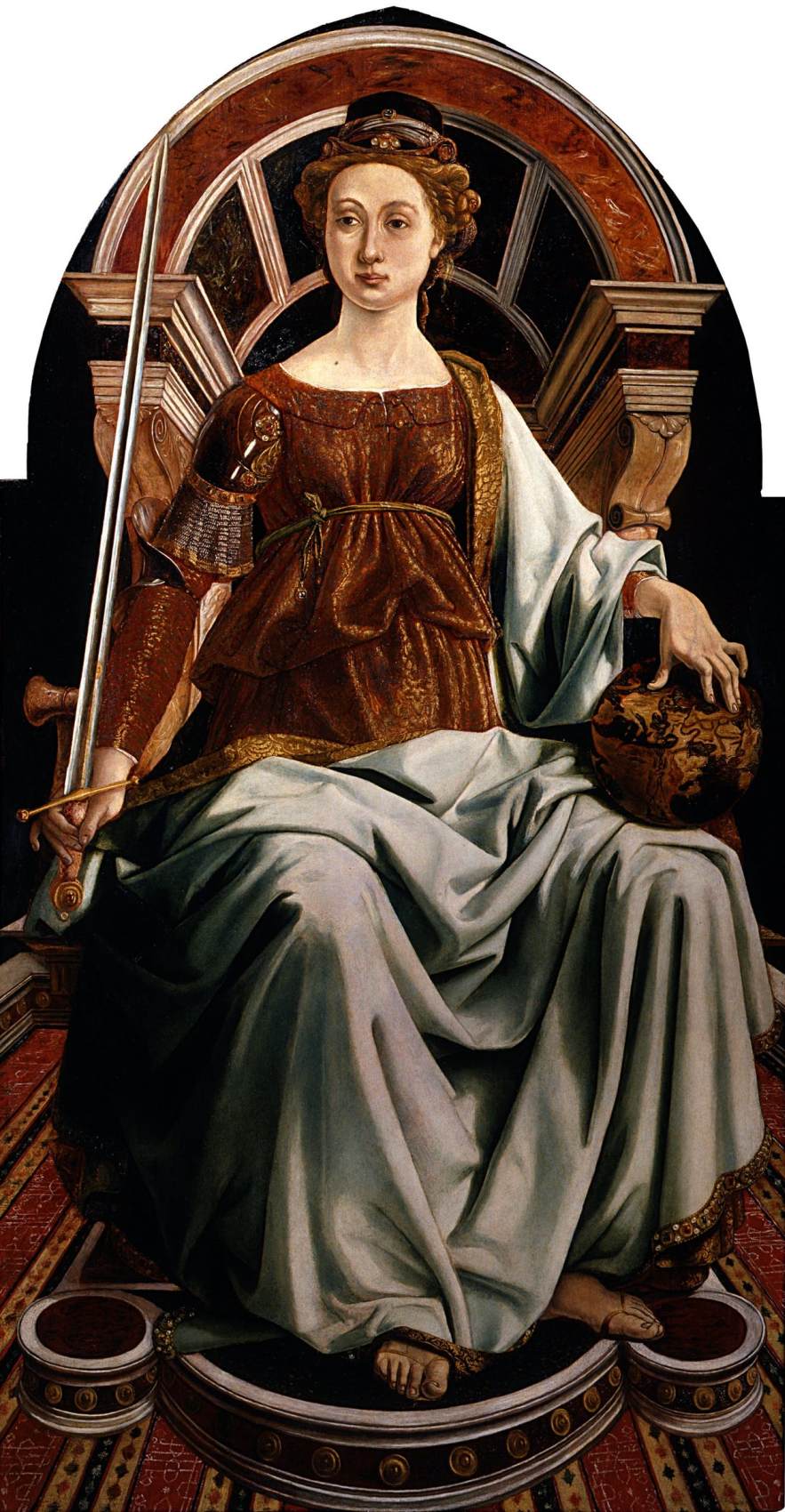
Justice
- MEDIUM
- Tempera grassa on panel, 168 x 91 cm
- TYPE
- Religious
PALETTE
HOVER OR TAP A SWATCH FOR NAME, SHARE AND HEX. SAMPLED FROM THE IMAGE — INDICATIVE, NOT A PIGMENT ANALYSIS.
DEVELOPMENT BUILD — NOT FOR PUBLIC USE. CONTRIBUTE ON GITHUB.
03 — ARTWORK
PALETTE
HOVER OR TAP A SWATCH FOR NAME, SHARE AND HEX. SAMPLED FROM THE IMAGE — INDICATIVE, NOT A PIGMENT ANALYSIS.
COMMENTARY
UNDERLINED TERMS ARE DEFINED IN THE GLOSSARY.
Seven paintings of the same size, representing the seven virtues, were commissioned from Piero del Pollaiuola in 1469 as the backs for chairs in the Audience Chamber in the Tribunale di Mercanzia in Piazza della Signoriafrom the late Middle Ages, the governing body of some of the Italian city states, usually presided over by individual families., Florence. Six of these - representing Charity, Faith, Hope, Justice, Prudence and Temperance - were executed by Piero, while the seventh - <a onclick="return OpenOther('/html/b/botticel/1early/09fortit.html')" href="/html/b/botticel/1early/09fortit.html">Fortitude</a> - was painted by the young Botticelli. The cycle was completed in 1472.
The Tribunale di Mercanzia was the body that decided on the business disputes between Florentine merchants and administered justice among the guildsGuilds were essentially associations of masters in particular crafts, trades, or professions. In Italy they go back a long way; there is documentary evidence of guilds in 6th century Naples. In origin they were clubs which observed religious festivals together and attended the funerals of their members, but in time they acquired other functions. Their economic function was to control standards and to enforce the guild's monopoly of particular activities in a particular territory. Their political function was to participate in the government of the city-state. In some cities, notably Florence in the 14th century, only guildsmen were eligible for civic office, thus excluding both noblemen (unless they swallowed their pride and joined, as some did), and unskilled workers like the woolcombers and dyers. In Florence in 1378 these groups demanded the right to form their own guilds, and there were similar movements of protest in Siena and Bologna. Guilds were also patrons of art, commissioning paintings for guildhalls, contributing to the fabric fund of cathedrals and collaborating on collective projects like the statues for Orsanmichele at Florence. The guilds were not equal. In Florence, the 7 'Greater Guilds', including such prestigious occupations as judges and bankers, outranked the 14 'Lesser Guilds', and in general the guild hierarchy was reflected in the order of precedence in processions. The great age of the guilds was the 13th and 14th centuries. The economic recession after 1348 meant fewer opportunities for journeymen to become masters, and greater hostility between master and man. The shift from trade to land in the 15th and 16th centuries meant a decline in the social standing of the crafts. In some towns, such as Brescia and Vicenza, guild membership actually became a disqualification instead of a qualification for municipal office. The guilds lost their independence and became instruments of state control. In 16th century Venice, for example, they were made responsible for supplying oarsmen for the galleys of the state., known as the Arts. In the 18th century, the wealth and heritage of this judiciary went to the Chamber of Commerce, including the seven paintings of the Virtues, taken to the Uffizi Galleries in 1777.
Justice is seated on a bench, sword in hand, with the tip pointing upwards. On her knees she holds a globe. Her clothing consists of an elegant dress, woven through with gold, and a grey-green cloak; it includes the harness and couter of a suit of armour. The iconographyThe systematic study and identification of the subject-matter and symbolism of art works, as opposed to their style; the set of symbolic forms on which a given work is based. Originally, the study and identification of classical portraits. Renaissance art drew heavily on two iconographical traditions: Christianity, and ancient Greek and Roman art, thought and literature. of Justice at arms became established in the 14th century, perhaps with the aim of vindicating the principle of certain penalty as a guarantee of peace and good government, or to indicate the righteous use of power. The globe probably alludes to the field in which Justice is called upon to exercise her reign, referring to the judgmental functions of the magistrature for which the painting was executed.
@online{wga-r1423a05645a88b,
  author       = {Krén, Emil and Marx, Daniel},
  title        = {Justice by POLLAIUOLO brothers},
  organization = {{Web Gallery of Art}},
  date         = {2026-09-13},
  url          = {https://beta.wga.hu/artists/pollaiuolo-brothers-ra85f423cdaa9e7/justice-r1423a05645a88b},
  urldate      = {2026-09-13},
  langid       = {english}
}
ACCESSED 2026-09-13. REPLACE THE AUTHOR FIELD WITH THE COMMENTARY AUTHOR WHERE ONE IS NAMED.


