03 — ARTWORK
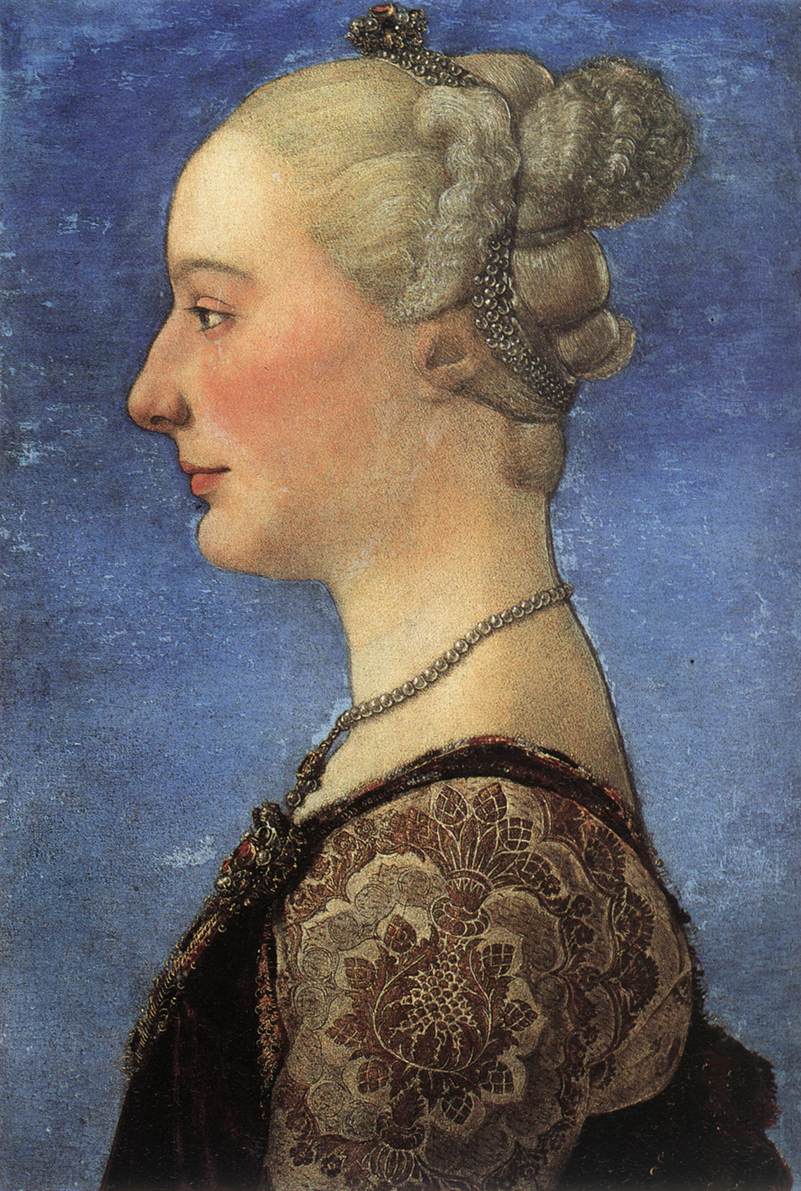
Portrait of a Lady
- MEDIUM
- Tempera on wood, 55 x 34 cm
- TYPE
- Portrait
PALETTE
HOVER OR TAP A SWATCH FOR NAME, SHARE AND HEX. SAMPLED FROM THE IMAGE — INDICATIVE, NOT A PIGMENT ANALYSIS.
DEVELOPMENT BUILD — NOT FOR PUBLIC USE. CONTRIBUTE ON GITHUB.
CURRENT LOCATION · Galleria degli Uffizi
03 — ARTWORK
PALETTE
HOVER OR TAP A SWATCH FOR NAME, SHARE AND HEX. SAMPLED FROM THE IMAGE — INDICATIVE, NOT A PIGMENT ANALYSIS.
COMMENTARY
UNDERLINED TERMS ARE DEFINED IN THE GLOSSARY.
PortraitThe Roman portrait bust survived in the form of life-sized reliquaries of saints, but it was in 15th century Florence that the individual features and character of a contemporary sitter were accurately recorded by sculptors such as Donatello, Desiderio da Settignano, Mino da Fiesole and the Rossellino. A similar degree of realism occurs in 15th century tomb sculpture. The equestrian portrait, based on antique statues such as the Marcus Aurelius monument (Rome, Campidoglio), was revived in the 14th century. Two examples in fresco are Simone Martini's Guidoriccio (c. 1328; Siena, Palazzo Pubblico) and the posthumous portrait of Sir John Hawkwood (1436; Florence, Cathedral) by Uccello, which gives the illusion of a 3-dimensional statue seen from below. The Venetian Republic ordered imposing monuments from Donatello (1447; Gattarnelata, Padua) and Verrocchio (14799; Colleoni, Venice), whilst other statesmen ordered their own images to be erected in public places, directly relating themselves to the military heroes of ancient Rome. Another form of political portraiture derived from antiquity was the commemorative portrait medal designed by artists such as Pisanello. The carved or painted profile portrait became popular in the 1450s. The realism of the clear, flattened image, painted under the influence of Flemish examples by the Pollaiuolo brothers, Piero della Francesca and Botticelli, was superseded by the three-quarter and frontal portrait, psychologically more complex, such as Leonardo's enigmatic Mona Lisa (Paris, Louvre) with her momentary smile or Andrea del Sarto's arresting Portrait of a Man (London, National Gallery). The 16th century portrait became generalized, Lotto's Andrea Odoni (1527; Royal Collection) being an idealized concept of a collector rather than an individual. Group portraits, decorating whole rooms, include the narrative scenes of the Gonzaga court painted by Mantegna (completed 1474; Mantua, Palazzo Ducale) and the elaborate schemes commissioned by the Farnese family in Rome from Vasari (1546; Palazzo della Cancelleria) and Salviati (after 1553; Palazzo Farnese). Portraits were also incorporated into religious narratives, as in Ghirlandaio's fresco cycle painted for Giovanni Tornabuoni in S. Maria Novella, Florence (1486-90). of a Lady c. 1475 TemperaA method of painting in which the pigments are mixed with an emulsion of water and egg yolks or whole eggs (sometimes glue or milk). Tempera was widely used in Italian art in the 14th and 15th centuries, both for panel painting and fresco, then being replaced by oil paint. Tempera colors are bright and translucent, though because the paint dried very quickly there is little time to blend them, graduated tones being created by adding lighter or darker dots or lines of color to an area of dried paint. on wood, 55 x 34 cm Galleria degli Uffizi, Florence
As the old attributions to Piero della Francesca, to Domenico Veneziano and to Verrocchio were discarded, the critics have been long undecided between an attribution to Antonio or to Piero del Pollaiuolo. Technical and stylistic analysis led to the conclusion that the portrait is a work by Piero.
The profile of the lady, who is not of classicalRelating to the culture of ancient Greece and Rome (classical Antiquity). The classical world played a profoundly important role in the Renaissance, with Italian scholars, writers, and artists seeing their own period as the rebirth (the "renaissance") of classical values after the Middle Ages. The classical world was considered the golden age for the arts, literature, philosophy, and politics. Concepts of the classical, however, changed greatly from one period to the next. Roman literature provided the starting point in the 14th century, scholars patiently finding, editing and translating a wide range of texts. In the 15th century Greek literature, philosophy and art - together with the close study of the remains of Roman buildings and sculptures-expanded the concept of the classical and ensured it remained a vital source of ideas and inspiration. beauty, is perfectly defined by a sharp line that separates it from the delicate lapis-lazuli blue background. The woman, with her colourful complexion and fashionable hairstyle, has a distinctly human appearance. The artist has paid particular attention to her clothes. The various materials and textures of the precious dress have all been carefully considered, from the imperceptible veil that adorns her hair to the shining crimson velvet and lavish brocade.
@online{wga-r5a3449da8df606,
  author       = {Krén, Emil and Marx, Daniel},
  title        = {Portrait of a Lady by POLLAIUOLO brothers},
  organization = {{Web Gallery of Art}},
  date         = {2026-09-13},
  url          = {https://beta.wga.hu/artists/pollaiuolo-brothers-ra85f423cdaa9e7/portrait-of-a-lady-r5a3449da8df606},
  urldate      = {2026-09-13},
  langid       = {english}
}
ACCESSED 2026-09-13. REPLACE THE AUTHOR FIELD WITH THE COMMENTARY AUTHOR WHERE ONE IS NAMED.


