03 — ARTWORK
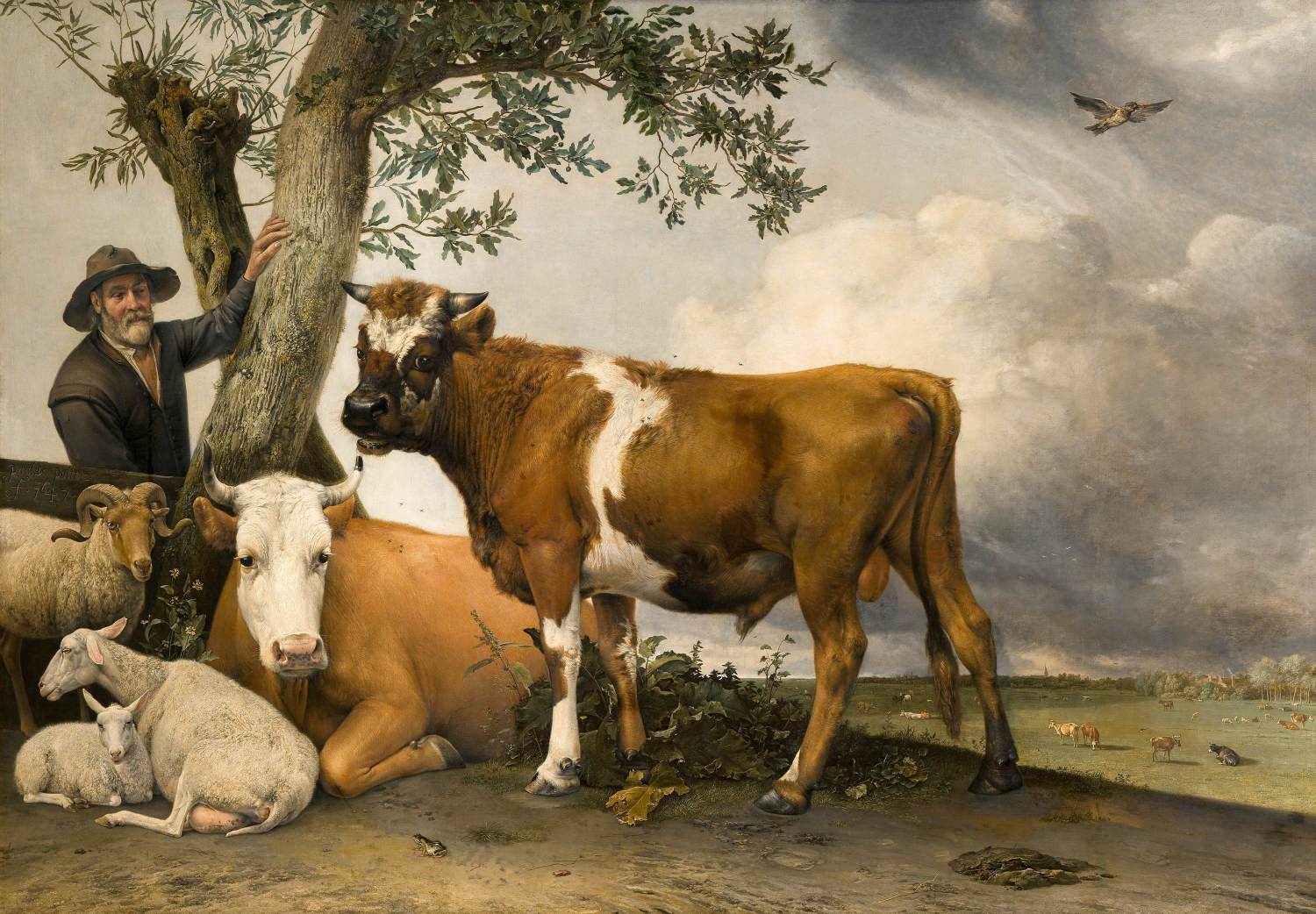
The Young Bull
- MEDIUM
- Oil on canvas, 236 x 339 cm
- TYPE
- Genre
PALETTE
HOVER OR TAP A SWATCH FOR NAME, SHARE AND HEX. SAMPLED FROM THE IMAGE — INDICATIVE, NOT A PIGMENT ANALYSIS.
DEVELOPMENT BUILD — NOT FOR PUBLIC USE. CONTRIBUTE ON GITHUB.
CURRENT LOCATION · Mauritshuis
03 — ARTWORK
PALETTE
HOVER OR TAP A SWATCH FOR NAME, SHARE AND HEX. SAMPLED FROM THE IMAGE — INDICATIVE, NOT A PIGMENT ANALYSIS.
COMMENTARY
UNDERLINED TERMS ARE DEFINED IN THE GLOSSARY.
In the work of Paulus Potter views of nature and animals are seen for their own sake, and not as a backdrop for human action. Potter can paint equally well the bright sunlight and the cool air, but his real fame lies with his penetrating portraits of animals. His best-known work is the life-size Young Bull, an unusual heroization of a single animal, a counterpart to the monumental trend of Ruisdael and Cuyp.
Although at first sight it appears to be a portraitThe Roman portrait bust survived in the form of life-sized reliquaries of saints, but it was in 15th century Florence that the individual features and character of a contemporary sitter were accurately recorded by sculptors such as Donatello, Desiderio da Settignano, Mino da Fiesole and the Rossellino. A similar degree of realism occurs in 15th century tomb sculpture. The equestrian portrait, based on antique statues such as the Marcus Aurelius monument (Rome, Campidoglio), was revived in the 14th century. Two examples in fresco are Simone Martini's Guidoriccio (c. 1328; Siena, Palazzo Pubblico) and the posthumous portrait of Sir John Hawkwood (1436; Florence, Cathedral) by Uccello, which gives the illusion of a 3-dimensional statue seen from below. The Venetian Republic ordered imposing monuments from Donatello (1447; Gattarnelata, Padua) and Verrocchio (14799; Colleoni, Venice), whilst other statesmen ordered their own images to be erected in public places, directly relating themselves to the military heroes of ancient Rome. Another form of political portraiture derived from antiquity was the commemorative portrait medal designed by artists such as Pisanello. The carved or painted profile portrait became popular in the 1450s. The realism of the clear, flattened image, painted under the influence of Flemish examples by the Pollaiuolo brothers, Piero della Francesca and Botticelli, was superseded by the three-quarter and frontal portrait, psychologically more complex, such as Leonardo's enigmatic Mona Lisa (Paris, Louvre) with her momentary smile or Andrea del Sarto's arresting Portrait of a Man (London, National Gallery). The 16th century portrait became generalized, Lotto's Andrea Odoni (1527; Royal Collection) being an idealized concept of a collector rather than an individual. Group portraits, decorating whole rooms, include the narrative scenes of the Gonzaga court painted by Mantegna (completed 1474; Mantua, Palazzo Ducale) and the elaborate schemes commissioned by the Farnese family in Rome from Vasari (1546; Palazzo della Cancelleria) and Salviati (after 1553; Palazzo Farnese). Portraits were also incorporated into religious narratives, as in Ghirlandaio's fresco cycle painted for Giovanni Tornabuoni in S. Maria Novella, Florence (1486-90). of a prize young bull Potter most probably composed his famous beast from studies of more than one animal since its dewlap, horns, and teeth belong to bulls of different ages. The ancient Greek painter Zeuxis used a similar method; when he painted his portrait of Helen in the city of Croton he chose five beautiful virgins, in order to copy the finest features of each, for in one woman he felt he could not find perfect beauty.
What makes this painting so special is the fact that Potter painted something as ordinary as a bull on such a grand scale - which had never been done before. And despite this large size, he paid great attention to the smallest details.
During the nineteenth century the Young Bull by the twenty-two-year-old Potter ranked close in fame to the Night Watch of Rembrandt. Later generations have been less captivated by Potter's fidelity to nature when he worked life-size. Although the shapes of the farmer, the tree, and the bull against the light sky are impressive and the textures of the animals have been convincingly represented by the use of an original impastoPaint applied in thick or heavy layers. which approaches reliefA sculptural work in which all or part projects from the flat surface. There are three basic forms: low relief (bas-relief, basso rilievo), in which figures project less than half their depth from the background; medium relief (mezzo-rilievo), in which figures are seen half round; and high relief (alto rilievo), in which figures are almost detached from their background., the entire foreground of this huge canvasA woven cloth used as a support for painting. The best-quality canvas is made of linen; other materials used are cotton, hemp, and jute. It is now so familiar a material that the word 'canvas' has become almost a synonym for an oil painting, but it was not until around 1500 that it began to rival the wooden panel (which was more expensive and took longer to prepare) as the standard support for movable paintings (the transition came later in Northern Europe than in Italy). Canvas is not suitable for painting on until it has been coated with a ground, which isolates the fabric from the paint; otherwise it will absorb too much paint, only very rough effects will be obtainable, and parts of the fabric may be rotted by the pigments. It must also be made taut on a stretcher or by some other means. seems airless. Atmosphere enters the picture only in the lovely distant view on the right, where a sunny light plays upon the cattle in the meadows and on the woods, making this passage one of his loveliest landscapes. Potter is more consistent on a small scale, and his cabinetA small, private room where works of art, valuables and curiosities were kept and contemplated at leisure; over time the term was used for the collections themselves. Renaissance cabinets played an important role in the development of museums and art galleries. pieces show him at his best.
Suggested listening (streaming mp3, 3 minutes):
Georges Bizet: Carmen, Prelude
@online{wga-r5b8b9f143c07d9,
  author       = {Krén, Emil and Marx, Daniel},
  title        = {The Young Bull by POTTER, Paulus},
  organization = {{Web Gallery of Art}},
  date         = {2026-09-14},
  url          = {https://beta.wga.hu/artists/potter-paulus-r6c6399cdafde33/the-young-bull-r5b8b9f143c07d9},
  urldate      = {2026-09-14},
  langid       = {english}
}
ACCESSED 2026-09-14. REPLACE THE AUTHOR FIELD WITH THE COMMENTARY AUTHOR WHERE ONE IS NAMED.


