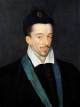
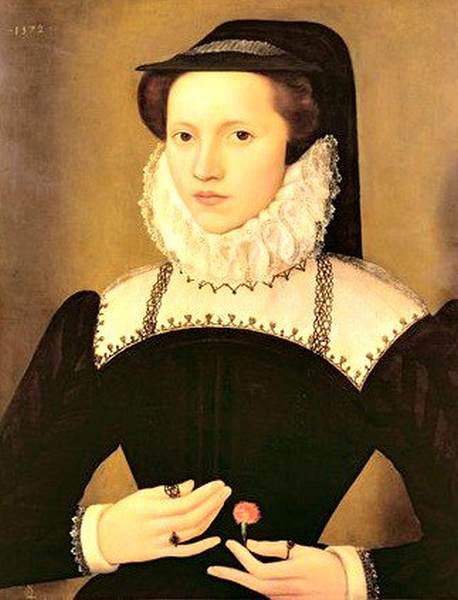
French painter and designer. He was the son of Pierre Quesnel (d. ca. 1574), a French painter in the service of James V of Scotland. His brothers, Nicolas Quesnel (d. 1632) and Jacques Quesnel (d. 1629), and his son, Augustin Quesnel (1595-1661), were also painters.
Documentary sources reveal that François was active in France as a decorator, designer of tapestries, coins and medalsGLOSSARYThe medal came to artistic maturity within a remarkably short time of its introduction in 15th century Italy. This was partly because ancient Roman coins, which were beginning to be reverently collected, suggested (on a smaller scale) its form: profile portrait bust on the obverse, a different design on the reverse, an inscription running round the rim. Like the finest Imperial coins, the medal's purpose was commemorative. Without monetary value, and of non-precious metal (bronze or lead), it was a way of circulating a likeness to a chosen few; it anticipated the use of miniatures and was indeed frequently worn round the neck. And while the reverse could record a historical event or make a propaganda point related to its subject's career, more commonly it bore a design that purported to convey the 'essence', as it were, of the person portrayed on the other side. Given the admiration for the men and artefacts of ancient Rome, the stress on individual character, the desire for fame and the penchant for summing up temperament in symbols and images, it is easy to understand how quickly the fashion for commissioning medals spread. Its pioneer executant was Pisanello. The precedents before he began to cast medals in 1438-39 had been few and excessively coin-like. Within 10 years he had established the form the medal was to retain until the influence was registered of the reverseless, hollow-cast and wafer-thin medals of the 1560s and 70s made by Bombarda (Andrea Cambi). Pisanello's approach was first echoed by the Veronese Matteo de' Pasti (d. 1467-688). It was, perhaps oddly, not until the works from 1485 of Niccolò Fiorentino (Niccolò di Forzore Spinelli, 1430-1514) that Florence produced a medallist of the highest calibre. Other specialists in the medium included Sperandio (Sperandio Savelli, c. 1425-1504), L'Antico (Pier Jacopo Alari Bonacolsi, c. 1460-1528), Caradosso (Cristoforo Caradosso Foppa, 1452-1526/27). The work of these men, and of the many, often anonymous, who reflected them, is still coveted because it avoided the two medallistic errors: making a medal look like either an enlarged piece of money or a small sculptured plaque., as a map-maker and as a painter of altarpieces, but above all as a portraitGLOSSARYThe Roman portrait bust survived in the form of life-sized reliquaries of saints, but it was in 15th century Florence that the individual features and character of a contemporary sitter were accurately recorded by sculptors such as Donatello, Desiderio da Settignano, Mino da Fiesole and the Rossellino. A similar degree of realism occurs in 15th century tomb sculpture. The equestrian portrait, based on antique statues such as the Marcus Aurelius monument (Rome, Campidoglio), was revived in the 14th century. Two examples in fresco are Simone Martini's Guidoriccio (c. 1328; Siena, Palazzo Pubblico) and the posthumous portrait of Sir John Hawkwood (1436; Florence, Cathedral) by Uccello, which gives the illusion of a 3-dimensional statue seen from below. The Venetian Republic ordered imposing monuments from Donatello (1447; Gattarnelata, Padua) and Verrocchio (14799; Colleoni, Venice), whilst other statesmen ordered their own images to be erected in public places, directly relating themselves to the military heroes of ancient Rome. Another form of political portraiture derived from antiquity was the commemorative portrait medal designed by artists such as Pisanello. The carved or painted profile portrait became popular in the 1450s. The realism of the clear, flattened image, painted under the influence of Flemish examples by the Pollaiuolo brothers, Piero della Francesca and Botticelli, was superseded by the three-quarter and frontal portrait, psychologically more complex, such as Leonardo's enigmatic Mona Lisa (Paris, Louvre) with her momentary smile or Andrea del Sarto's arresting Portrait of a Man (London, National Gallery). The 16th century portrait became generalized, Lotto's Andrea Odoni (1527; Royal Collection) being an idealized concept of a collector rather than an individual. Group portraits, decorating whole rooms, include the narrative scenes of the Gonzaga court painted by Mantegna (completed 1474; Mantua, Palazzo Ducale) and the elaborate schemes commissioned by the Farnese family in Rome from Vasari (1546; Palazzo della Cancelleria) and Salviati (after 1553; Palazzo Farnese). Portraits were also incorporated into religious narratives, as in Ghirlandaio's fresco cycle painted for Giovanni Tornabuoni in S. Maria Novella, Florence (1486-90). painter. A number of portrait drawings have been attributed to Quesnel on the basis of a signed Portrait of a Child (private collection). A painted portrait of Mary Anne Waltham (1572; Althorp House, Northamptonshire) signed with a monogram is the basis for the attribution of portraits such as that of Henry III (Musée du Louvre, Paris). His style is typical of late 16th-century French portraiture, in which the naturalismGLOSSARYGeneric term for scientific positions supported by natural insights. In fine arts and literature between approximately 1870 and 1900, Naturalism tried to reproduce the reality comprehended through sensory experience as realistically as possible, i.e. without idealising the object, but with scientific precision. In contrast to Realism, which was also based on the accurate description of natural occurrences, Naturalism concerns itself with the sensual dimensions of observation, whereby questions of morality and social criticism come to the fore. The spokesman for literary Naturalism was Emile Zola, who believed the artistic methods provided evidence of human existence. of François Clouet was stylised to such a degree that there is an almost complete absence of modelling and the picture is dominated by flat, linear pattern. Several of Quesnel's works were engraved by Isaac Briot (1585-1670) and Thomas de Leu (c. 1555-c. 1612).