03 — ARTWORK
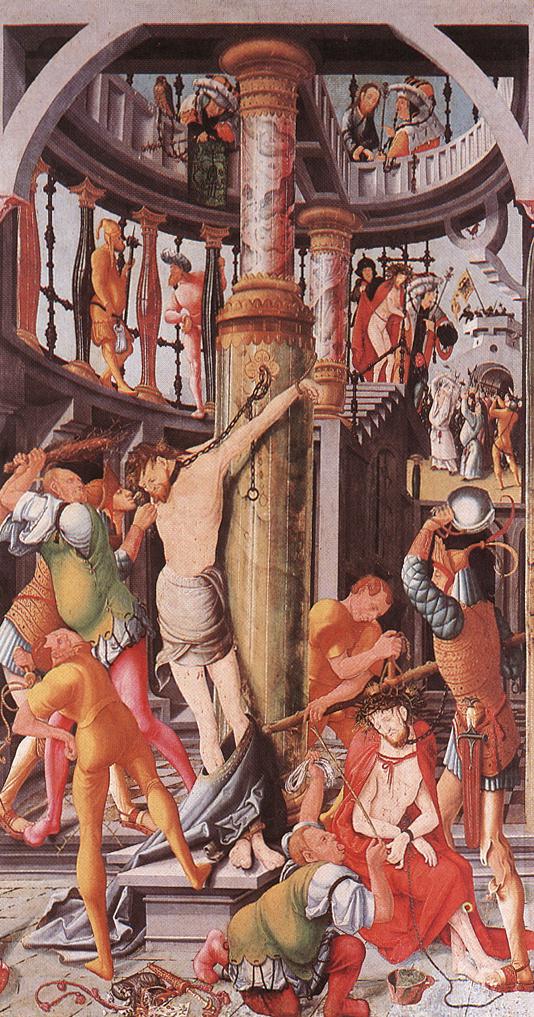
Flagellation of Christ
- MEDIUM
- Oil tempera on wood, 262 x 143 cm
- TYPE
- Religious
PALETTE
HOVER OR TAP A SWATCH FOR NAME, SHARE AND HEX. SAMPLED FROM THE IMAGE — INDICATIVE, NOT A PIGMENT ANALYSIS.
DEVELOPMENT BUILD — NOT FOR PUBLIC USE. CONTRIBUTE ON GITHUB.
CURRENT LOCATION · Staatsgalerie (Stuttgart)
03 — ARTWORK
PALETTE
HOVER OR TAP A SWATCH FOR NAME, SHARE AND HEX. SAMPLED FROM THE IMAGE — INDICATIVE, NOT A PIGMENT ANALYSIS.
COMMENTARY
UNDERLINED TERMS ARE DEFINED IN THE GLOSSARY.
The Flagellation is a wing of the Herrenbeg Altar in Herrenberg parish church. The Herrenberg Altar reflects the religious and social unrest of its day with a directness unequalled in any other work of German painting. Here, at an early point in time, the harmony of the High Renaissance has been destroyed in every respect. The panels of the altar, which is signed 1519, depict scenes from the childhood and PassionThe events leading up to Good Friday, beginning with Christ's arrest and ending with his burial. Portrayals of the Passion, which focus on the Suffering Christ, include depictions of Judas betraying Christ with a kiss, Peter cutting off Malchus's ear, the crown of thorns, and so on. of Christ. A fantastical rotunda provides the architectural framework not just for the Flagellation in the centre, but also for Christ's crowning with thorns (front right), presentation to the populace (on the steps in the background) and interrogation by Pilate (on the top storey).
With no knowledge of Italian art, the artist takes up some of the fundamental principles of Florentine Early MannerismA movement in Italian art from about 1520 to 1600. Developing out of the Renaissance, Mannerism rejected Renaissance balance and harmony in favor of emotional intensity and ambiguity. In Mannerist painting, this was expressed mainly through severe distortions of perspective and scale; complex and crowded compositions; strong, sometimes harsh or discordant colors; and elongated figures in exaggerated poses. In architecture, there was a playful exaggeration of Renaissance forms (largely in scale and proportion) and the greater use of bizarre decoration. Mannerism gave way to the Baroque. Leading Mannerists include Pontormo, Bronzino, Parmigianino, El Greco and Tintoretto.: the disruption of logical spatial relationships through the use of drastic foreshortening and enormous differences in scale between the figures; an asymmetrical composition combined with an emphatic spiralling movement around the central pillar; the distortion of natural proportions to heighten expressiveness; and finally a bright, iridescent palette.
With its manifold foreshortenings, vistas and staggered levels, the complex architecture might be seen as a distant forerunner of the visionary, surreal interiors of Giovanni Battista Piranesi's Carceri d'invenzione (Imaginary Prisons).
@online{wga-r0209cb78d5a6bb,
  author       = {Krén, Emil and Marx, Daniel},
  title        = {Flagellation of Christ by RATGEB, Jörg},
  organization = {{Web Gallery of Art}},
  date         = {2026-09-13},
  url          = {https://beta.wga.hu/artists/ratgeb-jrg-rc3bdccb671d109/flagellation-of-christ-r0209cb78d5a6bb},
  urldate      = {2026-09-13},
  langid       = {english}
}
ACCESSED 2026-09-13. REPLACE THE AUTHOR FIELD WITH THE COMMENTARY AUTHOR WHERE ONE IS NAMED.


